
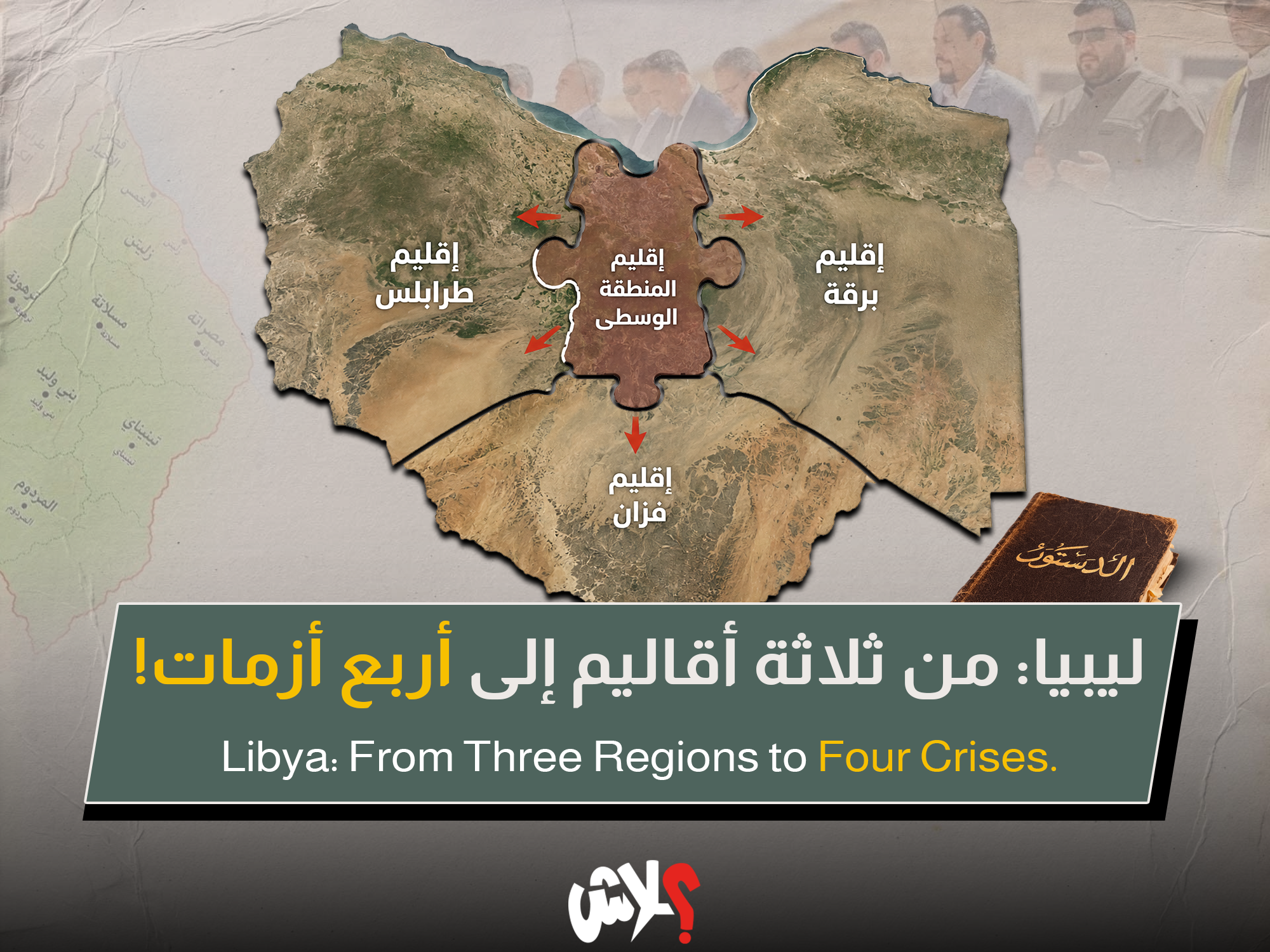
Libya: From Three Regions to Four Crises
"The more olive oil, the better the zmita." This popular Libyan proverb captures the idea that adding more of something enhances its quality and brings greater abundance. While this principle may hold true in cooking and the simple affairs of daily life, applying it to Libya's complex political reality creates an irony that is both alarming and absurd.
At a time when the country is suffering from unprecedented fragmentation and deep divisions, torn between two governments, two armies, and competing authorities, Libyans were suddenly confronted with an unusual official announcement proclaiming the birth of what was called the "Central Region." As a result, Libya's three historical regions were, according to the architects of this initiative, transformed into four.
It is as though those behind the project believe that multiplying the country's competing political and geographical entities will somehow solve the crisis, forgetting that adding more "oil" to the nation's already leaking tray will only cause it to overflow, plunging Libya deeper into fragmentation and further complicating an already intractable crisis.
The first challenge facing this newly announced entity is its complete lack of constitutional legitimacy and legal standing. The interim Constitutional Declaration, upon which Libya's current political system is based, does not recognize the concept of regions as an administrative or political governing structure. Rather, the modern Libyan state was built upon the principles of local administration and municipalities.
Accordingly, the persistent efforts by certain actors particularly in eastern Libya to entrench the concept of the country's three historical regions and defend it as a political inevitability appear, in reality, to be little more than an attempt to legitimize the existing de facto partition or, at the very least, to brandish it as a constant bargaining chip in pursuit of greater political and financial gains at the expense of Libya's unified national identity.
Amid this polarization, a fundamental question emerges: why would those who claim to be committed to Libya's territorial unity and political cohesion choose to accommodate those who promote division and even go a step further by creating an entirely new region?
Taking such a step amounts to a blow against efforts toward national reunification. Whether intentionally or not, it contributes to dividing what is already divided and fragmenting what is already fragmented, instead of concentrating efforts on bringing Libyans back together and ending the dual governmental and military structures that continue to burden both the citizen and the state.
Major questions also surround the circumstances behind this ambiguous announcement and the forces operating behind the scenes, particularly regarding the position of the Government of National Unity in Tripoli. Will it recognize this declaration, or reject it outright?
A closer examination of those promoting the initiative reveals that the Municipality of Misrata stands at its forefront and serves as its principal driving force. Misrata, as is well known, represents the primary political stronghold of the Prime Minister in Tripoli.
This close connection leaves observers with only two plausible explanations: either the declaration of the new region was an improvised initiative undertaken independently by local elites without fully considering its consequences, or it represents a political maneuver that has received tacit approval and guidance from the Prime Minister's office itself, intended to reshuffle the political landscape in response to growing regional and international pressure.
Yet the most important question remains one that lies beyond political calculations:
What practical consequences will this declaration have on the ground?
And what, if anything, can the participating municipalities actually gain from it?
The most logical and realistic answer appears to be: virtually nothing.
Since neither the Libyan state nor its constitutional framework recognizes such entities, it follows that no official budgets will be allocated to this region, nor will there be any tangible administrative or economic benefits arising from its creation. Consequently, the announcement remains little more than words on paper. It offers no meaningful advantages to its proponents and poses no direct threat to any opposing party, simply because the essential partner in the equation the state itself is absent. The entire initiative therefore amounts to little more than political theater and a complete waste of time and effort on imaginary battles that serve no public interest.
Looking at Libya from another perspective its geography and demographics the country, with its immense territory and vast distances, appears far too large to be adequately represented by only three regions should such a system eventually be adopted under a future constitution.
Current realities already demonstrate that residents of remote villages and towns suffer severe developmental and service-related neglect in favor of major urban centers located close to political decision-making. The same pattern would inevitably continue under the traditional regional model, with the principal cities absorbing the overwhelming share of resources while peripheral areas remain marginalized.
From this perspective, would it not be wiser if a regional system is ultimately adopted to divide the traditional three historical regions into a greater number of smaller provinces or administrative districts that more accurately reflect Libya's vast geography and demographic distribution?
Breaking up these large regional blocs into smaller administrative units may offer a far more effective means of bringing essential public services closer to citizens, improving their quality, and reducing the burden of excessive centralization, rather than creating amorphous entities such as the so-called Central Region, which was effectively stillborn lacking constitutional foundations, economic viability, or practical purpose and has done nothing except further complicate and fragment Libya's political landscape at a moment when the country desperately needs a common vision capable of restoring unity and ending division.