
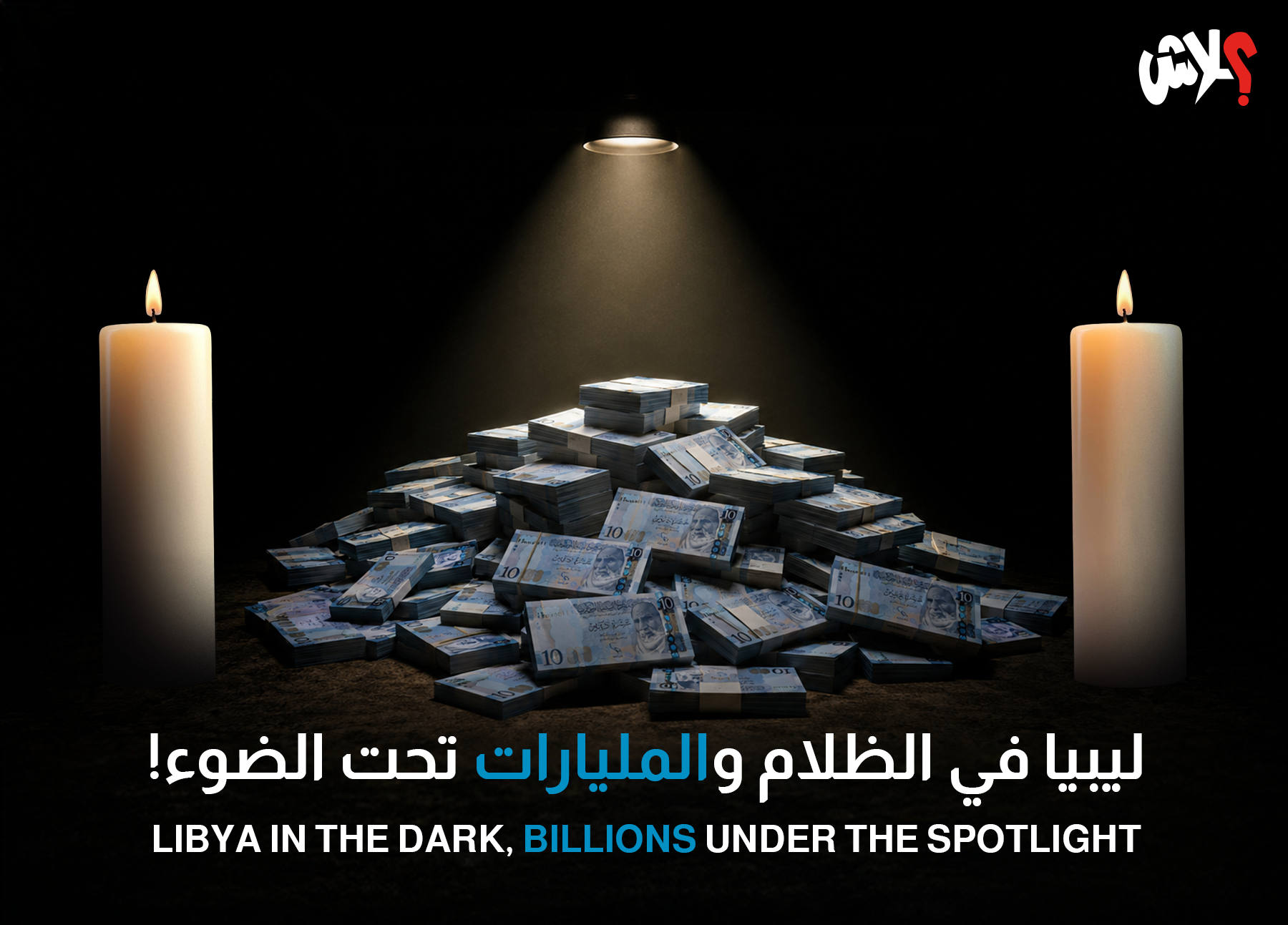
Libya in the Dark, Billions Under the Spotlight
With the return of summer come soaring temperatures and suffocating humidity. In other countries, this signals the beginning of the holiday season. In Libya, however, it means something entirely different. It marks the return of the nightmare of rolling blackouts, the return of electricity cuts lasting for hours, sleepless nights and sweltering days without air conditioning or even the most basic comfort, accompanied by the relentless noise and fumes of private generators.
The electricity crisis in Libya has become a permanent and unwelcome guest. We have grown accustomed to its constant presence for nearly 15 years, during which every attempt at reform and maintenance has failed. Billions have been spent perhaps enough to illuminate half the planet yet they have failed to provide sustainable electricity to a country with a population of no more than eight million people.
Although this summer's crisis is hardly new, it exposes a structural flaw at the heart of the Libyan state. For years, the Prime Minister of the Government of National Unity promised that rolling blackouts would soon become a thing of the past. More recently, he called for a fair distribution of electricity outages, insisting that power cuts should not affect "some people but not others." Yet the essence of the problem remains unresolved. Billions disappear every year, corruption eats away at the state's institutions and its most vital utilities, those entrusted with public services enjoy extraordinary wealth, and nothing changes. Every year the same record plays again: the General Electricity Company blames the National Oil Corporation, the National Oil Corporation blames the Central Bank, the Central Bank blames the Ministry of Finance, the Ministry of Finance blames the budget and I blame "Um Bseisi."
Electricity outages in Libya are not a natural phenomenon. Summer arrives every year. The sun rises in the east every morning. Temperatures reach fifty degrees Celsius in some regions during July and August. These are universal constants. So why doesn't the government's electricity strategy change accordingly?
This deterioration is neither sudden nor recent. It cannot be explained away by a delayed fuel tanker, a temporary valve malfunction, or a late gas shipment. It is the cumulative result of more than a decade of enormous financial spending that has yielded remarkably modest results on the ground, accompanied by one unsuccessful project after another. Despite successive governments allocating billions of dinars for modernization, expansion, and maintenance, persistent corruption, growing electricity demand, fragile infrastructure, and recurring interruptions in gas supplies have ensured that the crisis returns every time temperatures rise.
The results simply do not match the resources invested. Several entirely new power stations have been built, while numerous older generating units have undergone extensive maintenance and upgrades. Meanwhile, the Libyan state has enjoyed substantial financial revenues driven by an unprecedented surge in crude oil and petroleum product exports, coupled with soaring global oil prices. Yet everyday reality remains unchanged: citizens continue struggling simply to obtain the most basic public services.
After officials finish blaming one another for the crisis, only one target remains: the citizen. Suddenly, the blame shifts toward ordinary people. They consume too much electricity, they fail to pay their bills. Then foreigners and migrants are added to the list, accused of sharing the electricity supply and placing excessive strain on generating stations. Political interests soon enter the equation as well. Supporters of the western government accuse Haftar of diverting electricity to Egypt, while Haftar's supporters accuse Dbeibah of currying favor with Tunisia by giving away Libya's electricity as though Tunisia and Egypt actually depended on Libya's power supply, when in reality we purchase electricity from them almost every year.
Each time, however, we overlook the most important factor of all the one that has accompanied us for years, our old companion and constant friend: corruption. It is our country's greatest enemy. Because we lack either the will or the ability to confront it, and because the state itself feels no real pressure to do so, nothing changes. Both de facto authorities in the east and the west continue ruling by force of circumstance. Services will continue deteriorating one after another, while corruption devours every sector of the state, until perhaps the day comes when we nostalgically remember the "good old days" when we still had electricity for half a day during the blazing heat of summer or the bitter cold of winter.
Corruption in the electricity sector has evolved into a culture, almost as though an unwritten social contract has emerged between corrupt officials and ordinary citizens. The corrupt steal public money, while the citizen endures unbearable heat, illness, damaged household appliances, and sleepless nights. Meanwhile, the corrupt official sleeps peacefully beneath the cool air of an expensive air conditioner powered by a private generator worth more than the modest home of the average poor citizen, who spends the night on the rooftop desperately searching for a breath of fresh air.
Perhaps the strangest aspect of the entire story is that the electricity company and successive governments continue treating the crisis as though it were merely a technical problem. They dispatch maintenance teams, hire foreign contractors, hold endless meetings, request additional budgets, and open letters of credit to purchase spare parts. Yet at the very same moment your electricity is cut off, you see the chairman of the electricity company signing a multi-million contract not with a company such as Siemens, but with a football player for the club that he himself presides over.
Imagine giving someone one thousand dinars to buy medicine for your sick father, while fully aware that this person habitually purchases counterfeit medicine and sells genuine medicine on the black market. Would you still hand him the money? Of course not. Yet that is precisely what the state does every single year. It hands enormous budgets to corrupt officials and then acts surprised when the electricity keeps going out.