
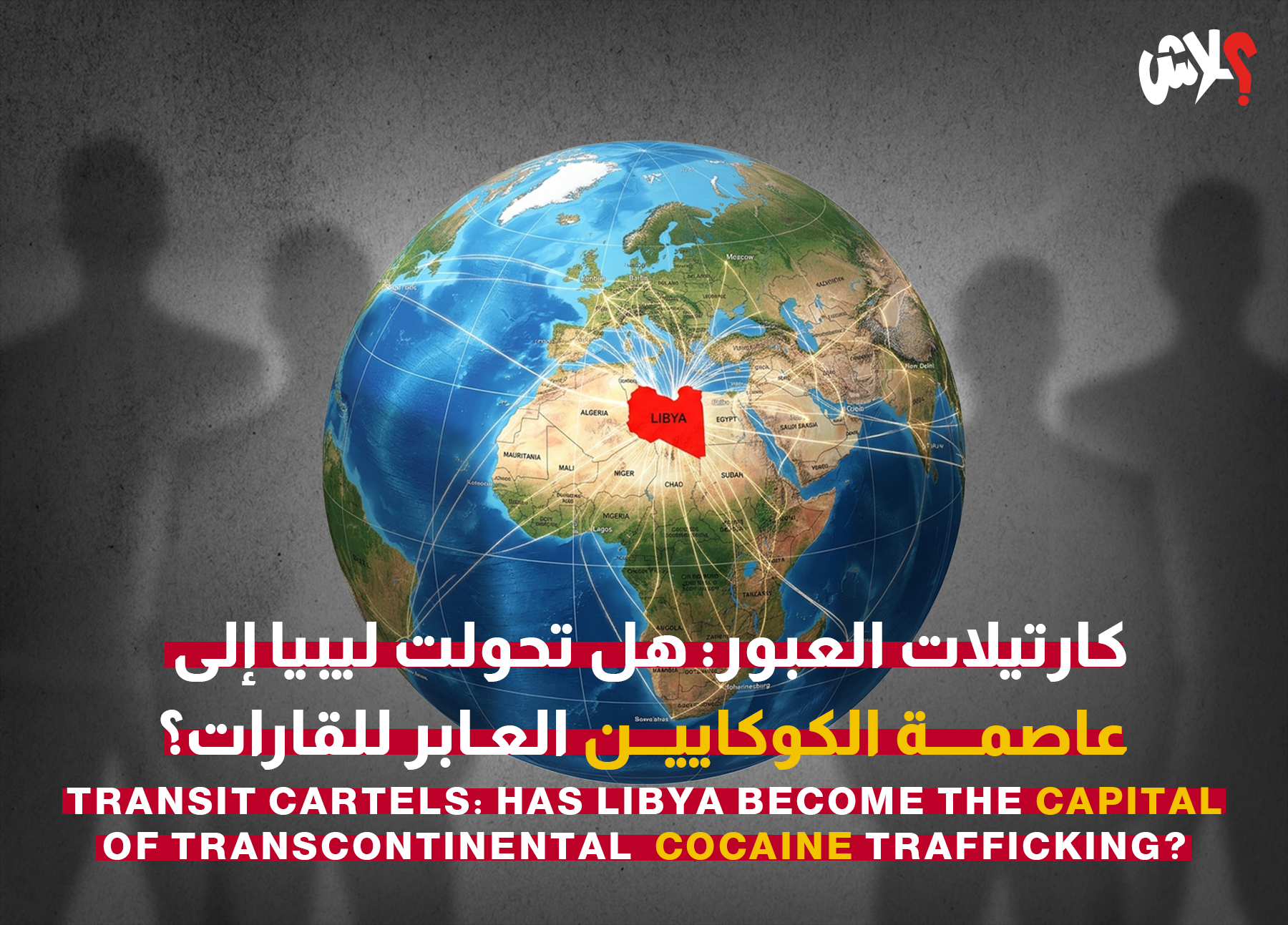
Transit Cartels: Has Libya Become the Capital of Transcontinental Cocaine Trafficking?
Beneath the seemingly calm surface of Libya's political, economic, and social turmoil, a frightening reality is emerging one that is reshaping the map of influence and organized crime across North Africa and the wider region. Libya is no longer merely an arena for power struggles or a corridor for irregular migration and human trafficking. It has suddenly become a strategic "hub" for the world's most dangerous trade: transcontinental cocaine.
Successive reports from international law enforcement agencies have sounded the alarm. Only recently, Spanish authorities intercepted massive cocaine shipments destined for Libya. This was followed by authorities in Niger, who seized hundreds of kilograms of pure cocaine deep in the Sahara while it was heading directly toward the Libyan border. The story did not stop at the land borders. Our neighbor Malta also announced record cocaine seizures (including one shipment of 612 kilograms worth approximately €69 million, and another recent seizure of 113 kilograms arriving from Costa Rica), all concealed inside containers bound for Libyan ports.
This series of successive interceptions not only demonstrates increased international vigilance, but also exposes a much darker reality: the enormous flow of cocaine entering Libyan territory from its principal source in South America, passing through West and Central Africa or across the Atlantic Ocean into the Mediterranean, before reaching Libya's borders and ports which now appear to have become a major transit and redistribution center for Europe and perhaps the Middle East.
The first and most logical question raised by these staggering figures is: Who is the consumer?
If we look at the Libyan domestic market, regardless of how much drug abuse and addiction may have increased among young people due to frustration and years of conflict, Libya's market capacity and purchasing power simply cannot, under any circumstances, absorb shipments measured in hundreds of kilograms or even tons of a substance as expensive as cocaine.
The direct answer, confirmed by "Interpol" reports, is that Libya has become a "transit state." Cocaine does not arrive to remain in Libya; rather, it is re-exported to the wealthy European market or redirected eastward toward the Gulf states and the wider Middle East.
The absence of centralized oversight, the fragmentation of security institutions, the country's long Mediterranean coastline, and its vast, largely unguarded southern land borders have turned Libya into the ideal free zone for international drug cartels (Latin American and European) operating in cooperation with local networks.
Nor can this phenomenon be separated from the unprecedented corruption and large-scale theft of public funds that have spread throughout the country. Here, an even more dangerous question emerges: are the same networks that smuggle Libyan oil and subsidized fuel also operating the cocaine routes?
The facts on the ground point to a close connection. Fuel and oil smuggling networks already possess secure and well-tested logistical supply chains (both maritime and overland). They maintain international connections, possess detailed knowledge of maritime routes to Europe and overland routes into Africa, and most importantly have a constant need for money laundering.
The enormous sums generated through oil theft and fraudulent letters of credit require hidden financial mechanisms through which they can be recycled. Drug trafficking provides an ideal environment for exchanging liquidity and generating extraordinary profits, suggesting that Libya may be witnessing a "mafia alliance" that combines the smuggling of the country's wealth with the importation of the world's deadliest narcotics. The influential importer is the one with the seemingly limitless financial war chest.
The fact that such enormous quantities of narcotics enter through official ports and border crossings or move freely across Libya's land borders completely undermines the assumption that we are dealing with "ordinary smugglers" or small-scale traffickers. A conventional smuggler would be financially ruined if authorities seized just one shipment worth tens of millions of dollars.
Yet what we are witnessing in Libya reflects the behavior of an "entrenched cartel." Spain seizes one shipment, and another is immediately dispatched through Niger. When Niger intercepts that one, a third shipment is redirected through Malta, as though the unspoken message were: "Losses are simply a calculated operating cost."
This extraordinary persistence and the ability to absorb massive financial losses without the slightest hesitation strongly suggests that the real importer is an individual (or network) enjoying overwhelming political or military influence within the state itself, protected from domestic accountability by powerful cover, and backed by financial reserves swollen with stolen public funds or profits from other smuggling operations. These are figures who enjoy de facto immunity and treat the country's ports and airports as though they were private property.
If this criminal trade previously flourished by flooding Libya with "Captagon" tablets shipped from ports controlled by the former Syrian regime to finance particular networks, then the shift toward cocaine represents a qualitative escalation in both criminality and financial power.
The most terrifying question remains the one that should concern both Libyans and the international community alike: if these are the enormous quantities successfully intercepted outside Libya, then how many massive shipments have actually entered Libya, crossed its borders, been transported, distributed, and sold without ever being detected?
Drug enforcement experience tells us that seizures generally account for only 10% to 15% of the total illicit trade. If that estimate is accurate, then Libya is facing far more than a political crisis it is confronting the danger of becoming a full-fledged "cartel state," ruled by men no less dangerous than Pablo Escobar, who, incidentally, was also well known for donating generously and helping the poor and the needy!