
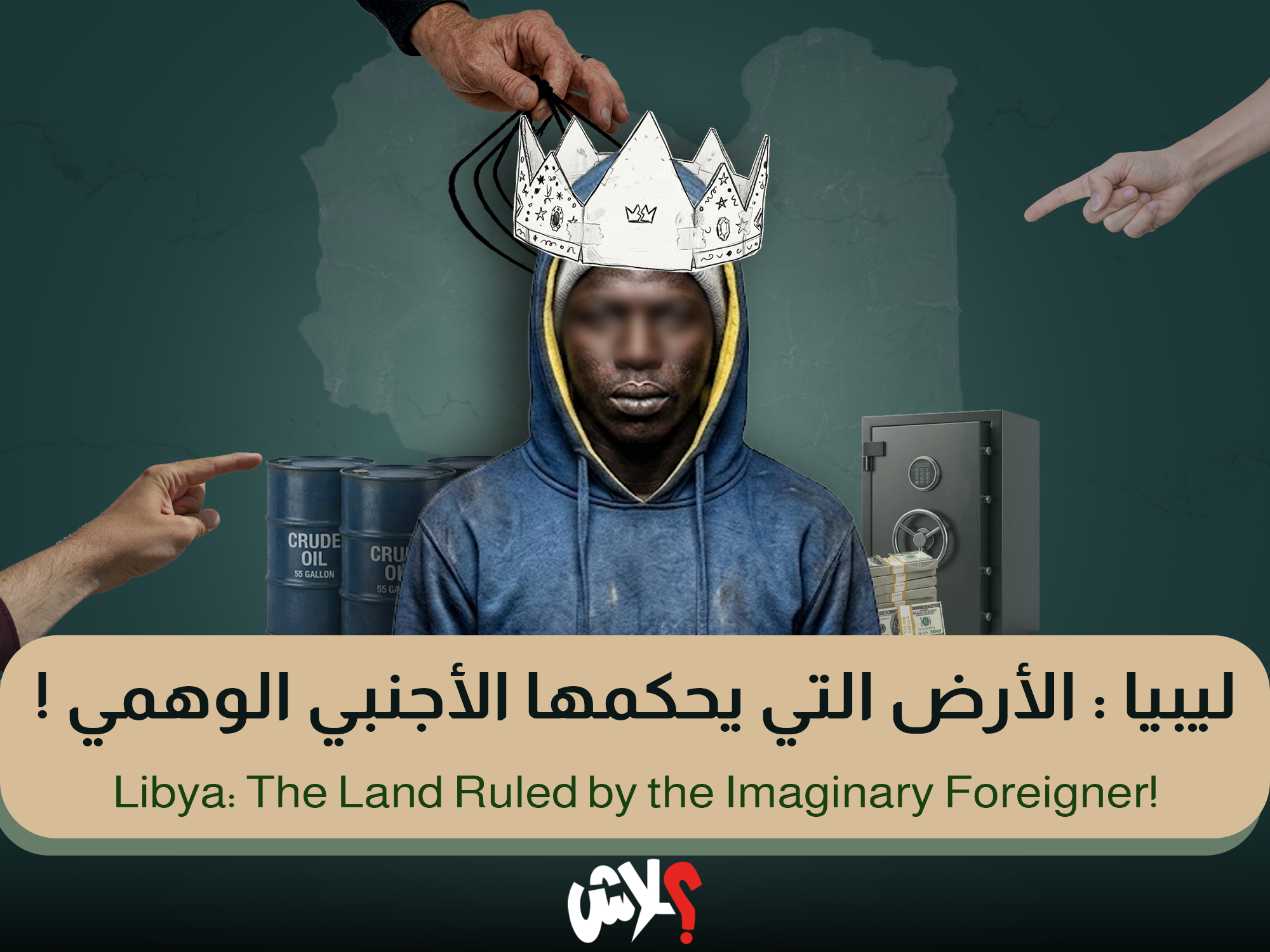
Libya: The Land Ruled by the Imaginary Foreigner!
Once again, we return to a file that refuses to close. The issue of racism and the sense of superiority displayed by a broad segment of Libyans is nothing new. The accusation of being a foreigner or a naturalized citizen is always ready, waiting for anyone who dares to disagree with us. We have written about this repeatedly on this platform until the letters themselves have grown weary, moving well beyond the stage of merely diagnosing the problem.
What is particularly interesting lately is the new angle some well-known writers and bloggers have begun promoting. They publish articles analyzing the situation with an air of manufactured innocence, placing all the blame on mysterious foreign actors. They claim that outside forces are fueling hostility in Libyan society toward foreigners especially African migrants and, more recently, Palestinians. According to them, every campaign promoting the narrative that the international community seeks to control Libya or settle foreigners on its territory is nothing more than a foreign conspiracy. They insist that the flood of hateful comments on social media platforms is merely the work of fake accounts and coordinated electronic armies, commonly known as bots.
This narrative is comforting to the conscience, but it is also a profound escape from reality. Yes, fake accounts exist, and online influence operations do attempt to shape public opinion. That is partially true. But it is by no means the whole truth. The sheer volume of hatred and hostile comments that flood Libyan social media beneath every post insulting Africans or inciting hatred against Palestinians cannot possibly have been manufactured entirely by artificial intelligence. The painful truth from which everyone is fleeing is that there are indeed clear aggressive tendencies within a significant segment of society. Simply put, we project our frustrations, insecurities, feelings of inadequacy, and helplessness onto those who are weaker than us. Meanwhile, the masses leave the corrupt elite, who openly steal billions from public funds before tossing back mere crumbs, and instead direct all their anger toward a poor laborer or a persecuted refugee. It is the perfect embodiment of the old proverb: "You only bully those you can overpower."
These aggressive tendencies did not emerge from nowhere. History has not passed us by without consequence. It has left deep wounds in our collective psyche. Decades of colonialism, dictatorship, domination, and rule by force shaped us profoundly. They did not merely plant hatred toward others; they also instilled a sense of inferiority that many Libyans now compensate for by looking down upon those who are weaker. As a result, it has become remarkably easy to invoke the specter of "the foreigner" whenever we fail at something. Has anyone ever stopped to ask why we so quickly curse migrants without even considering those who exploited their suffering, smuggled them across the desert and then across the sea, sometimes condemning them to death along the way?
The roots of this crisis stretch back through decades of complete isolation. For many years, we lived inside a sealed cocoon, with almost no genuine contact with other cultures. We were nourished on a security-state mentality of suspicion and raised on slogans about fighting imperialism and reactionary forces, all under the banner of a global conspiracy theory. We grew up believing that the entire world had no purpose other than conspiring against us, coveting our resources, and targeting our supposedly unique identity. This prolonged isolation, coupled with a profound weakness in general education, has made many citizens easy prey to illusions of racial and national superiority. Many now inhabit an imaginary world in which they feel inherently superior simply because they hold Libyan citizenship, while conspiracies are supposedly woven against them in every direction. One foreign power wants their state to fail, another wants their oil, another covets their gas. Then there are Africans supposedly seeking to take over the south, and Palestinians allegedly planning to settle in the north. Yet few notice that accusations of "settlement" always seem to shift according to whoever benefits politically from promoting them. Just a few years ago, we were hearing about alleged plans to settle millions of Egyptians in eastern Libya, accompanied by sponsored advertisements encouraging their expulsion and demanding the closure of the borders. Today, those campaigns have disappeared entirely, replaced by new campaigns using exactly the same language and methods only now directed against Palestinians!
Had the average citizen possessed even a modest degree of awareness, they would immediately recognize that this false narcissism is shared by many backward and isolated societies around the world. Had they reflected even briefly, they would realize that states pursue only their strategic interests; they do not place Libyans at the center of the universe, despite what many imagine. Had they possessed genuine insight, they would understand that our failure as a state is the natural consequence of our own neglect, our tolerance of corruption, and our silence before corrupt officials not because America or Europe spends every waking hour plotting to destroy our supposedly magnificent national experiment or erase our unique identity.
If reason were allowed to function even briefly, everyone would understand that the African migrant does not dream of settling permanently in a barren desert from which even its native inhabitants flee every day. He sees Libya merely as a difficult crossing toward the opposite shore. Likewise, anyone who looks honestly at reality would know that the Palestinian people steadfast amid catastrophe, defending their homeland and dignity are not about to abandon their cause and history in order to settle in this harsh land.
The simple truth is that the powerful deliberately direct the anger of the mob toward the weak so that people never notice who is actually robbing them and so that the weak never become strong. The only way to break this vicious cycle and defeat those who exploit it is through strength, and genuine strength cannot exist without genuine awareness. Yet awareness will remain painfully distant so long as society remains ignorant of its neighbors' cultures, unwilling to understand reality, and content to draw its information, opinions, and even its political beliefs from anonymous online pages many of them likely operated by the very bots those same bloggers claim to oppose.