
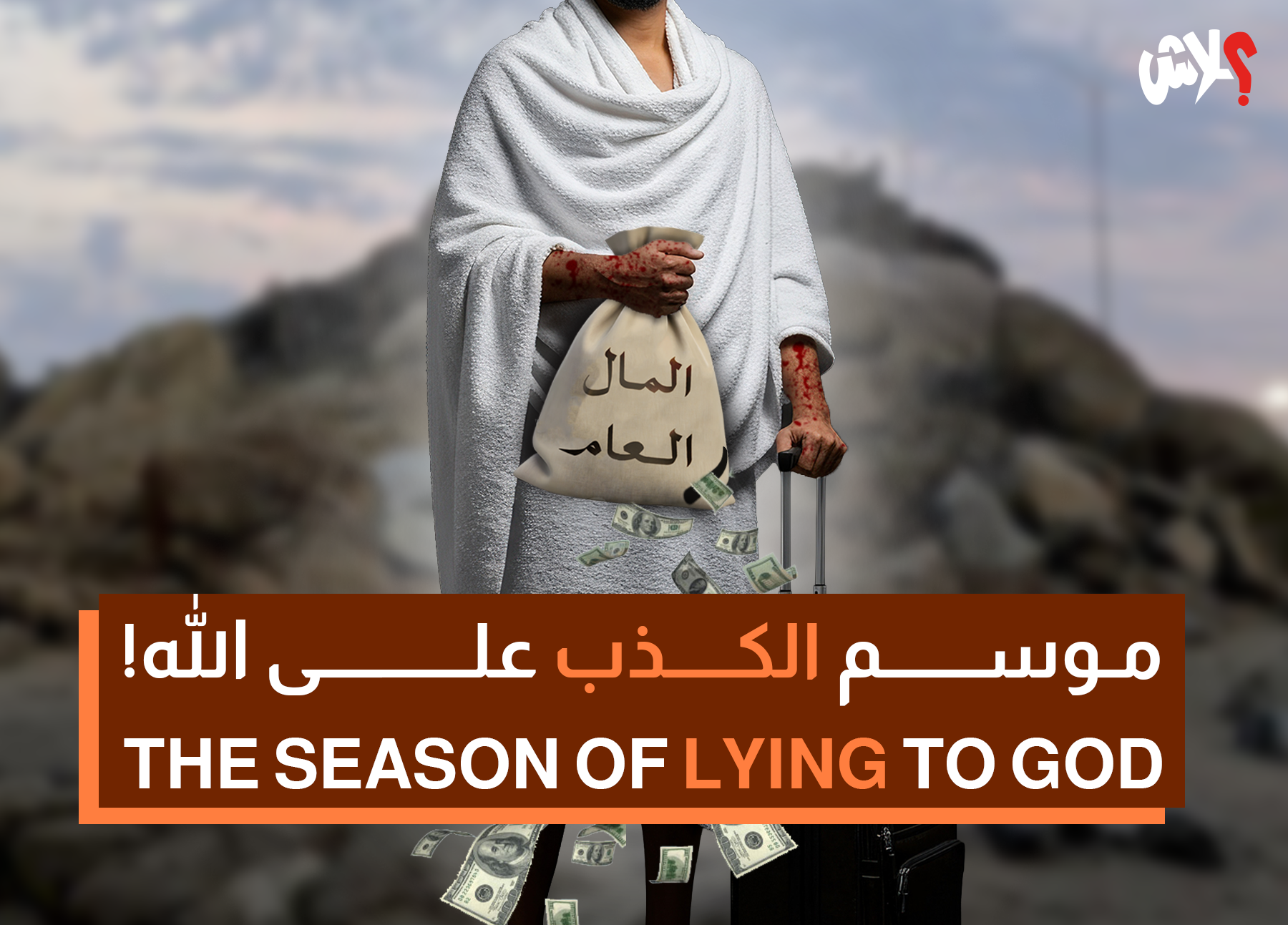
The Season of Lying to God.
This year, Libyans traveled in wave after wave to the Holy Lands to perform the pilgrimage. And, as every year, little has changed. Libyans have effectively been divided into three categories.
The first consists of those who managed to secure a pilgrimage through the lottery system, which accommodates no more than five thousand pilgrims. They represent the overwhelming majority of Libyans. Their hopes were placed into a randomized system, to which elderly men and women pinned their dreams, hoping it would finally do them justice this year. It selected the fortunate few and postponed everyone else's dream until next year if next year comes.
The second category consists of those whom we might call "the promised inhabitants of Paradise." These Libyans never pass through the blind lottery system. They go directly to the stage that says, "Congratulations, you will perform Hajj this year." Legally and financially, they are no different from those crowded into the first category. Their pilgrimage, too, is funded by the Libyan people. The only difference is that they happen to have sons or daughters in positions of power, whether in eastern or western Libya. That alone is enough to elevate their social standing and even "before God," in the eyes of those who designed this miserable life devoid of justice, even in its greatest act of worship.
The third category may simply be called "the owners of the country." They are the commanders of armed groups, the businessmen who have profited from Libya's crisis, and the officials of the de facto authorities in both the east and the west, whose hands are stained with blood and corrupt money stolen from the Libyan people in full public view and before the eyes of history.
Yet they possess enough audacity to travel to Hajj seeking God's forgiveness, hoping to return to Libya as pure as the day their mothers gave birth to them. It is as though they inhabit a deliberately surreal reality, detached from the truth of their own actions, having forgotten every Qur'anic verse and every authentic Prophetic tradition teaching that stolen wealth, the shedding of innocent blood, imprisoning people, torturing them, and depriving them of a dignified life are sins that cannot simply be erased by setting foot upon the sacred lands.
For this is what the Most Merciful has promised: justice and truth. In His presence, there are no "connections" or favoritism, and no one can deceive Him or lie before Him.
This scene reveals the depth of the disconnect in which this class lives. It is not enough for them to rob the country, impoverish its people, and crush their dreams; they have reached the point of believing they can negotiate even with God as though years of oppression, corruption, and stolen lives could be condensed into a journey lasting only a few days, after which one returns cleansed of everything committed against others.
For that reason, the Libyan pilgrimage season appears stranger than a simple religious occasion. It exposes how certain groups view power, wealth, and influence as tools capable of opening every door. Whoever becomes accustomed to obtaining everything through favoritism, escaping accountability through force, and purchasing silence with money may eventually forget that there remains one place where none of those rules apply.
There, where everyone stands clothed in the same garments, titles disappear, offices vanish, security escorts and official convoys become meaningless. No one remains the commander of an armed formation, an influential official, a businessman who built his fortune upon the ruins of the country, or the son of an official who obtained privileges denied to everyone else. There, each person is simply a human being carrying upon his shoulders the weight of everything he has done, whether good or evil.
Perhaps the most thought-provoking aspect of this scene is not that sinners go on pilgrimage for all human beings make mistakes and seek repentance but that those who continue practicing injustice speak of forgiveness; those who continue withholding the rights of others plead for mercy; and those who still believe that their problem lies only in their sins before God rather than in the wrongs they have committed against fellow human beings.
The God who promised forgiveness is the very same God who promised justice. The God who opened the door to repentance never closed the door of people's rights. That is why righteous people throughout history feared violating the rights of others more than they feared many other sins. God may forgive what lies between Himself and His servant, but the rights owed to other people can only be forgiven by those to whom they belong.
Every year, the same scene repeats itself. Airplanes carry both the oppressed and the oppressors to the same place. The same prayers rise into the sky. The same hands are raised in supplication. Yet what people do not see is that no two pilgrims arrive there carrying the same burden.
Some carry only a suitcase; others carry upon their shoulders the stolen years of countless people, rights withheld from their owners, and tears that have yet to dry in homes whose occupants they do not even know by name.
Perhaps that is precisely why the most striking feature of Libya's pilgrimage season is no longer who won the lottery and who lost it, but those who behave as though they have already been guaranteed forgiveness as though the problem were no longer committing injustice, but merely finding the appropriate method to wash it away. As though the God who knows every secret and everything concealed could somehow be deceived by the same tricks that deceive human beings.
In Libya, influence may succeed in placing your name on the list of pilgrims. Power may enable you to bypass the waiting lines. Wealth may purchase the finest services, the closest hotels, and the easiest routes. But one truth remains beyond anyone's reach: you may deceive the lottery system, deceive a government employee, deceive a public official, or even deceive an entire nation but before God, there is no exceptional list.