
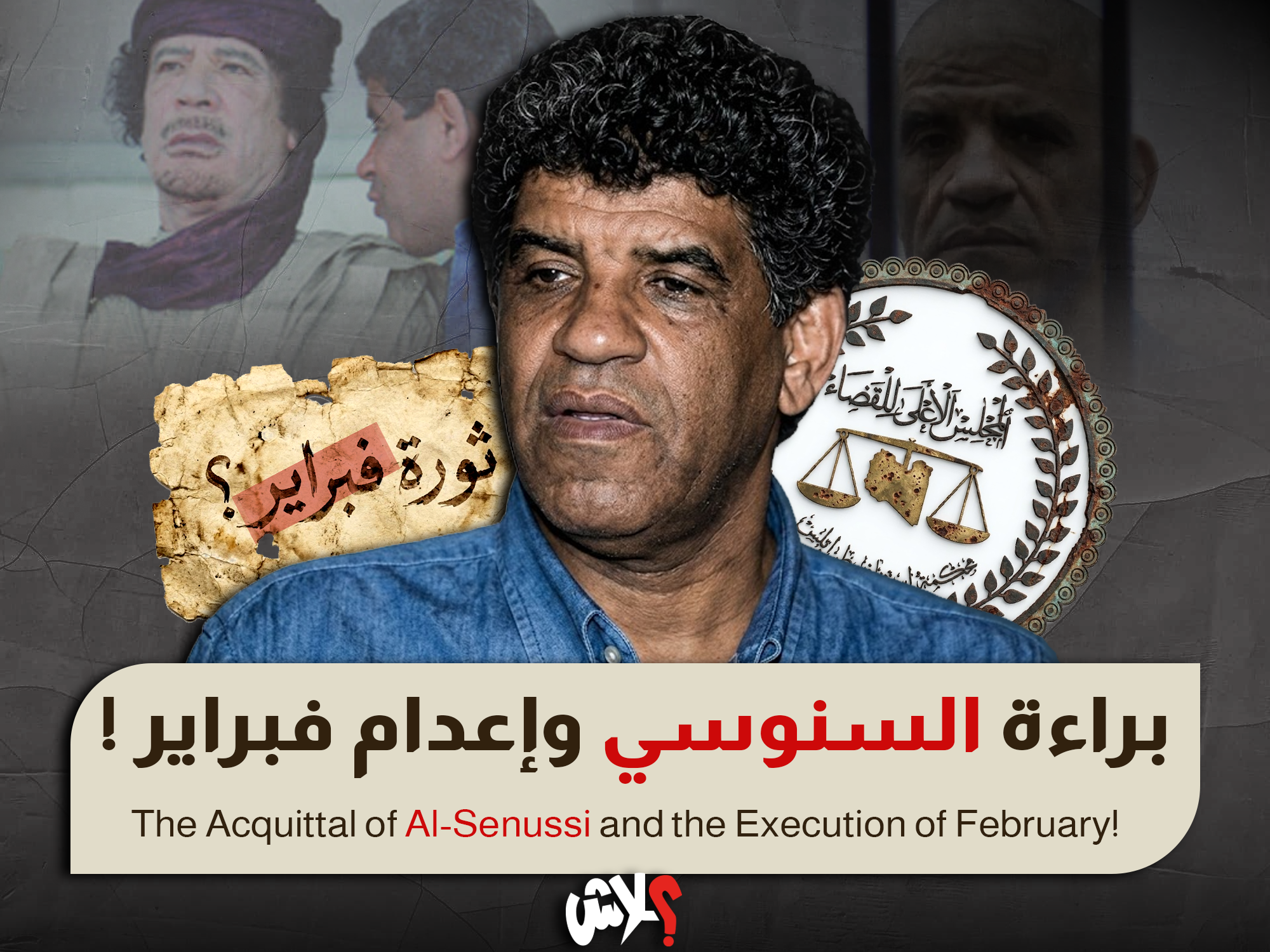
The Acquittal of Al-Senussi and the Execution of February!
The ruling issued by the Tripoli Court of Appeal acquitting Abdullah Al-Senussi and his associates of charges related to suppressing protesters during the 2011 February events shocked many. Yet this shock, in reality, reveals a naïve, almost childlike misunderstanding of the trajectory of the Libyan state after 2011. All the indicators had long pointed in this direction.
A revolution that failed to ensure cash liquidity, failed to provide electricity and basic services, failed to unify state institutions, and failed to end political division why would anyone expect it to succeed in the judiciary? February merely replaced one group of tyrants with another, and one set of corrupt officials with another. So why continue living under the illusion of a transitional justice system administered by the very same tools of the previous regime?
One of the clearest manifestations of the revolution's naïveté was its sanctification of the judges of the former regime, treating them as beacons of justice and believing they had opposed the regime and defended the rule of law. One of the greatest strategic mistakes committed by Libya's post-February institutions was the way they dealt with the former regime's judiciary. Instead of vetting, reforming, and removing those who had legitimized dictatorship for decades, what happened?
The old judges were empowered and granted a degree of immunity and independence they had never even dreamed of under Gaddafi himself. As a result, victims and perpetrators found themselves before the very judicial machinery of the old regime. Officials of the former government were prosecuted under their own laws and before their own judges. Only a fool repeats the same actions while expecting different results. February left the hammers of justice in the hands of the very judges who once danced to the slogans of the Revolutionary Committees "Liquidate them with blood" and "Hang them in the square." Then it lamented when those same hammers delivered verdicts of acquittal.
While figures from the former regime quietly and skillfully reinserted themselves into every corner of the state, the political and revolutionary elites of post-February Libya remained trapped in a coma of self-interest, consumed by disputes over salaries, privileges, and benefits. Successive legislative bodies devoted neither their time nor their energy to drafting revolutionary laws appropriate for a fragile transitional period. Instead, they focused on debating their own salaries, allowances, and luxury vehicles.
The revolution itself became immersed indeed consumed by the ideology of spoils. Those who remained from the revolutionary camp busied themselves dividing the spoils, controlling letters of credit, distributing ministries and public offices, and building private fortunes, while allowing the leadership of the state, intentionally or otherwise, to drift toward the abyss and toward a quiet counter-revolution.
Today's de facto rulers February's own tyrants and criminals were never genuinely interested in prosecuting their counterparts from the former regime, because establishing accountability today could easily threaten them tomorrow. Intentionally or not, they helped entrench narratives such as the "kind and forgiving people" and "let bygones be bygones." Through these slogans, today's perpetrators seek to normalize the idea of a general amnesty not out of love for reconciliation, but to secure an escape route for themselves should the balance of power one day turn against them.
To this must be added their embrace of the law of the jungle. Criminals do not punish criminals; they punish honorable people who demand justice and accountability. They think with the mentality of a jungle where no law exists and wish to universalize that reality, following the psychological maxim: "The adulteress wishes that every woman on earth were an adulteress."
Amid this black comedy, one burning sarcastic question emerges: Should the Libyan people now publicly apologize to Abdullah Al-Senussi and the symbols of the September regime? Were the people wrong to demand freedom? Will the next step be demanding compensation for them for the destruction supposedly caused by February?
The recent court rulings do more than acquit individuals; they almost appear to condemn the revolution itself, transforming it into a historical sin that must be atoned for. Imagine this surreal scene: security officers who fired live ammunition at protesters in Benghazi, Tripoli, and elsewhere; men who were seen dragging corpses through the streets; those who reportedly demanded of unarmed victims, before taking their lives, "Say: Long live Muammar." Today, acquittal is placed like a crown upon this absurdity, allowing the killer to walk out of the courtroom proclaiming: "Long live justice!"
The reality Libya has reached today is perhaps best summarized by the timeless words of Louis Antoine de Saint-Just: "Those who make only half a revolution merely dig their own graves." February carried out only half a revolution. It removed the head of the regime while leaving its body alive. That body then grew multiple heads, each competing for leadership, until it lost all direction, all leadership, and even recognition of its own principles. Today, it ends upon the very gallows that free people had hoped to reserve for tyrants. The acquittal of Al-Senussi and his associates is nothing less than the official death certificate of a justice system that was never truly born.
The hardest question remains: Who will prosecute today's criminals? Who will hold accountable the militia leaders who call themselves revolutionaries while repeating the very same practices of the former regime kidnapping, torture, and extrajudicial killings?
The unavoidable conclusion is that a revolution incapable of creating its own independent judiciary does not deserve to be called a revolution. A people who expect justice from those who once killed them cannot be called a truly conscious people. The acquittal of Al-Senussi is not the end of the tragedy; it is the announcement of its final chapter a chapter in which Libya is handed back to the men of the former regime, who in truth never left it, the revolution is surrendered to the graves of its martyrs who died in vain, and justice becomes, as it now stands, nothing more than another instrument in the hands of the tyrant.
If the prince is unjust, and so are his chamberlains,
And the judge of the land exceeds all bounds in judgment,
Then woe, and again woe, and yet again woe,
To the judge of the earth before the Judge of Heaven.