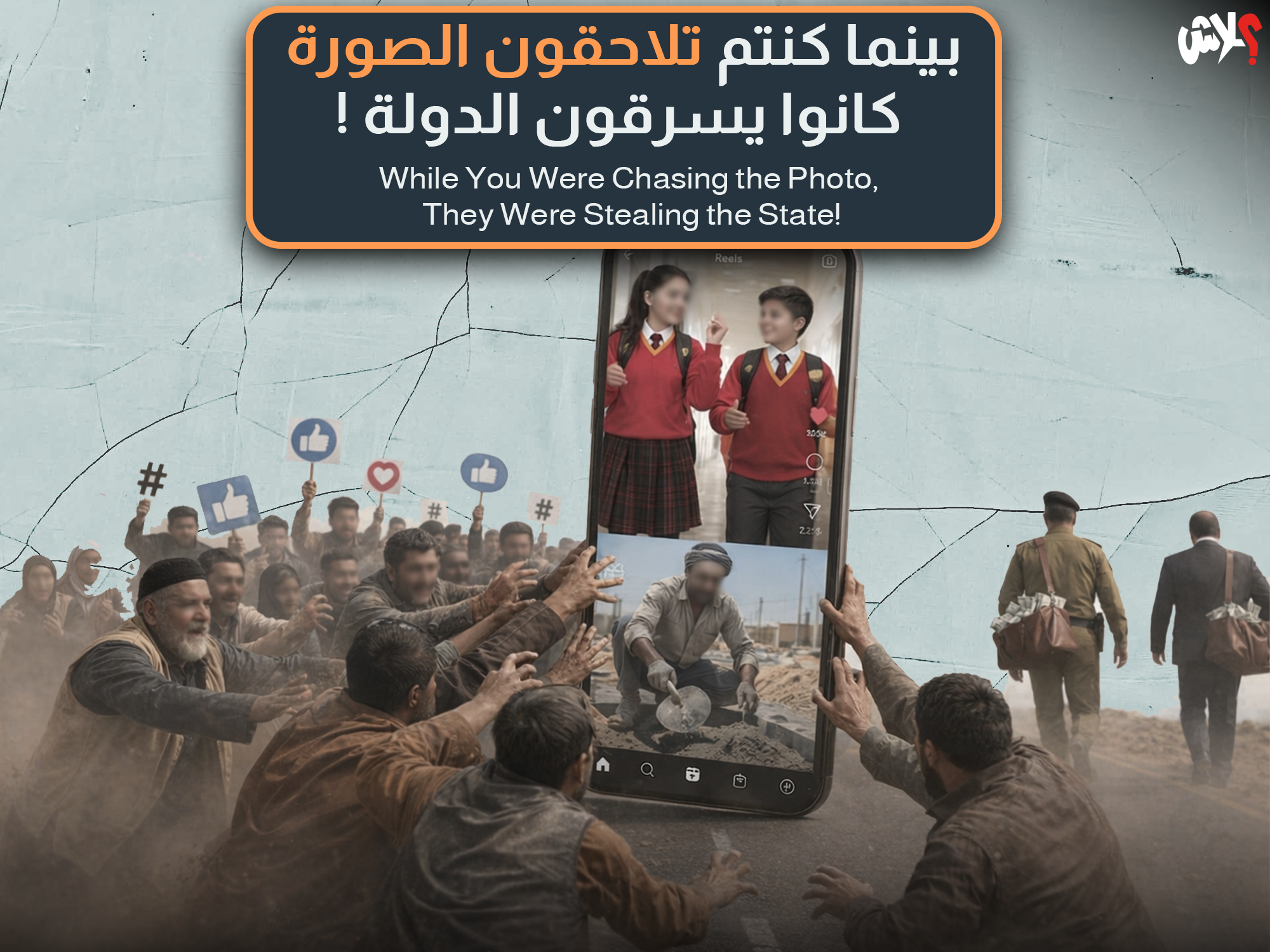
While You Were Chasing the Photo, They Were Stealing the State!
Whenever a state collapses from within, its people begin searching for an imaginary enemy to blame for its downfall. A few days ago, photographs of a little girl and her brother circulated and were described as offensive to public morals. Suddenly, an outraged public erupted, demanding the closure of foreign schools, the expulsion of foreigners, and threatening anyone who dared step outside society's accepted values.
At exactly the same time, the United Nations Panel of Experts on Libya released its report, documenting corruption eating away at the foundations of the state, theft amounting to billions of dollars, shell companies identified by name, evidence, and official documents. Thieves who have looted and continue to loot the livelihood of Libyans under the eyes of the entire world. Yet almost nobody cared, except for a handful of activists "blowing into a torn waterskin."
This is the Libyan reality in its entirety: we focus on the surface while the termites of corruption hollow out the very bones of the state from within.
Let us be honest: what truly brings down a state? It is not a photograph of a little girl or a young woman, no matter how provocative or offensive it may seem. Real collapse begins when a public official steals your money; when a government employee collects a full month's salary without ever entering his office; when electricity is cut for hours every day while its budget is spent on a football club; when your village goes days without water; when you search for medicine for your elderly father and cannot find it.
Moral decline is undoubtedly painful, but its consequences remain largely confined to those who practice it—or those who choose to be influenced by it. No one can force you into moral corruption. Financial corruption, however, forces you to live in the hell of collapsing public services and a miserable existence.
The greatest example is Europe that continent where moral liberalism, if one may call it that, has reached levels that some would describe as disturbing. You find things beyond imagination there: almost unlimited freedoms, diverse value systems, and open societies. Yet, at the same time, it remains among the world's leaders in healthcare, education, public services, and infrastructure.
Why? Because they fight financial corruption before anything else. They understand that a financially corrupt official corrupts not only himself but an entire state. He steals the future of generations, deprives patients of medicine, students of classrooms, and the elderly of electricity.
That is why millions of Muslims migrate to Europe in search of livelihoods and public services, leaving behind countries trapped in the illusion of virtue and morality while suffocating under corruption, poverty, and ignorance. This is the painful paradox of societies that passionately defend a moral system they rarely implement in practice, while turning a blind eye to a system of corruption that devours their dreams, livelihoods, and children.
The problem in Libya is that we have embraced an inverted conspiracy theory. Every time our wealth is stolen, we distract ourselves with a secondary moral controversy. Every time liquidity disappears or the dollar rises, we become preoccupied with what others are wearing. Every time schools collapse or electricity fails, we start talking about dangerous foreign ideas threatening our children.
Meanwhile, those who steal the country's oil, plunder the national budget, and obtain fraudulent foreign exchange allocations laugh quietly in the background. They know perfectly well that the loudest voices on social media will soon be occupied with a girl, a photograph, or a short video, forgetting entirely that they still have no electricity, no medicine, no schools, and no public services worthy of human dignity.
We suffer from a profound contradiction between what we say and what we do. We speak about morality as though we were angels walking the earth, even though the least corrupt among us may well be the public employee who receives a monthly government salary without performing a single day's work or showing up at the office. Sadly, even that is among the lesser evils.
Others steal millions through shell companies. Others smuggle subsidized fuel onto the black market. Others profit from subsidized medicine. Others import inferior goods at inflated prices while sharing the profits with corrupt officials. These are the people destroying the state. These are the people consuming its body day and night. They have transformed Libya into a marketplace for the corrupt and a banquet for the looters.
A little girl appearing in a photograph will not steal your money. She will not cut off your electricity. She will not deprive your father of medicine. Her influence over you is entirely optional. If you dislike what you see, look away. If you consider it inappropriate, do not imitate it. If it conflicts with your values, you alone may choose to reject it.
A corrupt government official, however, offers you no such choice. You are forced to deal with him. Forced to pay taxes he may steal. Forced to live with the crumbling infrastructure he has destroyed.
This does not mean we advocate immorality or defend inappropriate behavior. Every society undoubtedly has values and principles worth preserving. But when our priorities become so distorted that moral misconduct is considered more dangerous than financial theft, then we face the real danger.
Let us ask the question directly: who harms you more your neighbor who drinks alcohol privately in his own home, or the minister who steals the healthcare budget?
Who threatens your children's future more a student wearing inappropriate clothes at a school celebration, or an oil company selling crude oil for the benefit of its private owners?
Who truly makes your life unbearable a young woman posting a photograph with her brother on Facebook, or the electricity official who receives budgets worth millions while power stations remain idle because maintenance was never carried out?
The answer is perfectly clear.
Yet social media, which has increasingly become the compass guiding governments and authorities in Libya, thrives on instant outrage and visual stimulation. Meanwhile, the United Nations report spanning hundreds of pages and containing names, figures, addresses, and official documents is heavy reading. It requires analysis and sustained attention, making it unsuitable for short-form social media videos.
Morality is a beautiful thing and the foundation of stable societies. But morality without financial justice is merely a curtain concealing a deep abyss. The world's most successful countries were not built upon perfect moral values, but upon the rule of law and relentless anti-corruption efforts, regardless of how individuals chose to conduct their private lives.
Europe is filled with examples of moral choices some may disagree with. Yet it also provides universal healthcare, educational systems that produce innovators, and infrastructure that makes life easier. Why? Because public officials know that stealing even a single euro could land them in prison. What they wear or publish, however, remains a private matter with no bearing on the state.
Libya is almost the exact opposite. We dismiss an honest public official over a moral controversy, only to replace him with "Hajj So-and-So"—outwardly pious, yet a thief who devours everything in sight.
We are not saying: let moral corruption spread.
We are saying: put your priorities in order. The real enemy of your state is the one stealing from you—not the one offending your sensibilities with a photograph or a social media post. The thief who steals public money harms everyone, and there is no escaping his impact. The person who violates your moral framework affects you only if you allow it, and can never drag you into his own behavior unless you choose to follow him.
So let us say it plainly: the photograph of the little girl and her brother will not bring down the state. Our silence toward those who are stealing the state will.
We need to reorder our priorities. Before demanding the closure of a foreign school, let us demand an investigation into the Ministry of Education's contracts that failed to provide textbooks for our children.
Before demanding the deportation of a foreigner for moral reasons, let us demand the removal of the Libyan official who is financially corrupt and sells our country's oil for private gain.
And before becoming consumed by what others publish on their personal social media accounts, let us devote our attention to the reports of the Audit Bureau and the findings of the United Nations Panel of Experts for that is the only path toward saving what remains.