
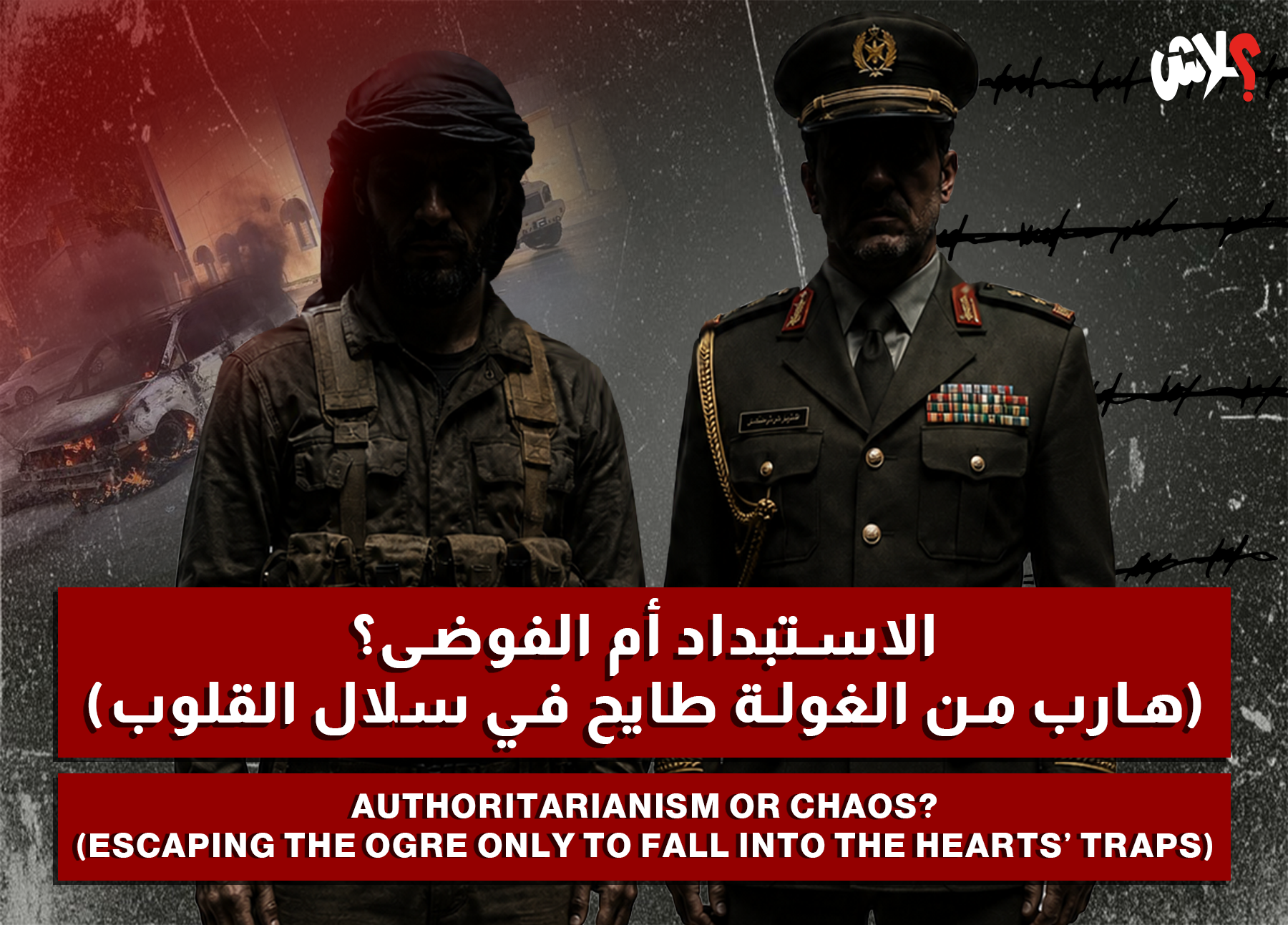
Authoritarianism or Chaos? (Escaping the Ogre Only to Fall into the Hearts’ Traps)
In light of the political, security, and military developments unfolding in Libya, an important question continues to arise: Which is preferable—tyranny or chaos? The events witnessed in Al-Zawiya over the past few days may seem to tip the balance in favor of tyranny. Then you remember that we are marking the first anniversary of the humiliating images of House of Representatives member Ibrahim Al-Dersi inside the prisons run by Haftar's sons, and you remember that even the man's own family cannot raise their voices against those they firmly believe are responsible for what happened to him.
This question is not merely a comparison between two undesirable conditions. At its core, it is a debate about the very purpose of the state and the nature of human beings. The conflict here is between two fundamental values: order versus freedom.
Those who favor tyranny prioritize order. Supporters of this view argue that even the worst form of tyranny is still preferable to a "stateless condition" or outright chaos better than a state ruled by Al-Far, Al-Baqarah, Al-Zamrina, Al-Tashayna, and Al-Marinda, better than the conflict of militia-controlled districts, tribal strongholds, and competing spheres of influence. For them, survival takes precedence over freedom. Their central argument is that the primary function of any authority is to protect lives. Tyranny, despite its cruelty, provides "physical security." Under an autocrat, you know what the rules are—even if they are unjust—and you know how to avoid punishment, allowing everyday life to continue.
Tyranny creates a degree of stability that enables people to anticipate the future. Merchants can buy and sell, farmers can cultivate their land, and students can attend school every morning because a central authority prevents random looting and lawlessness. This is, in their view, the logic of choosing the lesser of two evils: tyranny is one organized evil, whereas chaos consists of thousands of small tyrants. Under chaos, your neighbor becomes your oppressor, and the highway robber becomes your ruler, multiplying the sources of fear and death.
Those who favor chaos, on the other hand, prioritize freedom and the possibility it offers for eventually establishing a successful state, unlike tyranny, which is forever hostage to the whims of the tyrant. They do not defend chaos as destruction for its own sake; rather, they see it as a space that allows possibilities to emerge, as opposed to the political death imposed by authoritarian rule.
This camp believes that tyranny destroys the very essence of human dignity and reduces society to a herd. Chaos, despite its dangers, still contains the possibility of liberation and rebuilding a just and natural order provided the necessary conditions exist. In fact, they argue that tyranny is merely disguised chaos. It represents the highest form of moral disorder, where rights are violated under the authority of the tyrant's own laws. Stability under dictatorship is only temporary and inevitably explodes into even greater chaos. Libya in 2011 stands as compelling evidence.
A historical perspective also shows that tyranny is the greatest producer of chaos. Societies that are not built upon democratic institutions and the peaceful transfer of power inevitably descend into turmoil the moment the tyrant disappears or weakens. Libya itself is a clear example. After four decades of Gaddafi's authoritarian rule, the country produced a state of chaos that has persisted for more than thirteen years. So who can guarantee that a new dictatorship would not produce the very same outcome? And who can guarantee that the heirs of a new authoritarian project would not begin fighting over its legacy before it even fully comes into existence?
In short: tyranny is a slow societal suicide driven by the fear of being killed, while chaos is a gamble with the present in pursuit of an unknown future. Both represent the absence of justice, and without justice, preferring one over the other is merely choosing the manner of death. Would you rather die from militia gunfire, or from starvation or torture inside the prisons of tyranny? In either case, the destination remains the grave.
The solution everyone talks about but no one implements is the rule of law: a system that provides order and prevents chaos while guaranteeing freedom and preventing tyranny. But who will establish such a state in a country where militias hold the real power? Who will disarm armed groups in the east, west, and south? Who will convince those who have tasted the sweetness of ruling without law to surrender their seats simply because the constitution says so?
The painful answer is: no one. Tyranny and chaos are not theoretical options presented to Libyans they are daily realities. In the east, people live under military authoritarianism disguised beneath a cloak of questionable legitimacy, practicing chaos in an organized fashion. In the west, they endure the chaos of powerful or power-seeking militias. Whenever these groups disagree, they "zero" their weapons, position their artillery, and rain shells upon the heads of innocent civilians without warning. In the south, people suffer a combination of both, compounded by neglect and the severe absence of even the most basic resources.
Perhaps the more honest question is this: why do we discuss "tyranny or chaos" as though it were an academic debate held inside air-conditioned lecture halls, while people in Al-Zawiya bury their dead beneath the rubble of their homes, while families in Tripoli prepare shrouds in anticipation of clashes that could erupt at any moment, while the families of prisoners of conscience possess nothing except appeals to their jailers, begging them to show mercy to their loved ones? Meanwhile, corruption continues to flourish unchecked exploiting chaos in the west and thriving under authoritarian rule in the east.
Tyranny and chaos are simply two sides of the same coin, a coin called "the absence of the state." A missing state cannot be replaced by an unjust iron fist, nor by the illusion of creative chaos. What can replace it is a genuine popular will capable of imposing itself upon everyone who carries a weapon or wields official authority. Unfortunately, that will remains absent just like the state itself. The people remain distracted from their own cause, exchanging sarcastic jokes about the consequences of chaos and the burdens of tyranny, even though they alone bear the full weight of both.
In conclusion, anyone searching for an easy answer to the question "Which is better?" is wasting their time. The Libyan today is not choosing between order and freedom. He is choosing between death at the hands of one tyrant or death at the hands of ten smaller tyrants. The only difference lies in the number of bullets that strike his exhausted body. "And what does it matter to the sheep whether it is skinned after it has already been slaughtered?"