
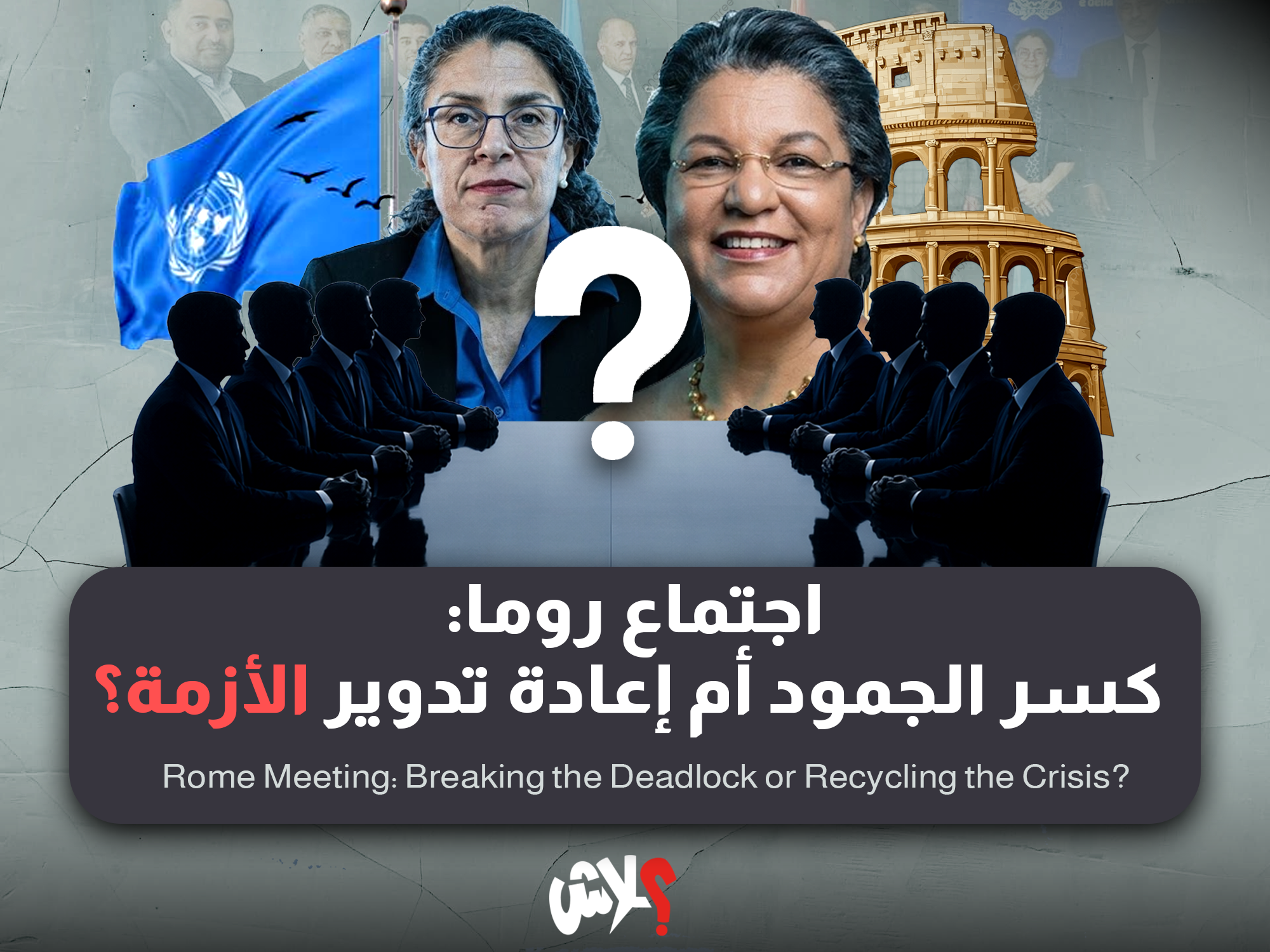
Rome Meeting: Breaking the Deadlock or Recycling the Crisis?
In a scene that perfectly reproduces the absurdity of Libya's political landscape, the United Nations Mission has taken what appears to be either a bold or perhaps a desperate step. In Rome, it brought together representatives of the Government in Tripoli and envoys of Khalifa Haftar, effectively bypassing both the House of Representatives and the High Council of State.
This move was not born out of a sudden moment of frustration. Rather, it came after the Mission had grown weary of the two councils' endless delays in agreeing on a constitutional basis for elections. It therefore decided to seize the initiative or at least, that is how it appeared.
The dispute itself is not new. At its core lies the failure of both sides to agree on restructuring the Board of the High National Elections Commission. The House of Representatives, led by Aguila Saleh, backed away from earlier understandings that called for replacing the entire board, opting instead merely to fill the vacant seats.
The High Council of State, for its part, described the move as an attempt to reshuffle the cards. In a formal session, it appointed a new Board of Directors and a new chairman for the Commission. Yet the newly appointed chairman never assumed office, while Imad Al-Sayeh continues to lead the Commission as though nothing had happened.
This is precisely what both councils want. Their disagreement over the Elections Commission provides each with grounds to reject its decisions and outcomes, thereby preventing elections from taking place. In turn, this guarantees their continued presence on the political stage indefinitely, with each side producing new crises whenever the prospect of a solution draws near.
The UN Mission's latest initiative offers a measure of hope. Perhaps there is now a genuine possibility of holding elections this time. Yet that hope quickly collides with difficult questions.
Will the two councils accept the outcomes of the Rome meeting if they include appointing a new Board for the Elections Commission? Will they recognize the new board and its decisions? And can any of this realistically happen when everyone knows that some of the actors currently in power would never accept election results that do not guarantee their own victory?
These are entirely legitimate questions.
Can elections whose outcomes are uncertain truly take place? And if they do, what will become of their results if they fail to satisfy the de facto authorities controlling the ground?
The House of Representatives, widely viewed as being aligned with Haftar, has yet to comment on the Rome outcomes. The High Council of State, seen as aligned with Dbeibeh, has likewise remained silent. Are they waiting for one another? Or are the real patrons behind both institutions yet to issue instructions to their representatives on whether to welcome or reject the initiative?
The Attorney General, whom the outcomes of the (4+4) Rome meeting proposed should nominate a member of the judiciary to chair the Elections Commission, has also remained silent. He has neither welcomed nor rejected the proposal. What position will he ultimately take? Will he accept a role assigned to him by a body that did not previously exist? Or will he maintain the cautious neutrality for which he has become known?
These questions compel us to pause at a fundamental point: Is the Rome meeting a genuine step toward the long-awaited elections, or is it simply another move on Libya's political chessboard?
A move designed to prolong the crisis while allowing those already in power to remain where they are sharing authority, dividing budgets, and distributing roles among themselves. At times they appear as rivals; at others, as partners.
At the same time, it is difficult to deny that bypassing the two councils was necessary. Over the years, both institutions have consistently demonstrated that they are obstacles to any meaningful solution, placing their own survival above the interests of both the nation and its citizens.
Yet the more important question remains: Does the UN Mission actually possess the ability to enforce the outcomes of this meeting on the ground?
Does it have real enforcement mechanisms? Or will these outcomes remain confined to good intentions, just as happened with the Skhirat Agreement, the Geneva Dialogue Forum, and the nationwide ceasefire agreement?
Past experience suggests that the Mission often limits itself to the role of mediator and adviser, without possessing the means to compel the parties to implement what has been agreed. This is precisely what Libya's political actors have learned to exploit. They agree to everything inside conference rooms, only to return home and search for loopholes through which they can delay, reinterpret, or abandon their commitments.
Haftar, Dbeibeh, Aguila Saleh, and Takala all understand that their continued political relevance depends upon the continuation of the crisis. Genuine elections could bring entirely new faces to power and remove them from the scene. Worse still from their perspective the situation could slip beyond their control altogether.
For that reason, they appear to prefer preserving the current arrangement. They present themselves as adversaries, wage proxy battles through official statements issued by governments and councils, yet in reality remain partners in dividing the spoils.
The ordinary Libyan citizen, who has been waiting for elections for years, no longer cares much about who wins. What matters is seeing an end to this endless cycle of dysfunction to experience genuine stability, to enter a bank without standing in endless queues, to have electricity that does not constantly fail, and simply to live as people do elsewhere.
Yet that citizen may have a long wait ahead. As long as those who possess weapons control political decisions, as long as the councils serve merely as political façades, and as long as the United Nations Mission lacks meaningful instruments of pressure, meetings in Rome, Geneva, Cairo, or any other capital will likely remain little more than new episodes in an endless series of delay and procrastination.
Yes, we support every genuine effort to hold elections, and every initiative capable of breaking the paralysis and obstruction of the two councils. But we do not want the dream of elections to become yet another mirage one we continue chasing only to grow even more thirsty.
Perhaps this time will be different. Perhaps the UN Mission has learned from its previous mistakes. Perhaps international pressure has reached a level that compels Libya's political actors to remain silent instead of openly rejecting the initiative.
But in Libya, we have learned not to place our hopes in perhaps. Too often, perhaps has betrayed us. Too often, it has transformed optimism into disappointment.
So we watch. We wait for the statements of the two councils. We await the position of the Attorney General. And we will soon discover whether this meeting gives birth to a living child called elections or whether, like so many initiatives before it, it will end up discarded in the graveyard of narrow political interests.
In the end, one can only hope that the Rome meeting truly represents a leap toward a solution, and that the United Nations has finally realized that dealing with the traditional actors alone leads nowhere, and that bypassing them may be the only way to break the deadlock.
History, however, teaches us not to rush to judgment. Libya's political chessboard is extraordinarily complex. Every move may be a deception. Rivals can become allies overnight, while allies may become enemies in the very next turn.
For now, all we can do is wait and see.