
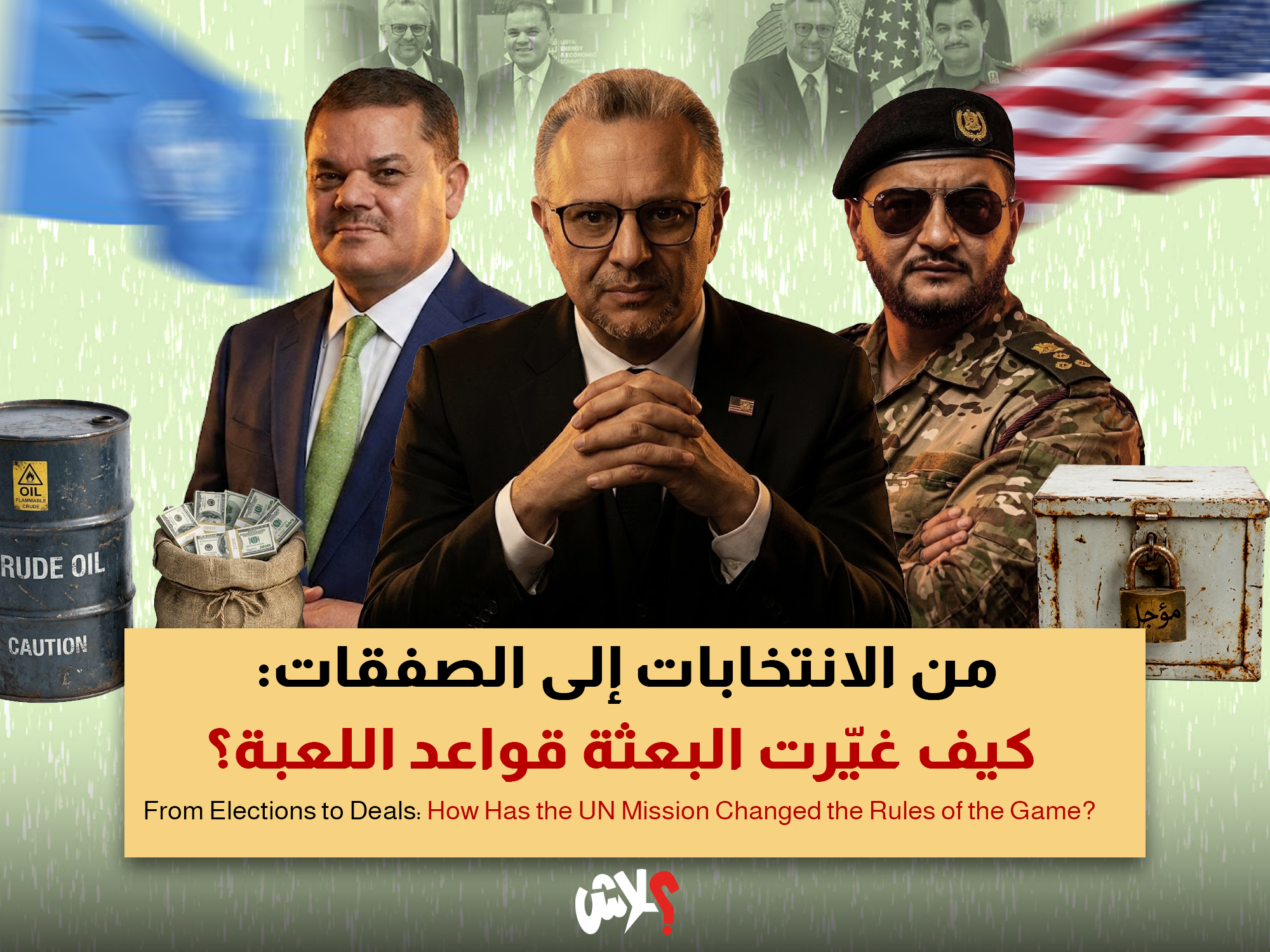
From Elections to Deals: How Has the UN Mission Changed the Rules of the Game?
Once again, the United Nations Mission in Libya has managed to outdo itself not only in failure, but in its astonishing ability to contradict itself. After years of promoting lofty slogans about elections and a structured dialogue that would lead to renewed legitimacy, it has now surprised us with a "mini-dialogue": four representatives from the east representing Khalifa Haftar, and four from the west representing Abdul Hamid Dbeibeh's Government of National Unity, as though the country were a private estate being divided between two men.
But what has changed? The Mission had long insisted that the only way out of Libya's crisis was through the ballot box, and that the structured dialogue was specifically designed to facilitate consensus on a constitutional framework that would enable elections capable of renewing legitimacy and replacing these exhausted institutions. Then, all of a sudden, we discover that the map has been redrawn, and that new ideas have emerged. Why?
Here, the scent of American pressure is unmistakable. Stephanie Koury, the Deputy Head of the Mission, is American, while Massad Boulos, the U.S. President's Special Envoy, has long been promoting a power-sharing arrangement between Haftar and Dbeibeh. His proposal, which recently surfaced in the media, hardly needs repeating. So, has Washington finally succeeded in steering the UN Mission toward a compromise that entrenches division instead of resolving it? Or has the Mission simply surrendered to the politics of the status quo, deciding to work with those who currently hold power on the ground, even if they represent the very deadlock it once claimed it was trying to overcome?
Hanna Tetteh, the UN Special Representative, stated in her latest briefing before the Security Council that the two tracks—the structured dialogue and the mini-dialogue are operating simultaneously. This is not merely inaccurate; it is blatantly contradictory. She herself previously described Dbeibeh's recent ministerial appointments as "non-consensual" and potentially lacking legitimacy. So how can someone who supposedly lacks the legitimacy even to replace a minister in his own government suddenly be treated as the legitimate ruler representing all of western Libya?
This is where the real irony begins. Let us assume, for the sake of argument, that Khalifa Haftar represents eastern Libya through his absolute authority. In reality, there is virtually no organized opposition to his rule across eastern Libya and large parts of the south; critics are either imprisoned or forced into exile. But who exactly represents western Libya at this mini-dialogue? Dbeibeh? A man who cannot fully assert his authority even over Tripoli itself, let alone the rest of western Libya?
Let us take a brief tour of the capital, beginning with its eastern districts. Abdul Raouf Kara and his forces; the Special Deterrence Force remains firmly entrenched inside Mitiga Air Base, enjoying both military and popular support. It has even strengthened itself by absorbing the remnants of Ghniwa's defeated forces. Is Kara aligned with Dbeibeh? Quite the opposite he remains one of the sharpest thorns in his side.
Now let us move westward to Tripoli, to Janzour, where the remnants of the Stability Support Apparatus remain active. Dbeibeh issued a decision dissolving the agency, yet the Presidential Council later ordered its continuation. It remains a constant source of concern, particularly given its popular base in Zawiya, where many view Dbeibeh as nothing more than a financier, not a leader. Further southwest, in Warshefana, stands Muammar Al-Dhawi, an unreliable ally who is adept at playing every side, backed by Osama Al-Juwaili, a powerful military commander officially recognized by the Presidential Council and an open opponent of Dbeibeh.
This is the situation inside Tripoli. Outside the capital, most areas of western Libya lean toward Dbeibeh only because he controls the budget. The moment that leverage disappears, so will much of his support.
So by what standard has the UN Mission concluded that this man represents western Libya in a mini-dialogue that is expected to determine the country's future? Simply because fighters affiliated with his Ministry of Defense participated in a joint military exercise alongside Haftar's forces? Is this now the new standard of legitimacy? Military displays now grant the authority to shape the future of millions of people?
Ironically, none of these realities escaped anyone's attention. Mohamed Al-Menfi, Chairman of the Presidential Council long regarded as a ceremonial figure and a marginal political actor has suddenly begun issuing defiant statements on social media. On the ground, Al-Menfi has gathered Dbeibeh's opponents from Tripoli and across western Libya, holding meetings that appear to focus on security coordination but carry an unmistakable underlying message: We are here. Our fingers are on the trigger. We will not allow ourselves to be bypassed in favor of family deals.
Even Dbeibeh's own allies have refrained from endorsing the initiative. Through his allies within the High Council of State, he himself threw a stone into the still water, as though saying: I am not part of this deal. If I were, those aligned with me would have accepted it. A calculated reading of the political winds.
As for the UN initiative itself, it is busy undermining itself. One initiative contradicts another: a structured dialogue alongside a mini-dialogue. Two tracks that are supposedly parallel but are, in reality, fundamentally incompatible. It is as though the Mission itself is serving competing interests. As the Libyan proverb says, "The longer the thread, the easier it is to lose the needle."
Behind all these maneuvers lies a single question that no one wants to ask: Where are the people?
The people remain permanently absent from every negotiating table. They are the ones who pay the price the soldiers who are killed, the displaced families struggling to survive, the students deprived of quality education, and the patients who cannot find medicine.
Every one of these initiatives speaks of consensus, compromise, and power-sharing, yet their true purpose appears to be preventing elections from taking place because genuine elections would threaten those currently seated at the table. They know perfectly well that they would lose the first truly free election, and that is why they prefer to reproduce failure rather than risk democracy.
The greatest beneficiary of the mini-dialogue is the very same beneficiary of every failed initiative: those who seek to prolong Libya's crisis, profit from instability, and build fortunes upon the ruins of the state. And under American pressure, the United Nations Mission appears content to dance to their tune.