
How Did We Become Complicit in the Lie?
Al-Tughra'i wrote in his famous poem Lamiyyat al-'Ajam:
"Loyalty has dried up while treachery has overflowed, and the gap between words and deeds has widened."
This verse perfectly captures Libya's reality today, where the gap between official statements and actual facts grows wider with each passing day. Citizens no longer seek tangible, indisputable truth as much as they seek a dose of hope, even if it is fabricated. Here lies the intelligence or perhaps the cunning of those in power: they master the art of inventing parallel realities that collapse at the first numerical test, yet still accomplish their purpose by providing temporary emotional comfort. And that is all they need to appear as the savior whom the entire nation wishes to kiss on the forehead.
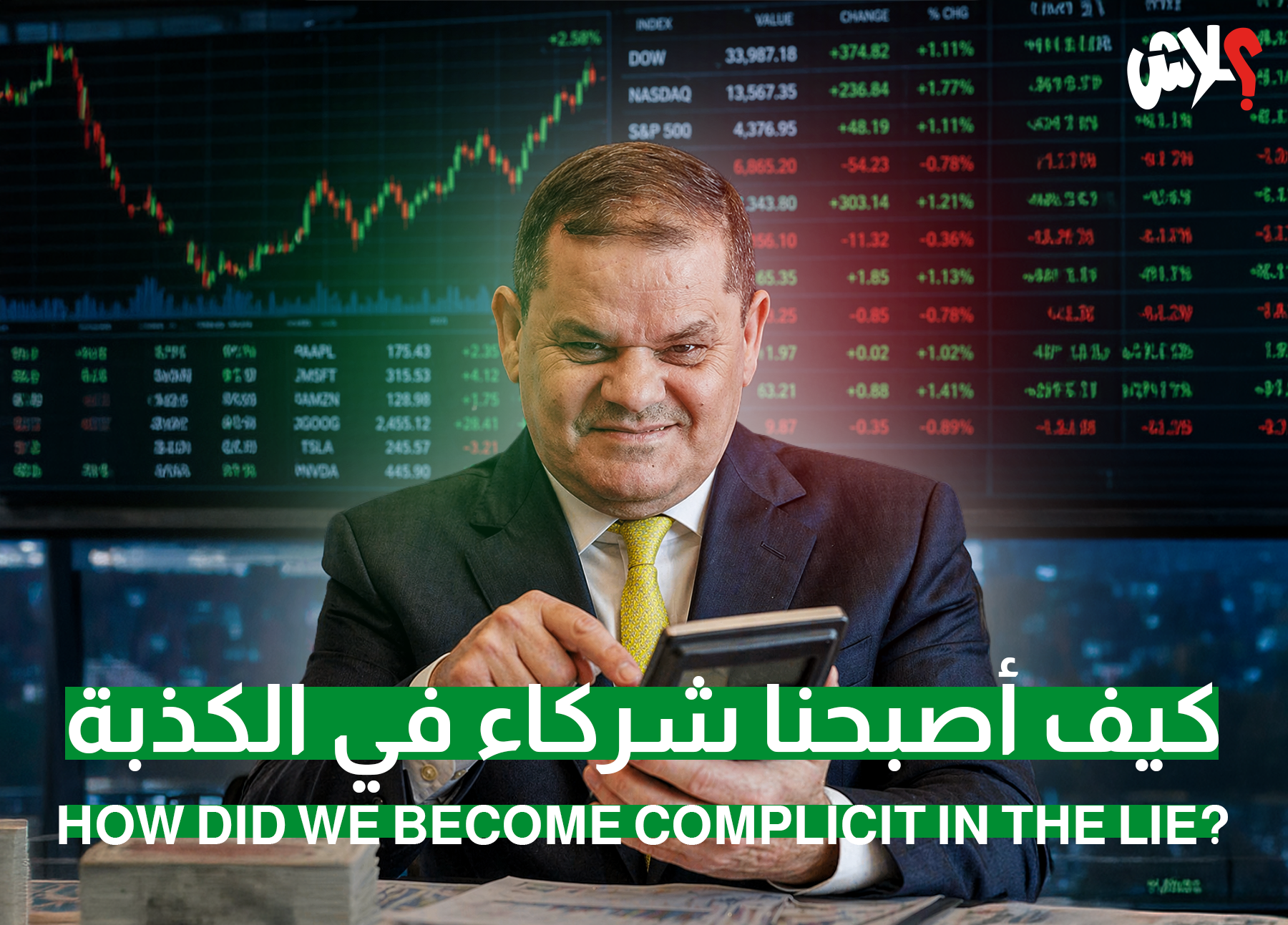
A few days ago, the Prime Minister of the Government of National Unity told us that the unified spending agreement had "restored 40% of the value of the Libyan dinar." Had such a statement been made in a country that respected the intelligence of its citizens, it would have been enough to dismiss its author before the ink had dried on the newspaper that published it. Reality, however, tells a different story. On the day the statement was made, the dollar traded at just over 8 Libyan dinars on the parallel market, while on the day the agreement itself was signed, it had not exceeded 10 dinars. This means that even if we generously attributed the entire decline solely to the agreement while ignoring every other contributing factor, a rather naïve assumption the improvement would still fall short of 20%, barely half of what the Prime Minister claimed. But none of that really matters. Who is going to calculate it anyway? What matters is that the lie is emotionally comforting, easy to swallow, and requires no calculator.
Not long ago, the very same Prime Minister also announced the suspension of contracts with the notorious company Arkno, claiming it was a response to public pressure. Yet before people had even recovered from the excitement of that announcement, local media circulated a letter from Arkno requesting the allocation of one million barrels of oil to market on behalf of the National Oil Corporation. The ink on the first decision had barely dried before we discovered that it was nothing more than ink. The company supposedly suspended because of our objections to its manipulation of Libya's oil was apparently still manipulating both our oil and us.
These are not isolated incidents. They represent a recurring pattern. An unrealistic statement is released through the media, people receive it with optimism, then another statement of the same kind follows shortly afterward. Before the time comes to verify the first promise, it has already been replaced by another, while people have forgotten the previous one and become occupied with hoping the next one will finally come true.
About three years ago, specifically in May 2023, the Prime Minister appeared in a commemorative photograph alongside a journalist, holding a sign that read "390 Days," referring to the time supposedly required to complete Tripoli's Third Ring Road. Three full years have passed. The road remains unfinished, and we are still far from completing it. But did anyone ask why? Did anyone protest? No. Because there is always another announcement, another promise capable of erasing the memory of the previous one.
The secret lies in one simple yet devastating fact—a fact every politician understands and knows how to exploit: the weakness of people's memory. More than that, people possess a powerful desire to believe anything positive that offers even temporary hope. The Libyan politician has become an expert at reading this weakness. He presents himself as a popular therapist, prescribing imaginary medicine for a real illness. And the patient remains grateful, because all he truly wants is to sleep peacefully—even if only for a few nights.
Yet whenever we reflect upon reality and history, we always arrive at the same conclusion. Political lying is not new. What has changed is that the media and public scandals can no longer keep pace with it, because the rhythm has become faster than any process of verification. False statements and empty promises have become a daily commodity. Citizens are no longer angrier at the lie itself than they are at the person who exposes it, because once the illusion is shattered, they are forced to confront a painful reality. They realize that nothing has fundamentally changed; those who steal Libya's oil continue stealing it, those who profit from the dollar continue filling their vaults, the dinar may rise temporarily but will inevitably decline again in the absence of genuine reforms, their suffering in banks and markets continues, and the hope sold to them by politicians turns out to have been buttered and butter does not survive beneath a scorching sun.
Perhaps the most painful irony is that the official who lies with such confidence does not do so because he is unaware of the truth. He lies because he knows it perfectly well, and because he knows that we know it too. Yet he continues betting that we will never act, that we will continue preferring the illusion of rescue over the burden of reality. Sadly, so far, he has not lost that bet.
The problem, therefore, is not the lie itself. The problem is that the lie has become part of an unwritten contract between ruler and ruled: you promise us what we want to hear, and we promise to forget what you said two weeks later. Then, once reality reveals itself, we all begin searching for another lie that offers us comfort. And so the cycle continues.
The bitter conclusion is that if our leaders truly respected us, they would recognize that we deserve the truth even when it is painful. Instead, as they watch us smiling at imaginary billboards, applauding impossible figures, and (wishing to kiss their heads), they have realized that the easiest way to govern is to keep people chasing the mirage of a lie until they eventually collide with the wall of truth.