
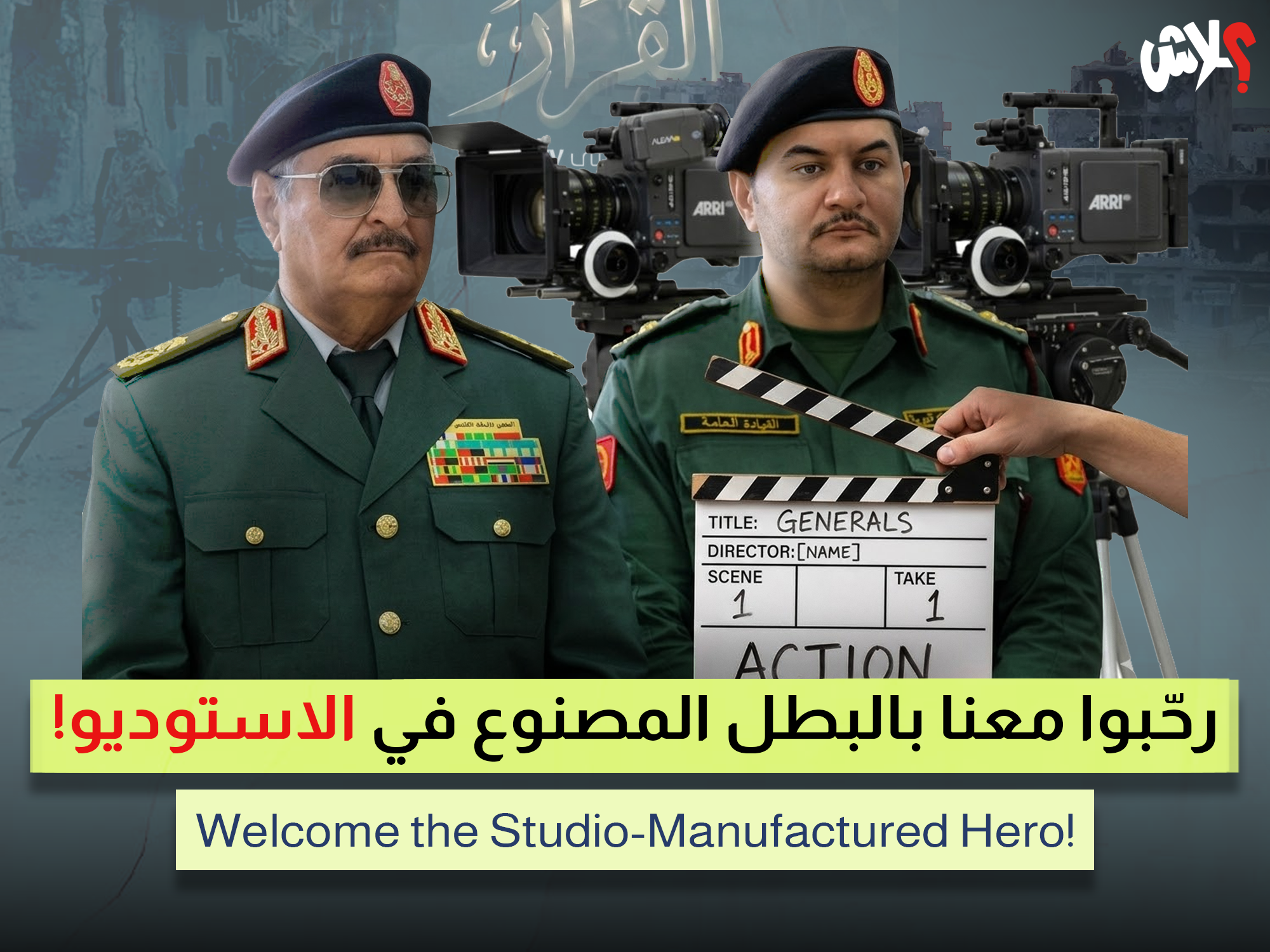
Welcome the Hero Manufactured in the Studio!
The renowned British writer George Orwell once said: Who controls the past controls the future. Who controls the present controls the past. It seems this quote has become the only instruction manual studied by modern tyrants. Today in Libya, a new chapter in the manipulation of collective memory is unfolding on television through a series titled The Decision. In reality, however, it is not an artistic decision at all, but a military, political, and strategic operation disguised as a high-quality drama, designed to sell us a paper hero a savior descending from a world of illusion.
The series, which seeks to market the heroism of Khalifa Haftar in the fight against terrorism, is nothing more than a clumsy imitation and a pale carbon copy of the Egyptian series The Choice. Tyrants have always exchanged methods of repression; today, they exchange actors, directors, and scripts to recycle the image of the inspired leader, without whom, they claim, the wolves of terrorism would have devoured us.
The irony is that The Decision attempts to create an alternative reality, one that leaps over the remains of victims and the sacrifices of genuine heroes, while conveniently forgetting that the terrorism it claims to have fought was, at times, used as a pretext to legitimize overturning the civilian political process and destroying entire cities over the heads of their inhabitants.
Governments and military regimes often exploit art and drama to paint crude stereotypes: absolute good is embodied by the military uniform and strict commands, while absolute evil is represented by anyone who dares refuse submission, dares to say No, or even simply demands a state governed by law and institutions.
The Decision goes even further by insulting local society, particularly in eastern Libya, portraying it as weak and helpless, waiting for a savior to break its chains, waiting for a superhero to rescue its daughters from captivity, while ignoring the fact that ordinary Libyans confronted terrorism with their own bare chests long before the issue became a series of political, military, and family bargains.
These fabricated narratives represent a desperate attempt to appropriate documented truth. A director may succeed in controlling the lighting and camera angles, an actor may convincingly imitate powerful emotions, and a screenwriter may produce a coherent and believable script, but they will inevitably fail to beautify an ugly reality, illuminate the darkness of prisons, or soften the horror of mass graves. They seek to convince us that this imaginary savior is our unavoidable destiny, and that modern Libyan history began only when this hero mounted a tank to teach us how to live in safety as though we were merely a flock of sheep surrounded by wolves, with no salvation except through the shepherd and his staff.
In the past, victors wrote history with ink made from the blood of the defeated. They could erase entire cities from memory, wipe out ancient civilizations, deny the humanity of their enemies, and present themselves as heroic saviors bearing the banner of absolute good. Today, however, we live in the age of live broadcasting an age of Facebook, YouTube, and their countless counterparts. It is an era in which falsified school textbooks and television dramas financed from looted public wealth can no longer completely wash people's minds or manufacture a single collective consciousness accepted by everyone.
The tyrant's narrative may cloud people's vision for a while. It may conceal the truth for a moment. It may even polish the image of The Decision in the eyes of the sycophants who applaud and profit from it. But truth cannot be erased through editing. Every stray bullet, every demolished home, every abducted activist, and every body discovered in a garbage dump has been permanently recorded in the memories of this country's victims. No cinematic scene, no mournful soundtrack, can erase those memories or manufacture false emotions strong enough to replace them.
Attempting to manufacture an alternative truth through drama is, in itself, an admission of failure in the real world. Had the savior truly been a savior, he would not have needed millions of dollars to repair his damaged image. Meanwhile, the documented truth recorded in sound and image, written in the blood of victims and the sacrifices of forgotten heroes who receive no tribute in propaganda dramas will remain the final reference.
The tyrant's narratives are not eternal. They die with him, disappear after his departure, and his television productions become little more than media junk at best, objects of ridicule. But the blood of innocents and the sacrifices of ordinary people, who were used as fuel for these manufactured victories, will endure. They will live on in the conscience of Libyans. Modern Libyan history will not be written by an obscure actor in a state-sponsored television series, but by the awareness of a people who have grown weary of war merchants and accidental saviors.
In conclusion, perhaps those behind this production should realize that the Libyan people who lived for forty years under the slogans of the International Leader and the King of Kings of Africa have developed a natural immunity to dramatic idols and manufactured gods. Heroism is not created inside television studios. It is forged in the arenas of justice and in building a state that respects human dignity not one that reduces human beings to mere extras in a drama glorifying a single individual.