
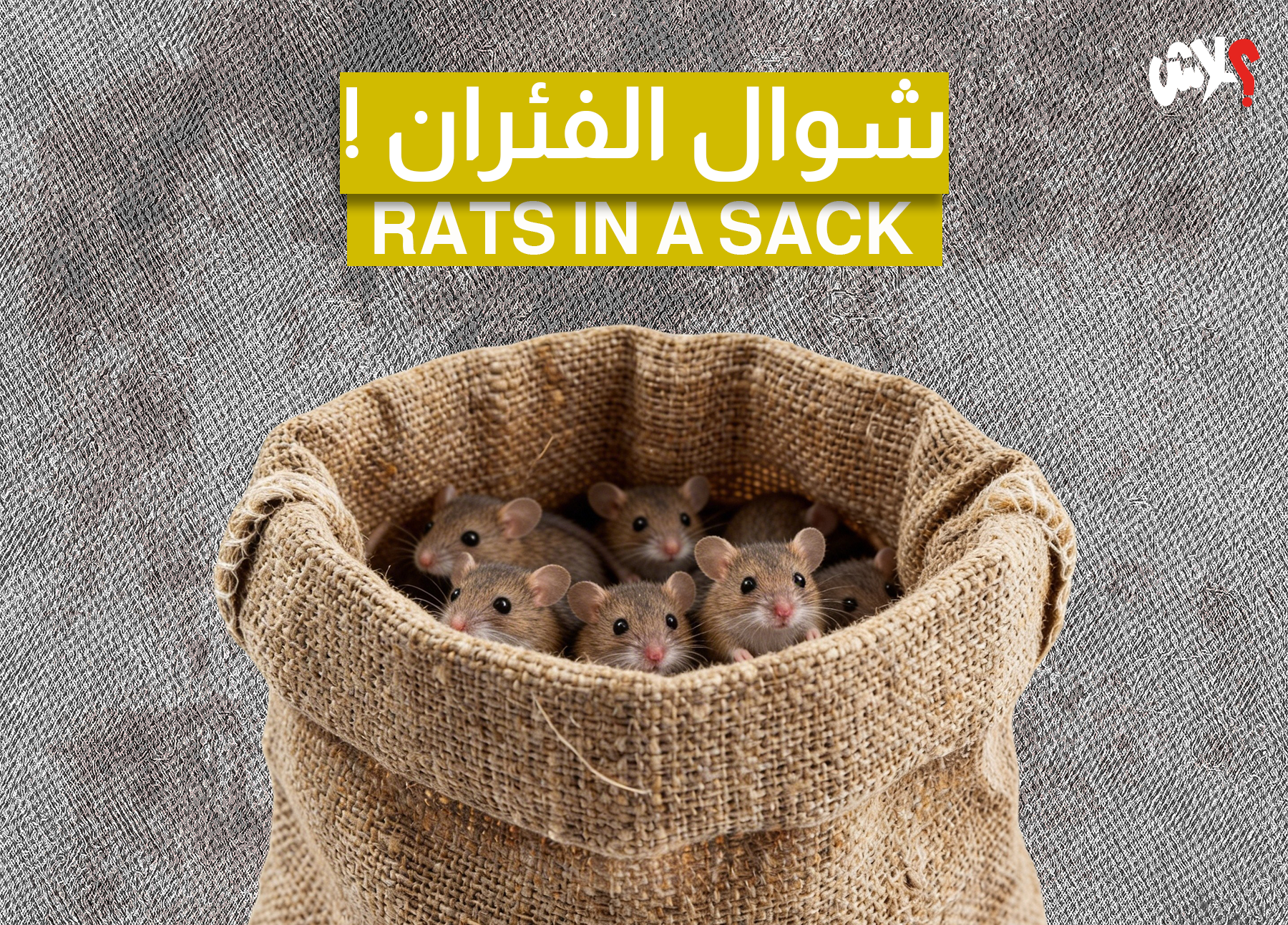
The Sack of Rats!
There is an old political joke that people used to tell. It says that a man once asked a tyrannical ruler: How do you keep an entire people under your control? How do you convince them of your strength and their weakness despite their actual strength and your own weakness? How do they never rise against you, even though you yourself claim to have overthrown those who came before you?
The ruler's answer was practical rather than verbal. According to the joke, he asked for a large (sack) filled with rats and said to the man: Can you keep the rats inside this (sack) so that they never escape, even though even the weakest among them is capable of gnawing through it?
The man replied that he could not, and that such a thing was impossible.
The ruler then gave him a practical lesson in taming the populace and keeping them exactly where the tyrant wants them.
Whenever things became calm inside the (sack), the rats would begin thinking about escaping. So the ruler would shake the (sack) violently. Each rat would become preoccupied with its own survival, struggling to remain upright amid the chaos, and the best solution would be to cling with all its strength to the (sack) which was, in reality, the very prison from which it should have been trying to escape.
The tyrant's simplest survival mechanism is to convince the people that he is indispensable to their survival. This can only be achieved by ensuring that there is always an enemy even more brutal and terrifying than he is, leaving the people to choose what they perceive as the lesser of two evils: accepting the tyrant's rule because, to them, it seems preferable to the chaos the coming enemy would supposedly unleash.
Stability is the greatest enemy of tyranny. If people were to experience genuine stability, they would open their eyes to their reality and begin asking: Why this ruler? Why this domination? Why all this oppression? They would realize that the tyrant is not essential to their lives, but rather a burden upon them.
That is why the tyrant constantly manufactures enemies. He creates them out of nothing, inflates their image, exaggerates their danger, transforms them into monsters threatening the very existence of society, and then presents himself as the heroic savior. The people forget that he was the one who created them in the first place or, at the very least, the one who exploited their existence to the fullest.
We have learned this lesson over decades. Muammar Gaddafi ruled us for more than forty years, yet Libya never experienced genuine stability during his reign. Reactionary forces threatened us from one direction, global imperialism lurked from another, American hegemony sought to seize our wealth, and international Zionism was forever plotting in the shadows.
The Libyan people remained preoccupied with fighting these imaginary enemies, absorbed in defending the nation against foreign conspiracies, forgetting that they themselves were living inside one enormous (sack). Whenever conditions became somewhat stable, the tyrant would shake it again, causing people to cling to the sack for fear of falling into the chaos supposedly waiting outside.
Gaddafi used to say: I am indispensable. I am the protector of the nation. I stand against colonialism. I distribute the nation's wealth. I safeguard its identity. My existence is a necessity, and if I disappear, nothing but ruin will follow. People believed him, became afraid, and clung to the sack. They remained attached to it for forty years before realizing that their prison had existed in their minds—not in the Colonel's sack.
Today, the same mechanism is repeating itself, only with new faces and new enemies. Those seeking authoritarian rule now possess a ready-made list of adversaries: religious extremism, terrorism, the Muslim Brotherhood, and anyone who opposes their rule is simply placed into one of these categories, becoming an enemy who must be fought, making the tyrant appear indispensable.
So he says: I protect you from terrorists who will slaughter you in your homes. I protect you from extremists who will destroy your country. I protect you from the Muslim Brotherhood, who seek to impose their guardianship over you. I am indispensable. If I disappear, the streets will be filled with corpses. People follow him, become afraid, and cling to his sack, without noticing that this very tyrant was the one who once opened the country's doors to mercenaries, exploited terrorism, magnified it, paved the way for it, and forged alliances with those he now calls enemies. As for the corpses he warns will fill the streets—they already have, but they belonged to his opponents.
None of that matters. What matters is that fear exists, and fear is tyranny's primary fuel.
The tyrant wants frightened masses who do not think; masses preoccupied with fighting imaginary enemies; masses clinging to the sack without ever asking why they are inside it in the first place.
Reasonable people, however, want the people to raise their heads, to look around them, and to realize that the sack is nothing more than an old piece of cloth that even the weakest rat can gnaw through and escape to freedom. The problem is that the rats remain too frightened of the monsters they believe await outside the sack, never realizing that those monsters were created by the very one shaking the sack.
In Libya today, military displays dominate the headlines. Power is showcased on every occasion. Terrorism is fought in the name of security and stability. The ordinary citizen fears the return of ISIS, fears new bombings, fears the chaos endured for so many years, and therefore accepts the sack, accepting the rule of the one who keeps shaking it, because he believes the alternative would be worse.
Tyranny is built upon the lie of an imminent danger, the lie of the lurking enemy, the lie of urgent necessity. The moment people discover that these are merely lies that the enemies are not nearly as powerful as portrayed, and that the tyrant is not indispensable but rather the greatest burden everything collapses. But this realization only comes through stability, and the tyrant despises stability because it opens people's minds to change. It shows them that life is possible without a tyrant; that days can pass without tanks in the streets; that schools and hospitals can replace military convoys; that children can go to school without fear; and that people can go to work without waiting for the ruler to tell them how to think.
Stability reveals to people that the tyrant is an unnecessary burden. That is why he constantly shakes the sack, creates crises, invents enemies, and manufactures fears, keeping people occupied with their own survival instead of thinking about him.
In the end, the sack is just a sack, and the rats are stronger than they imagine. Even the weakest rat can gnaw through the cloth and escape. But first, it must believe that the outside is not so terrifying, that the enemies are not nearly as powerful as claimed, and that the tyrant is merely another rat who seized control of the sack and convinced everyone that he was its protector.
Do not believe the tyrant's narrative, and do not fear his imaginary enemies. Your true stability begins the moment you realize that you do not need someone to keep shaking the sack in order to keep you inside it. Escape is possible, and freedom is closer than you think.