
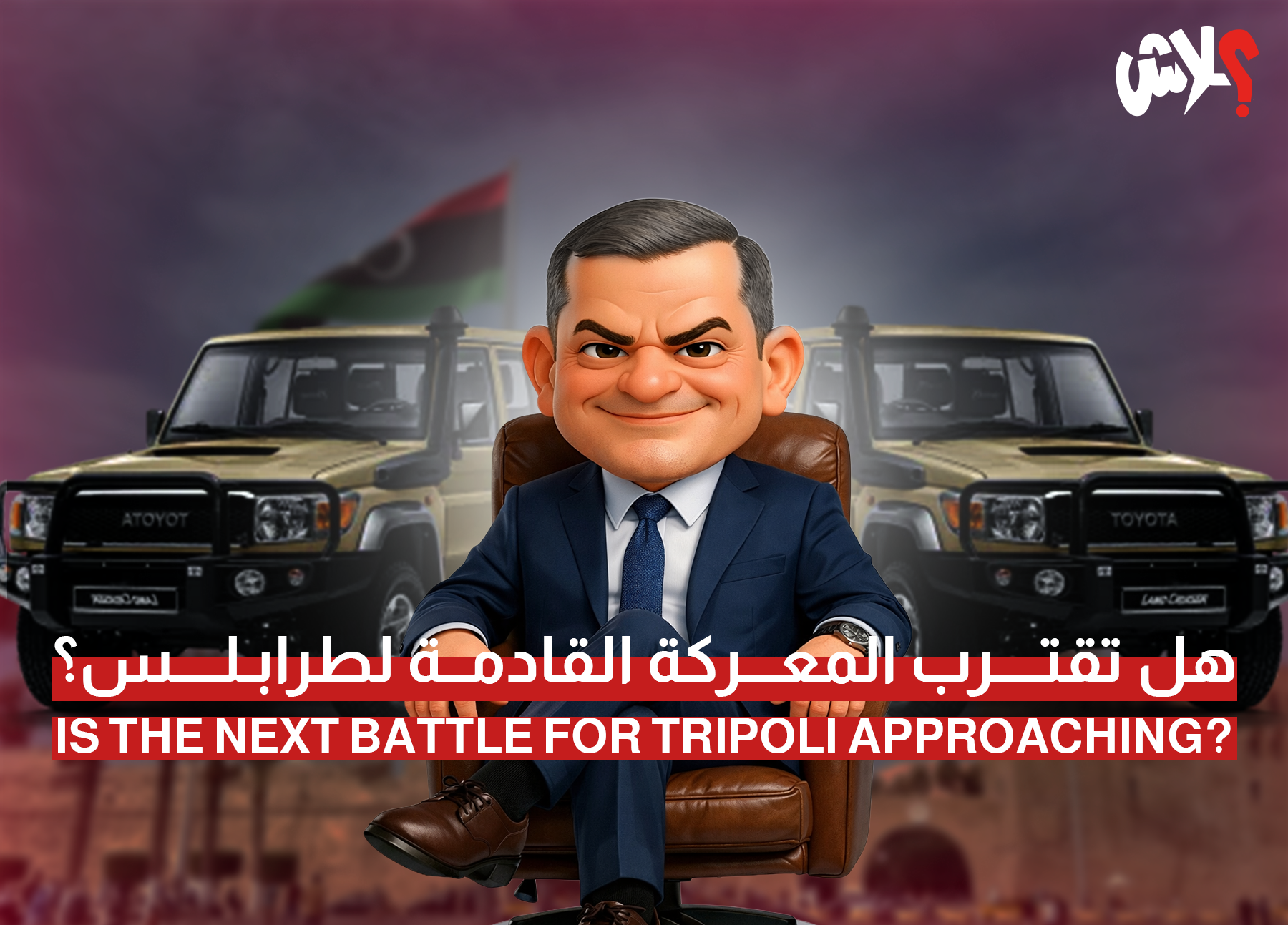
Is Tripoli Approaching Its Next Battle?
In Libya, major transformations rarely begin with the sound of gunfire. They usually begin with group photographs, quiet meetings, and handshakes published in the news. On the surface, these images appear to be ordinary scenes of political work, but in reality they often mark the beginning of an entirely different phase. For years, politics in this country has not moved only inside meeting rooms; it has also moved across the maps of power drawn by armed formations on the ground.
Over the past few days, Abdul Hamid Dbeibeh, Prime Minister of the Government of National Unity, held a series of meetings with a number of armed groups in western Libya. It was particularly notable that the city of Zawiya featured prominently in these meetings, with the leaders of nearly all the armed formations that had opposed the government over recent years attending the Ramadan gathering. It appears that a very broad understanding has been reached among them.
It was also evident, according to some observers, that the Deputy Minister of Defense and commander of the 111th Brigade, Al-Zoubi, played a significant role in bringing these parties together. What raises even more questions is that all of these commanders had previously sided with the Special Deterrence Force during its confrontation with Government of National Unity forces several months ago. Their advance toward the capital to break the siege on the Deterrence Force was a decisive factor in allowing it to remain intact and in frustrating the government's military moves.
This was followed by a meeting with figures from Warshafana, including Muammar Al-Dhawi, adding another layer to this quietly evolving picture. On the surface, these meetings may appear to be part of managing relations with influential actors on the ground—a policy successive Libyan governments have pursued for years. However, the breadth of these meetings and their timing raise questions that go beyond simple security coordination or political courtesy.
Zawiya and Warshafana are not merely neighboring areas of Tripoli; they represent two critical nodes within the network of armed power in western Libya. Zawiya is considered one of the region's most significant armed strongholds, while Warshafana occupies a strategically sensitive position overlooking the southwestern approaches to the capital. When the political leadership simultaneously reaches out to both areas, the matter extends beyond protocol meetings and begins to resemble an effort to construct a broader network of influence around Tripoli.
For years, the Libyan capital itself has existed under a fragile balance among several armed groups. This balance has never represented genuine stability as much as it has reflected a carefully managed conflict, with each force remaining within its own sphere so long as the balance of deterrence remained relatively equal. Over time, this situation evolved into something resembling a prolonged truce among forces fully aware that any disruption of this balance could open the door to a large-scale confrontation inside the city.
At the center of this equation stands the Special Deterrence Force, which has become one of the most influential security actors in Tripoli over recent years. Its role extends far beyond that of a conventional security force; it has become an integral component of the capital's balance of power. Consequently, any attempt to restructure Tripoli's security landscape cannot realistically proceed without addressing this force either by incorporating it into a new framework or by reducing its influence within the city.
Viewed from this perspective, the recent meetings appear to be part of a broader effort to reshape the balance of power around Tripoli. Building a network of relationships with influential actors in Zawiya and Warshafana could create a political and military support belt surrounding the capital one that may prove decisive should the authorities decide to move forward with reorganizing the city's security architecture.
The Special Deterrence Force, which has taken a clear stance against the Government of Return to Life, is unlikely to remain detached from these developments. Many observers believe that these arrangements are laying the groundwork for another attempt to dismantle the force's influence inside Tripoli.
Should such a scenario unfold, it would mirror the government's earlier strategy when it dismantled the Stability Support Apparatus by killing Ghniwa Al-Kikli and effectively ending his organization's power. At that time, the stated objective was to reassert governmental control over Tripoli's security environment and bring all armed formations under state authority.
Today, the government needs to demonstrate to both domestic and international audiences that it exercises effective control over all of western Libya. Such a position would strengthen its leverage in negotiations over proposals to establish a unified government between eastern and western Libya a process that the U.S. President Trump's envoy is reportedly seeking to advance in the coming period.
Our recent history has taught us that major transformations in Libya have often unfolded only beneath the sound of gunfire. We certainly do not wish for that outcome. Rather, this is an attempt to anticipate what may lie ahead, because ordinary citizens walking the streets of Tripoli and Libya are usually the ones who ultimately bear the cost. And since we are almost always the ones who pay the bill, we have, at the very least, the right to ask how high it might be.