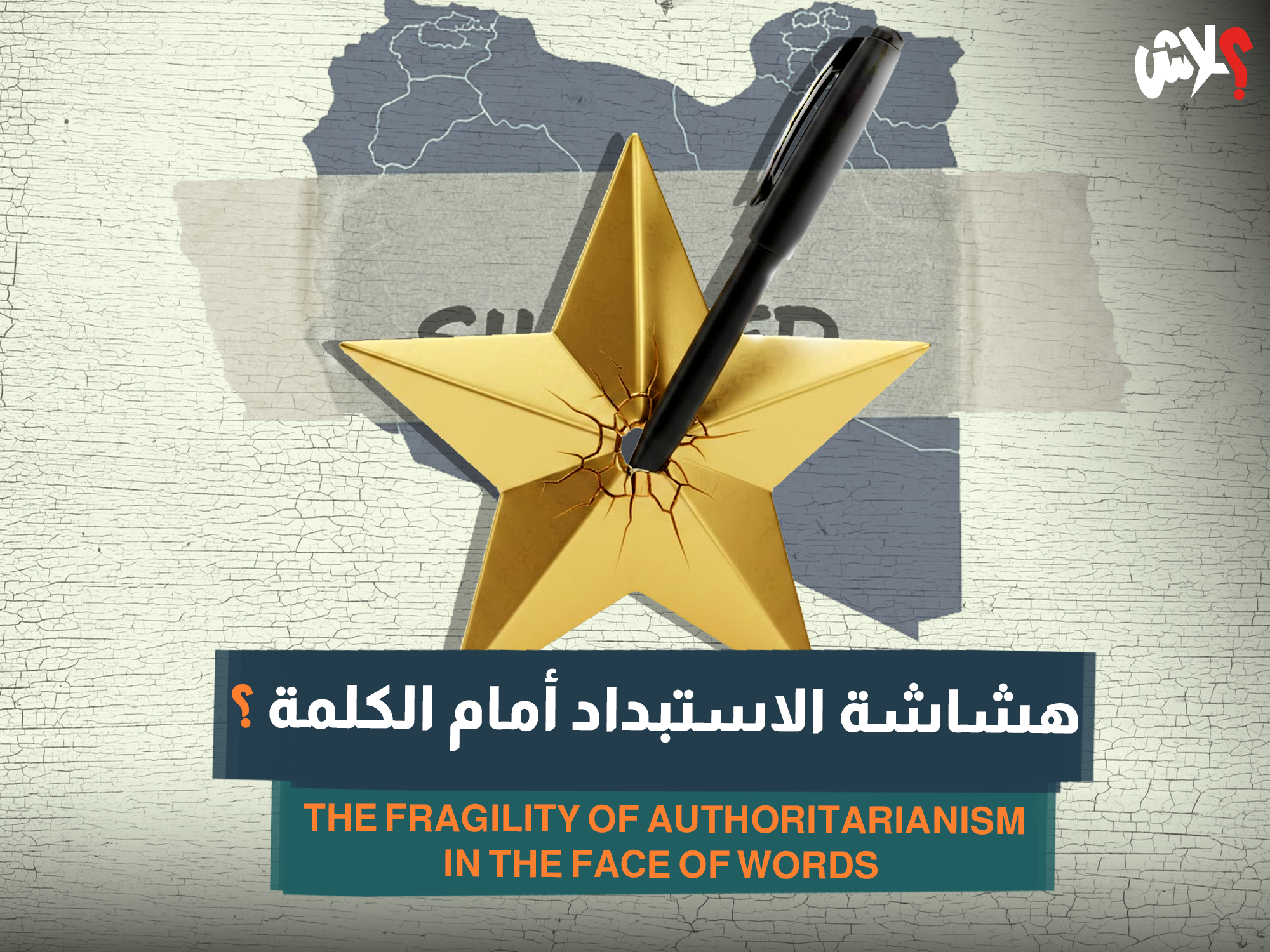
The Fragility of Tyranny Before the Power of Words
No matter how hard a tyrant tries to present himself as strong and in control, he is, in reality, weak and fragile. What truly unsettles him most is the word the simplest weapon ordinary people possess against him.
A tyrant fears words more than bullets. A bullet can be met with the full force of his military arsenal, but a word has the power to undermine his authority by dismantling the narrative upon which his rule depends.
As Václav Havel, the last President of Czechoslovakia before its dissolution, once said: The power of the powerless lies in their ability to speak the truth and live in truth, even under the harshest oppressive regimes. A totalitarian system is built upon lies, and when a single individual refuses to live within those lies, he strikes the system at its very core.
This is precisely what is happening in Libya today. Authoritarian regimes derive their legitimacy from a grand falsehood. That is why the simplest form of resistance speaking the truth becomes a deadly weapon in their eyes, because it exposes their fragility.
Authoritarian systems construct themselves upon absolute seriousness and manufactured prestige, symbolized by medals, military ranks, portraits lining the streets, military parades, poetry festivals, and grandiose speeches. Through this carefully orchestrated spectacle, they demand unquestioning obedience while presenting themselves as beyond criticism. Here lies the true danger of words and satire: they shatter the illusion of power. A clever joke breaks the barrier of fear, strips the tyrant of his carefully crafted image, reminds people that rulers are ordinary human beings capable of error, and robs them of the aura of sanctity that protects them.
Satire also creates hidden solidarity. When people laugh together at a political joke in a private gathering, they share an unspoken understanding: We all recognize the absurdity of this regime. That shared laughter creates a psychological space in which people begin to free themselves from the regime's intellectual domination.
Satire cultivates critical awareness. It broadens people's perspectives, encourages them to question reality, and teaches them not to accept official narratives as unquestionable truth. It nurtures skepticism and independent thought. Thus, a dictatorship that believes itself powerful because of its army and security services suddenly discovers that it is defenseless before a joke spreading like wildfire, or before a truthful word spoken to a tyrant. That is the deeper meaning behind the tyrant's vulnerability before words.
What recently happened to actor Faraj Abdul Karim, followed one day later by poet Faiz Al-Arfi, and to the creators of the television series Khallik Min Al-Kalam, whose show was suspended and whose producers from Ajdabiya were pursued, reveals only one thing: the weakness, insecurity, and fragility of authority.
The imprisonment and persecution of those whose only weapon is the word is nothing new in Libya, and what has happened in recent days is neither isolated nor likely to be the last such episode.
Faraj Abdul Karim was among the earliest supporters of the Commander-in-Chief and his sons, publicly endorsing all of their military campaigns, including the offensive against Tripoli. Yet none of that protected him when his comedy series despite having no apparent intention of insulting the authorities used satire. He was imprisoned, his series was suspended, pressure mounted against him, and he ultimately announced his permanent retirement from acting.
The real paradox is not simply Faraj Abdul Karim's imprisonment, but that an authority many perceive as powerful because of its military and security apparatus has demonstrated that it cannot tolerate even a joke from one of its own supporters.
The authorities are sending a clear message: even their supporters are not safe. If you utter words they dislike, prison awaits you. If you laugh at something they forbid, prison awaits you. If you dare imagine that they are human beings like everyone else, prison awaits you. This is not strength. It is weakness.
True strength tolerates criticism. It tolerates satire. It is capable of seeing itself reflected in the mirror of honest words, even when those words are critical. Only the weak fear a joke, a line of poetry, or a theatrical scene.
The authoritarian narrative is built upon deception, exaggeration, and the inflation of the ruler's image. Honest words dismantle that fragile narrative. Satire strips the regime of its manufactured prestige, bringing it down from the realm of sanctity and glorification into the realm of ordinary human weakness, diminishing it in the eyes of people who obey the tyrant only because they once believed his narrative.
What is happening in Libya today is not new, but it reminds us of an important truth: no matter how long a tyrant remains in power, and no matter how much force he commands, he remains vulnerable before words. Words do not die in prison. Prisons may fill with writers, artists, and poets, but words slip beneath prison doors, pass through windows, and spread among people like wildfire.
Faraj Abdul Karim never intended to insult the authorities through his television series. He merely exercised his natural right to satirize reality, only to discover that reality cannot tolerate even an innocent joke. That is not the strength of authority it is its greatest weakness.
The authoritarian narrative rests upon lies. Honest words dismantle that fragile narrative, while satire strips the regime of its sacred aura and returns it to the level of ordinary human weakness. That is the most powerful weapon against tyranny. Do not believe the tyrant's narrative. Laugh at it. To the tyrant, that is far more dangerous than bullets.
Bullets are confronted by armies, but words have no shield against them. A bullet kills one body; a word awakens countless souls. A bullet fades away; a word endures forever. In Libya today, some believe that imprisonment, censorship, and persecution can silence words. They are mistaken.
The word imprisoned today returns tomorrow stronger.
The word banned today spreads even farther the day after.
The word the tyrant fears today is the word that will bring him down tomorrow.
This is not rhetoric.
It is one of history's enduring lessons.