
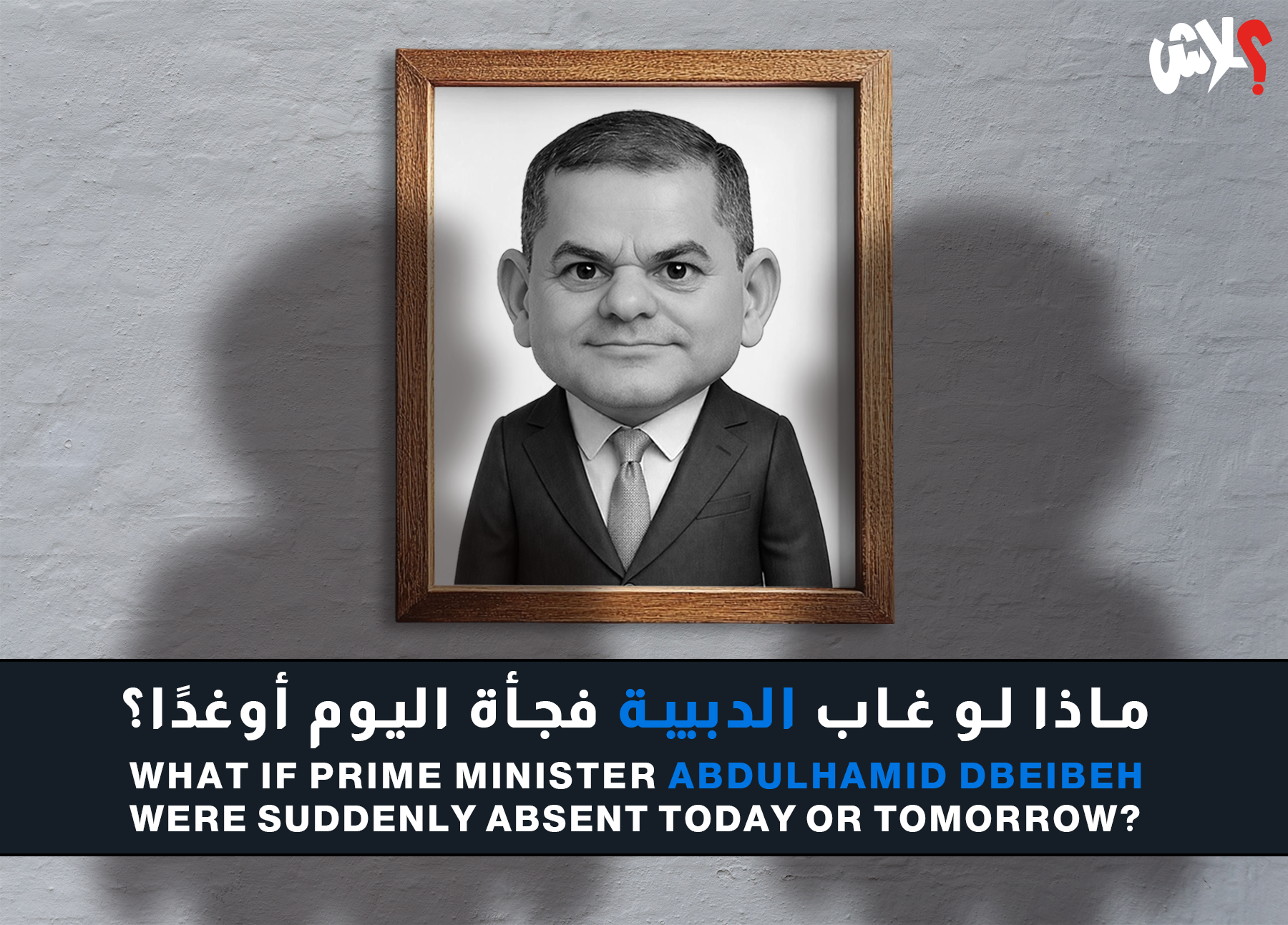
What If Dbeibah Suddenly Disappeared Today or Tomorrow?
Our society has long been accustomed to discussing its most consequential issues with an overwhelming dose of emotion. Gossip often comes closer than reason to describing how we debate the major turning points in our collective destiny. On this land, every development is either explained through grand conspiracies, or reduced to such simplistic analysis that it becomes almost impossible to understand.
As we have said before, we do not claim to possess the keys to the truth. We simply offer an analysis that we believe is careful, free from emotion, and grounded, as much as possible, in the realities on the ground.
Abdul Hamid Dbeibah heads the Government of National Unity under the Geneva Agreement. If he were suddenly to disappear, the government itself would effectively collapse, given the absence of functioning deputies the first has disappeared from the political scene, while the second is imprisoned on corruption charges.
Accordingly, the more logical question becomes: what would happen to the executive authority if he were suddenly gone?
Many observers believe that such a scenario would significantly strengthen the role of the Presidential Council, particularly its chairman, Mohamed al-Menfi, who enjoys a relatively broad level of acceptance in Tripoli and across western Libya, especially among the armed groups (titles acknowledged).
His position became particularly evident during the recent confrontation between the government and the Special Deterrence Force, when he opposed efforts to dismantle the force and instead favored de-escalation and preventing armed conflict. Likewise, following the killing of Abdul Ghani al-Kikli at Takbali Camp, he refused to dissolve the Stability Support Apparatus, despite considerable pressure to do so.
Instead, he effectively revived the organization by appointing one of Zawiya's influential figures (al-Zraybat) to lead it a figure whose family enjoys significant influence in the city. Al-Menfi also maintains close ties with Salah al-Namroush, who has become Chief of Staff of the Libyan Army in western Libya and appears likely to remain in that position.
At the same time, Al-Menfi enjoys a strong relationship with Osama al-Juwaili, the dominant military figure in Zintan, whose influence extends across a vast stretch of western Libya from the outskirts of Warshefana to the Libyan-Tunisian border near the Dhehiba crossing, and southward toward Ghadames.
These important political and military connections could place Al-Menfi in a strong position either to assume the premiership himself or to appoint a new prime minister should anything suddenly happen to the head of the Return to Life government. Under the Geneva Political Agreement, he remains the highest authority within the executive branch, and with the UN Support Mission yet to present a clear vision for Libya's next executive structure, western Libya is unlikely to be left to descend once again into institutional chaos because of a vacuum at the top of government.
Some ask what role the Dbeibah family might play if such a scenario were to occur.
Many analysts believe the family would withdraw from Tripoli and return to Misrata, where it would likely attempt to reorganize politically while opposing whatever role Al-Menfi might assume. However, they are generally seen as lacking the military leverage necessary either to reverse developments or to prevent Al-Menfi from implementing his course of action.
Misrata, in turn, may choose to avoid entering a military confrontation that offers little strategic benefit, so long as its influence inside Tripoli remains intact whether through al-Zoubi or through the force previously established by the Chief of Staff to separate rival factions. Under such circumstances, the city would likely accept the new political reality, while the Dbeibah family would lose any realistic prospect of returning to power.
As for the international community, it would most likely support Al-Menfi during this transitional period. A violent struggle for influence in Tripoli and western Libya would make any rapid political settlement far more difficult, potentially setting Libya back by years and undermining the considerable efforts invested over recent years particularly by European governments to stabilize the Tripoli side of the Mediterranean coast and curb irregular migration, whose pace has declined only during the past few years.
As for the ordinary citizen, he would most likely continue occupying his familiar role as the object rather than the actor, lacking genuine influence over events and simply accepting developments as they unfold around him.
That is why my advice here to the citizen, that is whether the scenario outlined in this article materializes or not, is to keep one eye on the fuel gauge of your car, make sure there is always a can of cooking oil at home, pay close attention to the mobile data on your phone so you do not miss whatever comes next...
...and preserve your sense of humor.
You're going to need it in the days ahead.