
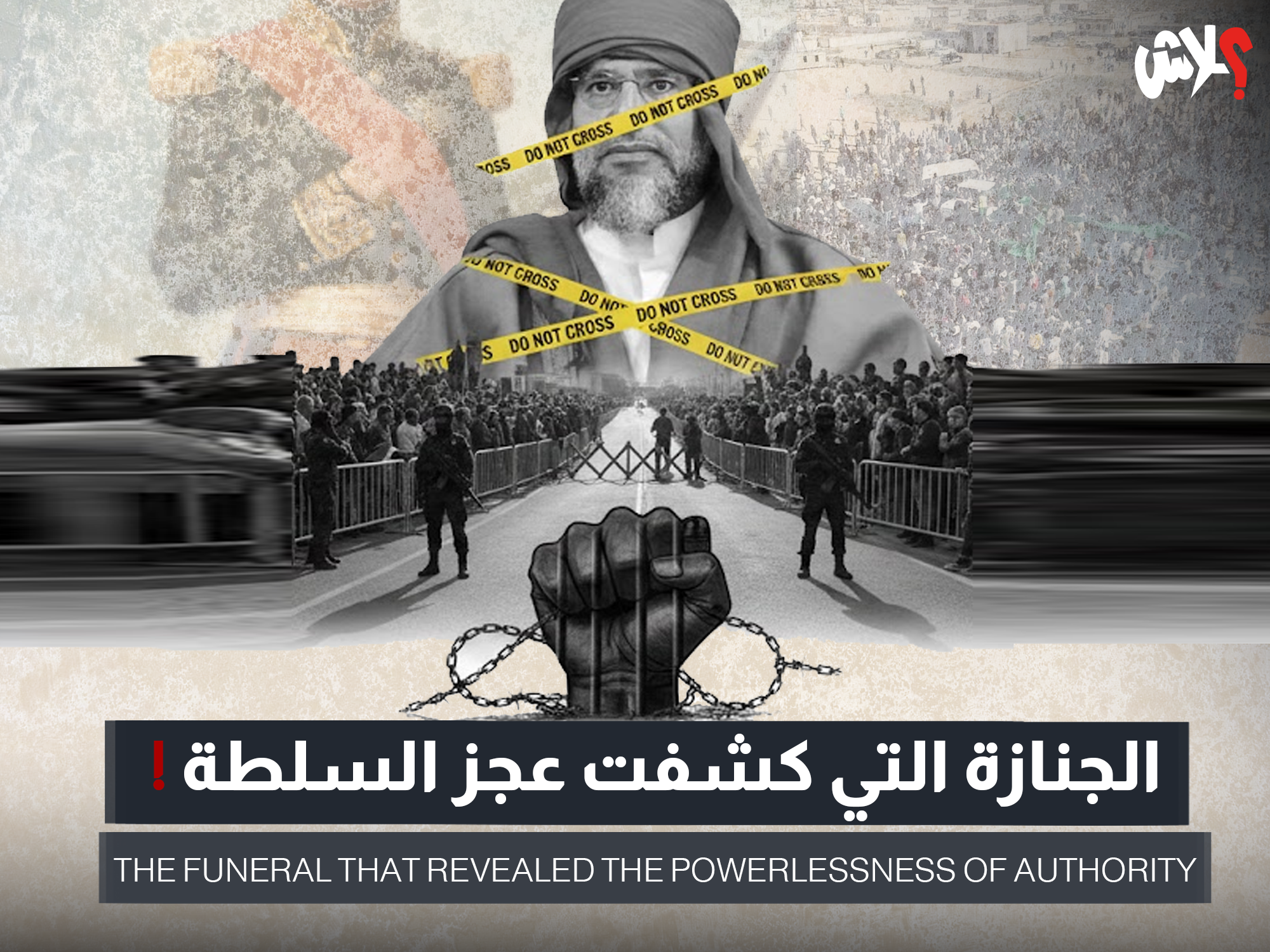
The Funeral That Exposed the State's Helplessness!
On Friday, Saif al-Islam Gaddafi returned to his supporters and to those of his father in Bani Walid. But he did not return as the long-awaited leader destined to rebuild his father's Jamahiriya, a system that had begun to decay long before it collapsed. He did not return as a source of hope or inspiration for generations that mistake illusion for promise. Nor did he return as the man some still feared and others wished would come back. He returned as a body, to be buried in a land that still professes loyalty to his father—a man who left neither there nor elsewhere anything truly deserving of such loyalty. Yet in Libya, even the dead are denied peace. They become pieces in a political game that has never truly ended.
The strict conditions imposed by Khalifa Haftar for holding the funeral in Sirte were not motivated by concerns for security or respect for mourning rituals. Rather, they were an explicit declaration of absolute control a message that everything, even the burial of a symbol of the former regime, must pass through his gate and bear his imprint. He alone grants permission, and he alone imposes restrictions. In the world of the Marshal, authority is measured through such seemingly minor details. Whoever controls the rituals of death proves himself master of life within that bleak geography.
On the other side, the approval issued by the Government of Tripoli resembled little more than a disguised surrender. It amounted to accepting what it had no practical ability to prevent. The area receiving the body lies, in reality, outside the government's effective control, and any attempt to impose its authority would only have reopened old wounds while exposing the fragility of its claims to sovereignty. So it chose instead to appear magnanimous granting permission for something it never truly possessed the power to forbid. It was another exercise in projecting confidence when submission to reality was the only available option. An equally important part of this political performance was to contrast itself with its rival, portraying Haftar's camp as rigid and restrictive while marketing itself as moderate and democratic.
The real paradox, however, lay not in the offices where decisions were made, but in the square that received the funeral procession. The crowd that gathered in Bani Walid spoke an entirely different political language. It did not represent the strength of a living political project for that project had died long ago. Instead, it pointed toward something deeper: the profound failure of its opponents.
Despite his overwhelming military and media dominance in eastern Libya, Khalifa Haftar has failed to mobilize genuine public support. His so-called million-man rallies have repeatedly fallen short, leaving public squares only sparsely occupied—sometimes attracting not even a thousand participants. The Government of Tripoli and the armed factions in western Libya have likewise failed to bring large crowds into the streets under their banners. Even those opposing the Tripoli government have repeatedly failed to mobilize meaningful protests against it. Everyone possesses money, weapons, and organizational resources, yet none possesses the ability to inspire authentic public support that emerges voluntarily rather than through financial incentives or intimidation.
Why do people turn out in large numbers for the funeral of a dead symbol while refusing to attend demonstrations organized by the living authorities who claim to govern and represent them?
The answer is simple: people are no longer deceived by political theater. They have seen million-man marches reduced to mere hundreds. They have watched tents of popular mandate remain empty, swaying in the wind and gradually being buried beneath drifting sand. They have grown weary of speeches promising dignity while failing to provide medicine, electricity, or even a stable and fair exchange rate for a collapsing currency. Today, the authorities in both eastern and western Libya share one defining characteristic: they are capable of repression and exclusion, yet utterly incapable of inspiring confidence or hope.
Regardless of the motives of those who attended, the gathering in Bani Walid delivered a political slap to everyone. It demonstrated that genuine emotions even if rooted in nostalgia for a distorted past or selective attachment to symbolic figures can mobilize people more effectively than all the empty political rhetoric and tired slogans broadcast through official media. Yet the gathering itself should not be exaggerated. Had it truly represented the political force that some imagine, Saif al-Islam would not have spent his final years in hiding, living as a fugitive whose influence stemmed less from his own strength than from the weakness and failures of his opponents.
Saif Gaddafi's funeral does not represent a return to the past for there is little in that past worthy of revival. Rather, it serves as an autopsy of the present. It reflects the complete disconnect between Libya's ruling elites, in all their different forms, and a society exhausted by failure and corruption. Citizens now find their pockets filled with officially sanctioned worthless banknotes that can no longer provide the life they deserve. Left with little else, many retreat into selective memory, recalling a time when they returned home carrying their subsidized cooperative groceries, having spent less than what a single meal costs today.
For Saif al-Islam's supporters, the turnout in Bani Walid was smaller than they had hoped. Yet for those currently in power, it represented a resounding political rebuke. It exposed a painful truth they continue to ignore: despite controlling institutions, weapons, and resources, they remain unable to understand why no one is willing to mobilize on their behalf.
In the end, the body was buried and another chapter closed. Yet the lesson it left behind remains very much alive. Real authority is not measured solely by control over airports, ports, or central banks. It is measured by the voluntary trust and confidence of the people. That is the one resource every major political actor in Libya appears to have exhausted completely. Neither the Marshal in the east nor the authorities in the west possess it. Neither Muammar Gaddafi nor his son truly possessed it either. Yet the failures of those who followed have created the illusion that they once did. Saif al-Islam Gaddafi is gone, and so is his political project. But the crowd that accompanied him to his grave delivered a painful message to those still alive: their own political end is drawing near and when their time comes, no one will mourn them.