
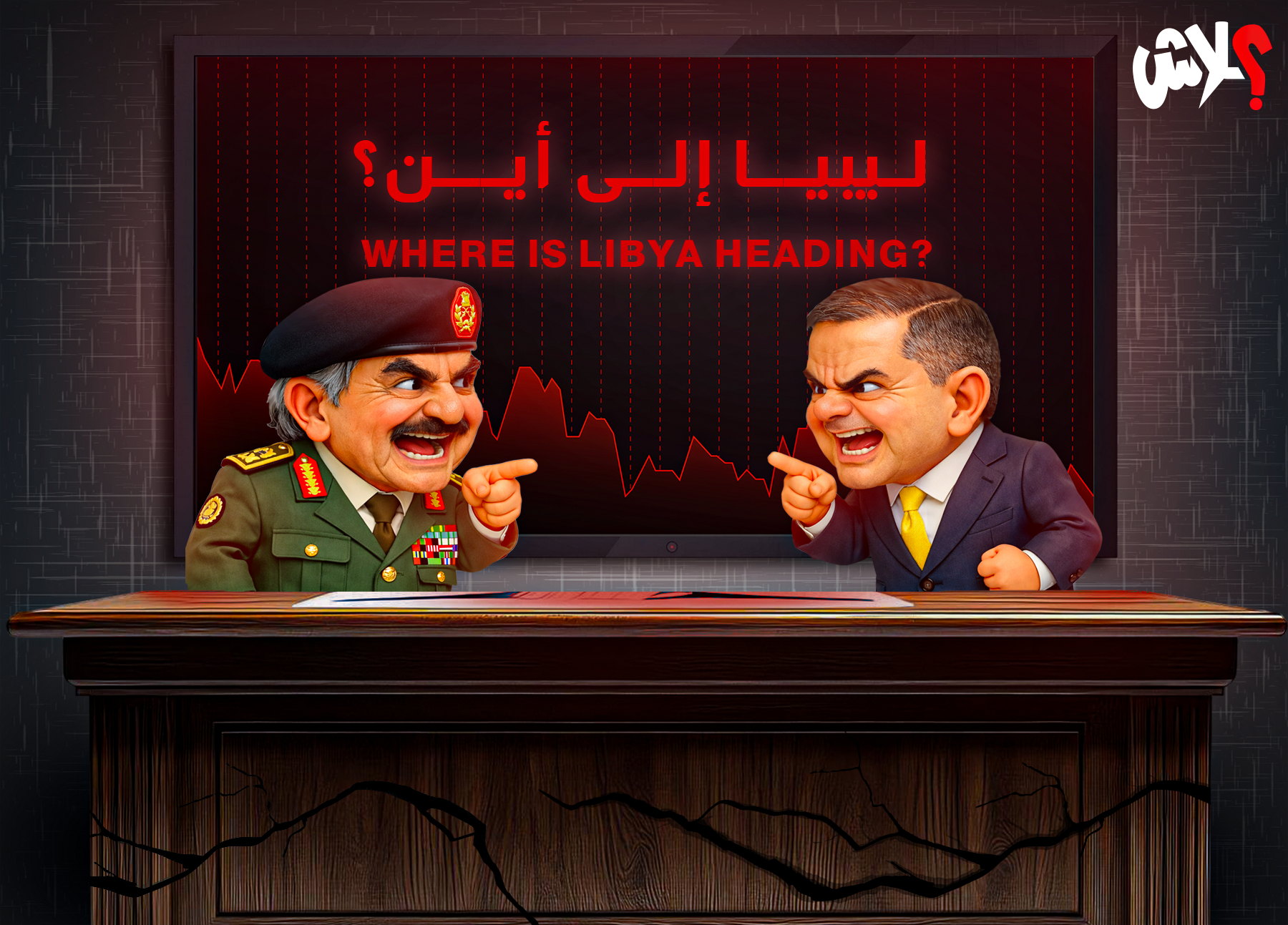
Where Is Libya Headed?
Whenever I try to picture Libya in my mind, one image inevitably comes to me: a starving cow being milked from the east and milked again from the west. Frail and emaciated, she no longer produces enough milk to feed even her own hungry owners, yet the hands of the milkers never stop. The weaker and more exhausted she becomes, the more stimulants they inject into her stimulants that only make her even weaker before returning once again to milk her dry udder.
The abnormal expansion of public spending has not stopped over the past twelve years. On the contrary, it has grown worse, larger, and more deeply entrenched. Today, as the country stands on the edge of an economic abyss, the currency continues to bleed, savings are evaporating, and thousands of families are joining the long queue of poverty, while the rulers in both the east and the west continue competing over who can squander more under the banner of reconstruction. Frankly, I care little about who started it; what matters is that both continue to do it.
Only weeks ago, the House of Representatives passed legislation recognizing all the debts accumulated over the years by parallel governments through borrowing billions from domestic banks debts incurred without oversight, without transparent contracts, without tangible results, and without accountability.
The decision instructs the Central Bank of Libya and the National Oil Corporation to deduct a portion of oil revenues to repay those debts. In simple terms, they are telling us the Libyan people that we will repay the price of their corruption in installments, sacrificing our hopes and livelihoods in the process.
At the same time, Parliament insisted on allocating 69 billion Libyan dinars over a three-year period to the Development and Reconstruction Fund, headed by Belqasim, the son of Khalifa Haftar. This is the same fund that has already spent billions on projects, some of which failed their very first real test: bridges developing structural defects, roads and streets submerged after the heaviest rainfall the country has witnessed in years. Yet despite all this, they insist on pressing ahead.
It is as though Libya were enjoying an era of prosperity, with nothing left to do except spend billions every year on projects that are either failures or surrounded by serious suspicion.
This alarming reality leaves us with unavoidable questions.
First: How much longer?
How much longer will Libyans endure crushing poverty, a dollar that devours their savings, and rulers chasing the illusion of absolute control?
Can this immense accumulation of public anger eventually erupt into a popular uprising that sweeps away these exhausted institutions, which have long since lost even the legitimacy to claim legitimacy?
The era of revolutions, as we once knew it, has passed. February 17 was an exceptional moment, shaped by a unique convergence of local, regional, and international circumstances that are unlikely to be repeated. Today's Libyan street is exhausted, consumed by the daily struggle for survival, and trapped by a justified fear of authorities that treat even peaceful protest as rebellion deserving extraordinary repression.
The second question: Where are we headed?
Will the two ruling camps in eastern and western Libya eventually abandon their illusion of controlling the entire country and instead accept partition as a compromise that guarantees each side its own resources and sphere of influence?
Should that happen, an entirely new conflict would begin. Where would the borders be drawn? Who would control the Oil Crescent and its ports? Who truly owns the Oil Crescent? Who would inherit the commercial importance of the eastern and western ports? And who would control the Great Man-Made River?
An agreement to partition Libya might bring one chapter to a close, but it would almost certainly mark the beginning of new wars this time fought over maps, resources, and geography.
There is nothing more dangerous than a partition left unfinished.
The third question: Is there any glimmer of hope? Is there any light at the end of the tunnel?
The recent Paris understandings between representatives of the Dbeibah camp and the Haftar camp may inspire cautious optimism among those still capable of hope. These were closed-door meetings held at the Élysée Palace, away from television cameras and mutual accusations. Both sides sat around the same cake called Libya, seeking a settlement acceptable to themselves—though not necessarily acceptable to the Libyan people.
Could these discussions produce agreement on a minimum political settlement? Could they pave the way for elections capable of restoring legitimacy and launching a new phase?
Remarkably, these secret meetings took place only days before the death of Saif al-Islam Gaddafi under mysterious circumstances. To both eastern and western camps, he represented a genuine threat in any credible election. Regardless of one's opinion of him, he possessed a significant popular base, the symbolic weight of his family name, and tribal support stretching from Libya's far east to its far west.
With his disappearance, that shared threat diminished. The two camps suddenly found themselves closer to reaching an understanding over how to divide what remains of Libya's oil wealth, rather than continuing their struggle over who should control all of it.
The fourth and perhaps most important question: Where do ordinary Libyans fit into all this?
In every one of these scenarios, where does the average Libyan stand? Is he truly part of the equation? Or is he merely another figure in public spending calculations, another taxpayer forced to shoulder public debt, another voter summoned only to legitimize, with electoral ink, a settlement negotiated by those who first stole his political will?
Across all these possibilities, one certainty remains.
The cow is not immortal.
Eventually, she will die not simply because she is starving, but because the milkers have left her with nothing capable of sustaining life. And when she finally collapses, each side will rush to blame the other while escaping with its share of the spoils, disappearing beyond the reach of those crushed beneath the ruins.
The question therefore remains unanswered, waiting for each of us to confront it honestly once we step outside the suffocating logic of political polarization:
Will we wait until the cow collapses upon our heads, or is there still another horizon that we have not yet managed to see?
The answer does not lie in Paris, nor in Rome, nor even in Geneva.
If any answer still exists, it must begin here.