
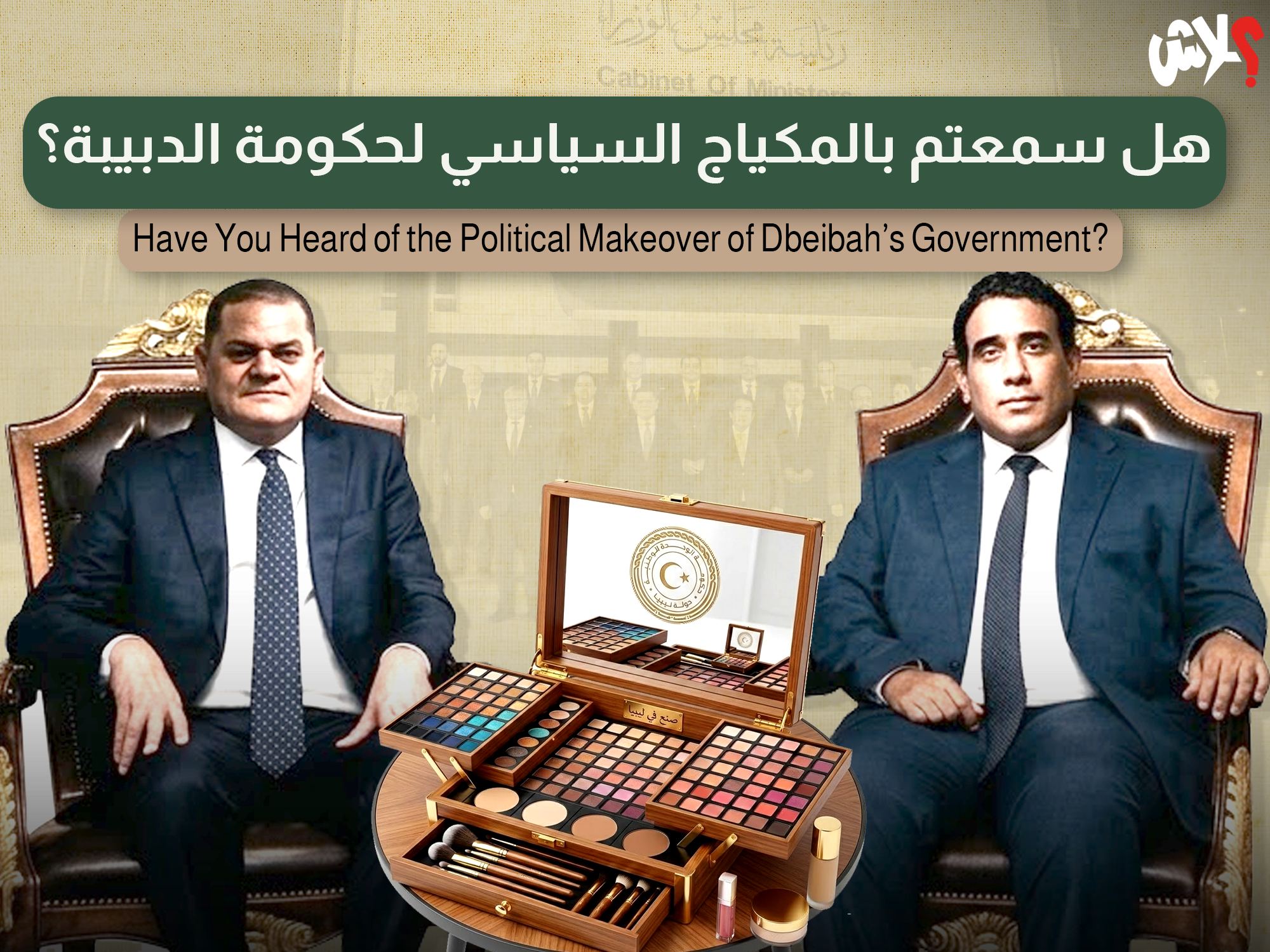
Have You Heard of Dbeibeh's Political Makeover?
In an ambitious speech delivered at the first meeting of his government following the latest cabinet reshuffle, Prime Minister Abdul Hamid Dbeibeh adopted a firm tone in addressing corruption. He declared that there would be no tolerance for corruption or corrupt officials and pledged full cooperation with oversight bodies to combat this scourge. By choosing this particular moment to speak about corruption, Dbeibeh appeared to be seeking legitimacy for his ministerial changes, as though saying: We are sifting through the government, removing the weak and the negligent, and replacing them with strong ministers capable of implementing ambitious reform plans, including a one-hundred-day plan for healthcare reform and another for education.
Yet regardless of how the Prime Minister attempts to justify these changes, they raise questions that neither his speech nor his subsequent statements have answered. The timing of the reshuffle alone invites suspicion, particularly amid growing domestic and international discussions about the need to establish a new executive authority to lead the country toward elections.
Some specialists may welcome the appointment of ministers who are professionals from within their respective fields instead of the outsiders who dominated the previous quota-based cabinet. However, quota-sharing has hardly disappeared from the political scene, and the narrative of technocracy has failed to convince many observers. The prevailing view is that the reshuffle has less to do with renewal than with a carefully calculated effort to rearrange political alliances and buy the government additional time in the face of mounting pressure.
Still, Dbeibeh deserves credit for his political agility in handling these pressures. This became evident when Presidential Council Chairman Mohamed Al-Menfi attended the inaugural session of the newly formed cabinet and publicly endorsed the reshuffle only days after criticizing it and rejecting the unilateral manner in which it had been carried out.
Al-Menfi's earlier objections were quickly seized upon by a dismissed minister, who refused to hand over her duties and reportedly attempted to force her way back into the ministry before being denied entry. It is even said that she still controls the ministry's official social media page and continues issuing statements an episode that reflects the height of administrative absurdity. It is also rumored that Al-Menfi's initial objection stemmed from the exclusion of candidates he had proposed for sovereign ministries. So what changed? Was he ultimately appeased with a side slice of the cake, or did he suddenly become convinced of the competence of the new ministers?
Another development that invites ridicule is the creation of a Ministry of Digital Economy and Artificial Intelligence. It is undoubtedly an ambitious idea, yet one that appears completely detached from Libya's reality. What digital economy are they referring to in a rentier state whose economy depends almost entirely on oil and gas exports? Are they planning to develop smart applications to sell oil online? And what are their plans for artificial intelligence when our children still study outdated curricula and obsolete computer programs abandoned two decades ago?
At the Ministry of Economy, Mohamed Al-Huwaij was dismissed and replaced by his deputy, Suhail Abu Shiha, who is widely rumored to have been the architect behind the controversial commodity tax proposal that sparked widespread public outrage and nearly brought the entire structure crashing down. This raises an obvious question: Does Dbeibeh know that Abu Shiha was behind the idea? If he does, then failure is being rewarded. If he does not, then the situation is even worse, because it would mean that the Prime Minister is the last person to know who is actually running his own economic kitchen.
Equally noteworthy is Dbeibeh's apparent exploitation of divisions within Haftar's camp through the appointment of Salem Al-Zadma as his deputy representing southern Libya. Salem, who previously served as deputy to Osama Hammad in the east, left his position following disputes involving his brother Hassan (a prominent military commander) and Haftar's sons. Does Salem's political alignment also imply Hassan's military alignment? And what weight could the Al-Zadma brothers add to Dbeibeh's campaign to remain in office? It appears we are watching yet another player skilled in the political game of Scopa, collecting winning cards from his rivals' hands to play them in the final moments.
Professionally speaking, the success of this reshuffle will ultimately depend on what happens on the ground. Libya's problem has never been the number of ministers; rather, it lies in the absence of an institutional framework capable of functioning coherently, the weakness and at times complicity of oversight institutions, and the widespread culture of impunity. Unless these structural distortions are addressed at their roots, the country will continue revolving within the same vicious cycle, and changing names will amount to nothing more than the same man in different clothes.
Politically, however, the reshuffle may provide Dbeibeh with greater room to maneuver, especially amid reports that Washington is sponsoring a third meeting between representatives of Dbeibeh and Haftar. Washington's desire to accelerate an end to the conflict may well be driven more by concerns over global energy price fluctuations than by any deep concern for the Libyan people. Yet while officials in Washington and Tripoli remain occupied with drawing political maps, ordinary Libyans continue confronting far more frightening maps the maps of soaring prices.
In the end, Libya's ruling class seems to have mastered the art of political makeup. A light layer of technocratic cosmetics, generously applied alongside fragrant promises to combat corruption, is intended to conceal the ugly face of political quota-sharing. Yet the simple truth understood by ordinary citizens whether standing in bank queues or staring at empty supermarket shelves is that these changes amount to little more than a superficial anesthetic applied to a deep and festering wound.
Betting on new faces within an old system is like betting on a donkey to win a horse race simply because someone changed its saddle. As long as the governing approach remains unchanged, and alliances continue to be built upon the principle of give me what I need so I can stay, then whatever emerges from Dbeibeh's reshuffle and the Washington meetings is unlikely to distract people from their real concern. As long as the dollar is worth ten dinars and a tin of cooking oil costs thirteen, everything else is merely dust scattered across Libya's shifting political sands.