
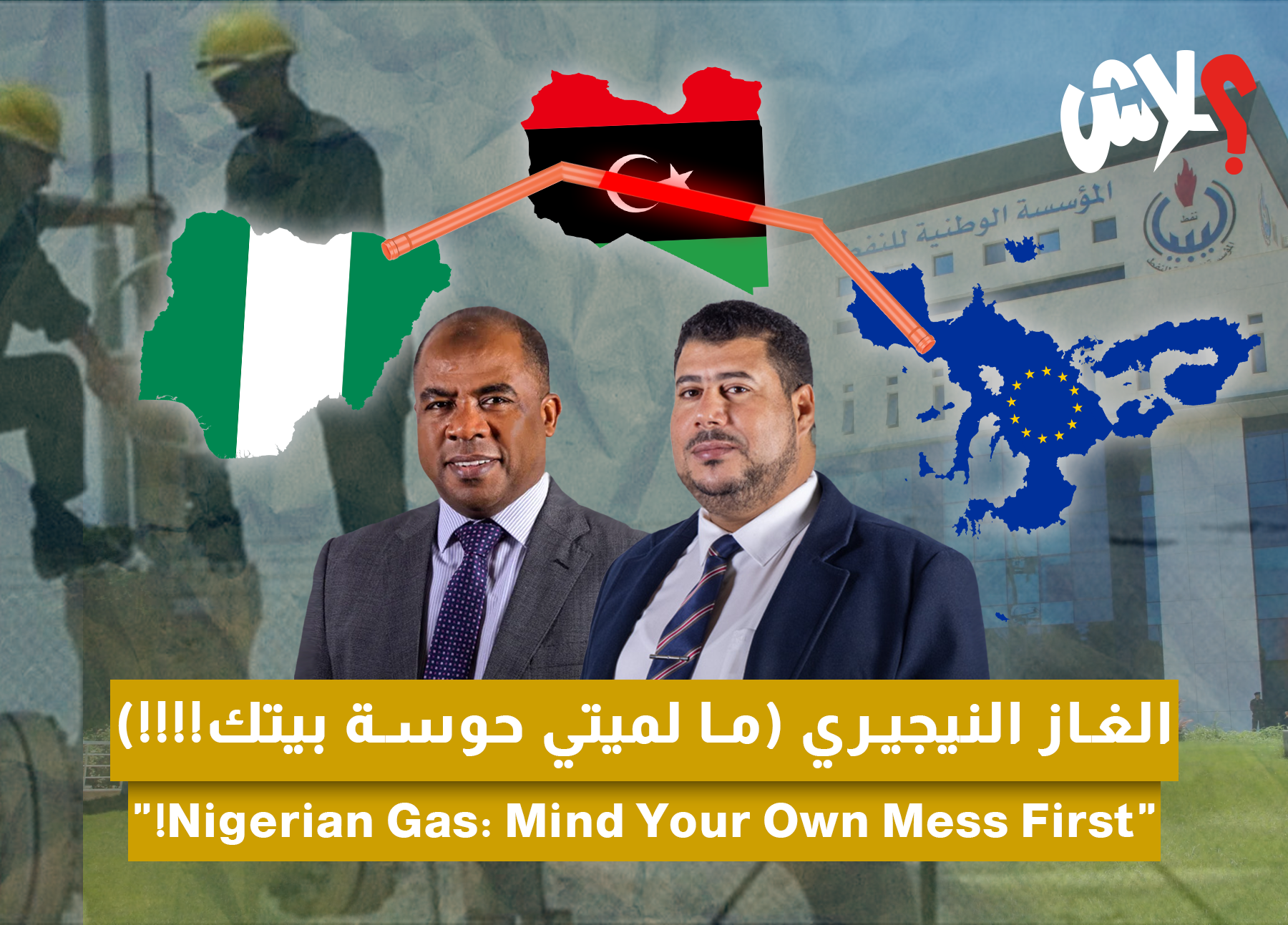
"Nigerian Gas: Mind Your Own Mess First!"
People in the past used to tell a (lazy woman) who neglects house cleaning, yet suddenly rolls up her sleeves preparing to stuff the complicated and beloved Libyan dish “asban,” which requires extensive washing, cutting, and preparation:
“You didn’t clean your own house yet you want to make asban!”
Today, painfully enough, we find ourselves forced to say this sentence to the National Oil Corporation, the Ministry of Oil and Gas, and the rest of the state institutions whose imagination ran wild believing they can compete with stable nations to acquire one of the most significant energy projects in the region and the world: the Nigerian gas pipeline to Southern Europe.
What meaning does it carry when Libya talks about becoming a “strategic energy corridor” while its National Oil Corporation struggles to obtain its approved budget for years to increase its oil production? What logic is there for a country barely able to maintain its current output to speak of hosting a massive project a 3,300-kilometer gas pipeline from Nigeria to Europe?
And how will we convince the world that we can safeguard the flow of Nigerian gas through a pipeline when we failed to protect the flow of our own? Will (protesters) and endlessly demanding groups respect the guest pipeline and blockade only ours during their (peaceful) sit-ins?
The Libyan dream of becoming a bridge for a strategic mega-project like Nigerian gas to Europe seems like building sandcastles on a beach swallowed by waves. The project which gained huge traction in Europe shortly after Russia invaded Ukraine is not just a pipeline; it is a leap in the energy world, a winning card for Europe and NATO states to liberate themselves from dependence on Russian gas. Implementing it is a test of Libya’s ability to escape its collapse cycle… but which “state” are we talking about?
The Libyan reality today is one of division, power struggle, and (cake-sharing). Security is hijacked by militias; internal authorities cooperate with external forces for their own interests making the idea of a unified authority capable of protecting such a project borderline fantasy. How can a pipeline traverse lands filled with armed groups and foreign meddling when such a project requires a stable and secure environment? The question itself carries its own brutal answer.
Sadly, Libya’s doors are wide open to foreign interference. It has become a battlefield where powerful states settle their disputes and fight for influence over its resources. A project like this wouldn’t remain Libya’s dream alone it would become the prey of many international powers, turning into yet another instrument of conflict rather than development.
Even before external threats are considered, the internal rot alone can kill any ambitious dream. The National Oil Corporation, supposedly the backbone of this project, is struggling to receive its budget, fighting to increase production while barely keeping current output stable amid constant threats of port and field shutdowns.
How can an institution unable to finance maintenance of existing infrastructure participate in managing and executing one of the biggest infrastructure projects in the region perhaps the world?
Libya’s security dilemma is, in truth, a state-building dilemma. A country unable to enforce sovereignty across its territory or build unified national security institutions cannot protect its own assets let alone a mega-pipeline crossing its deserts.
Meanwhile, Europe watches this Libyan dream with wary eyes. Energy security is its greatest obsession. The closer winter approaches, the more urgent the questions become about a stable and reliable alternative to Russian gas.
And while Europe desperately needs gas from Africa, the migration flows from the same continent remain its greatest concern. Europe may cooperate with African states for its energy security but simultaneously continue policies to keep migrants from those same countries outside its borders, even if the cost is supporting actors who ignore humanitarian suffering. This contradiction makes its engagement driven by narrow interests, not a genuine strategy for building a stable Libya simply because that isn’t its concern beyond what serves its benefit.
Add to this that Libya is competing for this project with stable states whose security and military institutions hold firm control across their land states far more qualified to host such a project. We are talking here about Algeria and Morocco. What do we have to rival them?
To the ordinary citizen, talk about such strategic projects feels like intellectual luxury. Libya’s political conflict is miles away from people’s needs and simple aspirations. Elites are busy clinging to power and fighting for seats turning this strategic project into nothing more than another card in their power struggle. Without a unified government and national institutions capable of overcoming “state failure,” the oil sector along with Libyans’ dreams of prosperity remains hostage to political turbulence.
The truth we must face is that although this project is a massive strategic step, it requires financial, administrative, and political stability that is nowhere in sight. Libya has become an arena for regional and global power struggles, its wealth a target for ambitious states. Within this chaos, the ordinary Libyan’s dream of a dignified life is buried.