
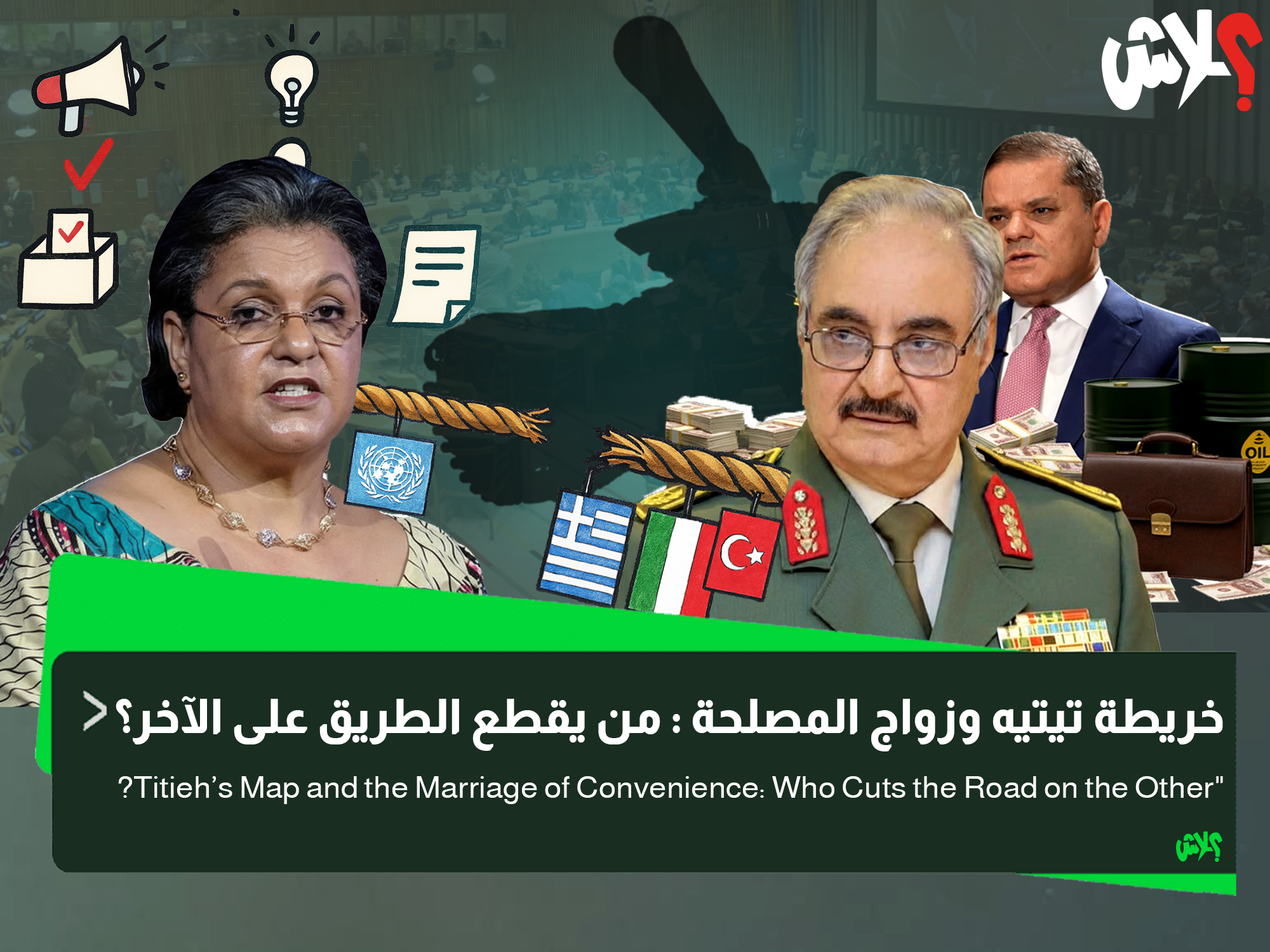
"Titieh’s Map and the Marriage of Convenience: Who Cuts the Road on the Other?
The UN Mission is desperately trying these days to revive its project in Libya, where SRSG Hanna Tetteh is actively promoting a roadmap through which she hopes to resurrect a political process that resembles a lifeless corpse. The roadmap announced in August is moving slowly and stumbling, while the two ruling families in Libya East and West move steadily toward clinging to power and perpetuating the crisis.
Tetteh is exerting visible effort during the UN General Assembly in New York to rally international support for her plan. She meets senior officials and explains that forming the new government is not the beginning but is preceded by other steps such as restructuring the High National Elections Commission and holding a structured dialogue involving all crisis actors along with various segments of society but her efforts seem to collide with a bitter truth: none of the key players on the ground want this plan to succeed.
Behind the scenes, an unprecedented rapprochement accelerates between the two ruling families in the East and West a rapprochement resembling a marriage of convenience between two sides that cannot stand one another, yet each knows its survival depends on the other, at least for now. Even if the marriage is built on suspicion and distrust, they cooperate publicly and secretly to undermine the UN roadmap while simultaneously plotting publicly and secretly to eliminate one another and monopolize power.
The international scene has changed. Haftar, once relying on traditional allies such as the UAE, Egypt, and Russia, is now knocking on new doors. He realized that survival requires widening alliance circles and now Greece and Italy, alongside Turkey, race toward unprecedented normalization with him. Turkey in particular moves toward him in wide steps, hosting his sons, sending delegations and senior officials, and signing civil and even military agreements while simultaneously pushing for direct negotiations between the two legitimate proxies of the ruling families: Saddam Haftar on one side and Ibrahim Dbeibeh on the other.
But this Turkish track seems doomed from the outset. Turning the informal relationship between the two families into an official framework appears near impossible especially with the air of mutual suspicion surrounding both sides. Turkey knows this and is not pursuing this path out of fondness for Dbeibeh but because it is the only available option in a reality where Haftar has become the strongest and most organized player between the two. This may tempt him into a new military gamble one that could leave Turkey in an unenviable position, where neither the attacker deserves support nor the defender deserves defending.
The Rome meeting between Ibrahim Dbeibeh and Saddam Haftar supported by an American initiative stands as the clearest sign of this international shift. Even Italy, which hosted this meeting and previously approached eastern authorities with caution, is now more open toward Haftar and his family.
Today, Haftar strengthens his position continuously and appears as a strongman firmly controlling his areas of influence, while Dbeibeh lacks this advantage. He once ruled the entire west yet today he does not even fully control the capital. His shaken security posture weakens his political position, while Haftar receives increasing recognition he could have never dreamt of just a few years ago.
These dynamics weaken the marriage of convenience. At least one party may soon feel no longer compelled to maintain it, believing instead that it can monopolize power relying on military strength, old allies, and new allies it seeks to pull away from its opponent’s camp.
So what is the fate of Tetteh’s roadmap amid such a complex scene? The picture is bleak. Proposed solutions like forming a unity government endorsed by main crisis actors or agreeing on a neutral figure acceptable to all parties appear fragile and unworkable against a coalition of shared interests between rivals who unite only to divide wealth or sabotage any process threatening their survival.
The bigger question:
Do Tetteh and the states supporting her plan have the will to block this game?
Or will the marriage of convenience despite its fragility succeed yet again in turning Libya into an endless battleground where the people are the only losers?
Reality suggests history repeats itself and people repeat the same mistakes while hoping for different results. So we ask: is this the newest episode of the series “Didn’t we tell you?”
All signs warn the new roadmap will meet the fate of its predecessors hugs, smiles, good intentions, tears of joy on the Skhirat stage and ink on paper.