
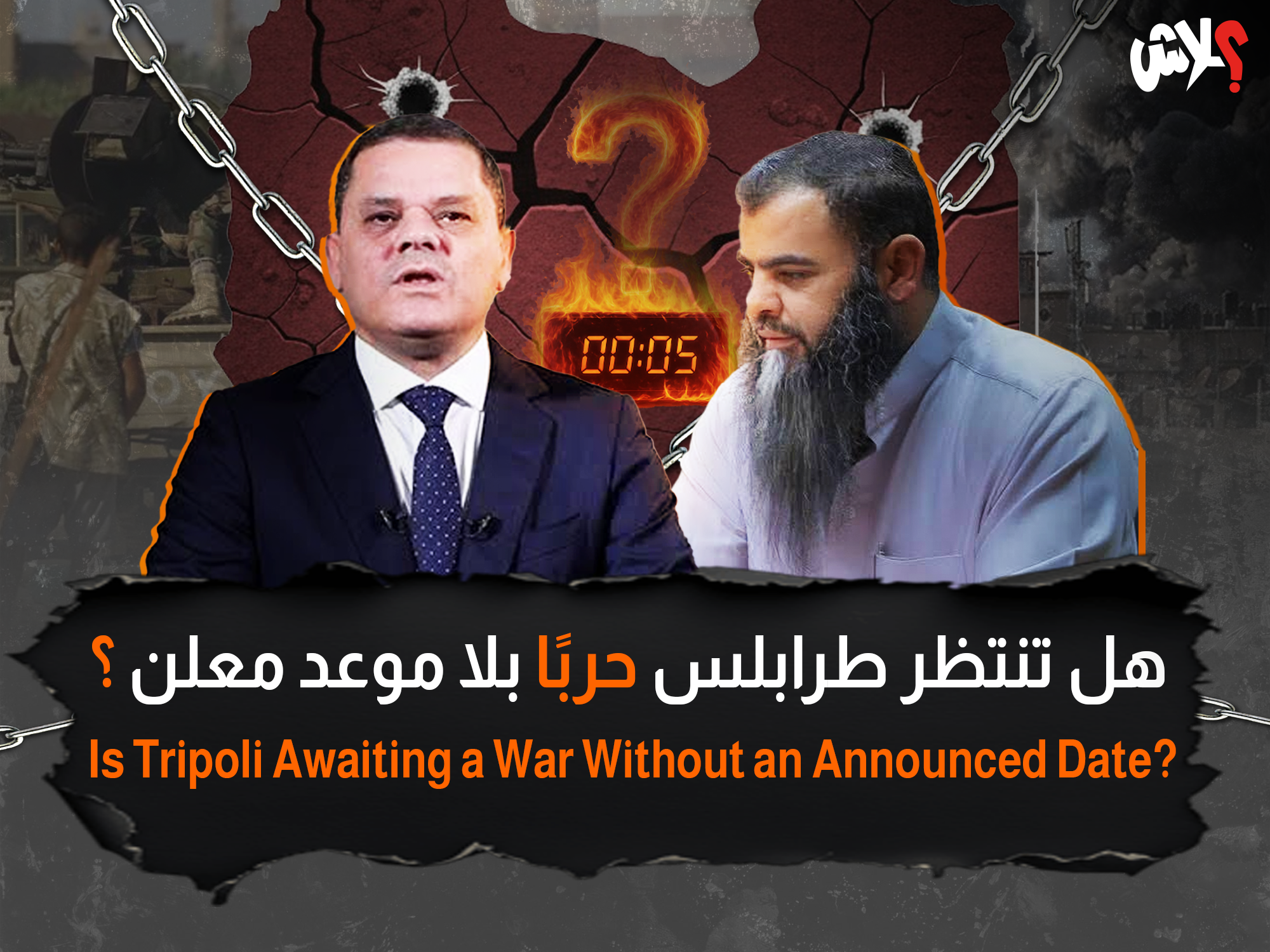
Is Tripoli Awaiting a War Without an Announced Date?
Some historians say that the Umayyads in Damascus used Tariq ibn Ziyad, a strong Amazigh military commander, to complete their project of opening Al-Andalus in 711 AD.
They assigned him the mission after Musa ibn Nusayr paved the road.
Tariq led his army, crossed the sea, and achieved a crushing victory in the Battle of Guadalete, opening the doors of Al-Andalus to the Umayyads.
But after completing his mission and gaining wide influence among the soldiers and Berbers, the Umayyads feared he could become an independent leader.
He was summoned to Damascus by order of the Caliph Al-Walid ibn Abd al-Malik, stripped of authority, and disappeared from the political and military scene dying silently without the position he deserved.
It is often said that power is sterile, and so it is especially in lands accustomed to using violence to bring change.
We in Libya are not an exception; I cannot recall any stage in our history where power transitioned and stabilized without bloodshed without destroyed homes .
Residents of Tripoli today live in a deeply complicated state of anxiety, where the question:
“When will the war begin?”
tops every conversation inside the capital.And indeed, waiting for war is mentally and psychologically harder than its occurrence.
Analyses and expectations are increasing, and we previously dedicated an article ten days ago about the options available to the “Return of Life” government if it decides to remain in power and not comply with Teteh’s roadmap aiming to form a new internationally-recognized unified government.
Now we ask: Why hasn’t the war started yet?
Especially since the government seems not to have agreed to Teteh’s plan, while its opponents the Deterrence Apparatus and its allies prevent it from controlling Tripoli and imposing new conditions enabling it to re-enter negotiations.
Many observers believe what delays the confrontation is the lack of solidity among the armed groups allied with the government.
You find that Al-Zoobi’s force represented in Brigade (111) is thinking carefully before entering such a war.
Its loss even if the Deterrence Force merely withstands and does not fall and the latter wants nothing more than that, would threaten the brigade’s future presence in Tripoli.
It is not among the armed groups rooted within the capital’s population; it lacks a popular base.
Its thinking is: “As long as a new government is coming, why engage in a risky war that may strip me of my gains and push me back to Misrata’s outskirts?”
Thus, many believe Al-Zoobi has not yet decided on war even though he is Deputy Minister of Defense and acting Minister because maintaining his military presence outweighs a temporary political position in the lifespan of armed groups .
As for Brigade (444) and its flying commander Mahmoud Hamza, many believe he is only waiting for the order of war.
He seeks according to this view to use what remains of the Return of Life government to settle his score with the Deterrence Force.
Because if Dbeibah’s government falls which would be considered a victory for the Deterrence Force, turning it into a military and political power influencing the next government then Mahmoud Hamza will have no official presence in the so-called Libyan state.
Even if Brigade (444) remains a usable military actor, some argue that Mahmoud Hamza will not be allowed to continue if the government exits without war.
As for the Public Security Force and the Misrata Joint Force, both are structurally tied to the Return of Life government.
If the government ends in any way, Abdullah Farawla and his brother the minister will not be allowed to remain in Tripoli, and the Joint Force under Bugdada will have no option except returning to their camps in Misrata.
Thus, they are fully prepared psychologically and militarily for a battle aimed at toppling the Deterrence Force because if it does not fall and the Return of Life government fails to control Tripoli, the next “Khraashu Brashu” video from Zintan will be directed at Bugdada at Misrata’s outskirts.
The Deterrence Force whose supporters believe it is well-positioned and overestimate its ability to repel an attack if it occurs does not enjoy a better state.
Today it is truly surrounded from all directions.
If all the previously mentioned groups plus the force positioned in Al-Qarboli east of the capital coming from Misrata move against the Deterrence Force in Mitiga, it will face a difficult situation.
Even with popular support behind it, time may be on its side but everyone will be against it.
And as the Libyan proverb says: “What impresses you is the length of time.”
And no party, if war erupts, will control time.
As for the residents of the capital: as a friend says, “they only explode—they do not protest.”
So far, they watch what is happening racing against time, anxiety, and fear neither at the breaking point nor reassured.
But they are afraid, and fear when prolonged is the emotion that ultimately leads humans to explode and halt the chaos.
And until that happens, dear reader or doesn’t happen you know what to do these days.
You have gained experience from past events. Add to that one fact: no war in history ever came with a scheduled and announced date.
And do not be with the Umayyads nor with Tariq ibn Ziyad.