
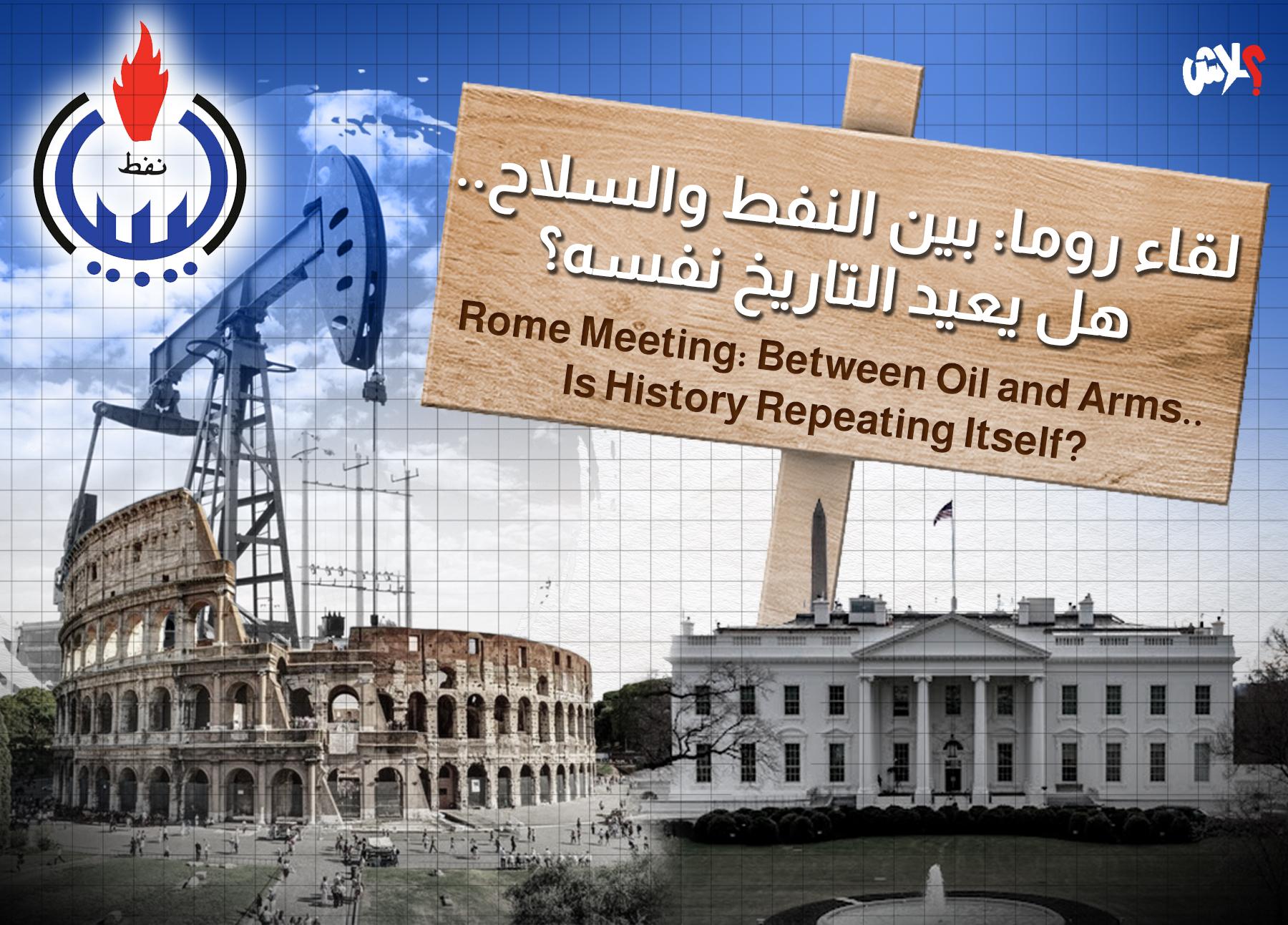
Rome Meeting: Between Oil and Arms… Is History Repeating Itself?
Once again, a European capital hosts a Libyan meeting behind closed doors – this time in Rome where Ibrahim Dbeibah, National Security Advisor and cousin of the Prime Minister in Tripoli, met with Saddam Haftar, Deputy General Commander of the eastern Libyan forces and the de facto ruler there.
The meeting was neither casual nor accidental; it was carefully planned and wrapped in total secrecy. None of the involved parties acknowledged it or spoke about it, and some even tried to indirectly hint that it had not happened without saying it outright.
Italian newspapers confirmed the presence of White House adviser for Africa and the Middle East, Mased Bolus, who happened to be in Rome at the time. Coincidence? Or was the meeting internationally endorsed, just like what happened previously in Abu Dhabi?
The timing itself carries many implications:
Tripoli is experiencing unprecedented security alertness, fast-moving military mobilizations between forces loyal to the government and others opposed to it, escalating threats of clashes that could erupt at any moment, with undeclared military support and explicit media backing from Haftar’s camp for the Special Deterrence Force and its allies opposed to the government.
So, did the two men discuss this file?
Or was security merely a cover for a bigger deal?
Just days earlier, Hanna Tetteh, head of the UN mission, presented a roadmap culminating in the formation of a new government to lead long-delayed elections an idea rejected by the Tripoli-based government despite its formal welcome of Tetteh’s plan, while reaffirming, as before, that it will not hand over power except to an elected government.
So, was the Rome meeting an attempt to undermine the UN’s plan?
Are both sides trying to secure their positions through a ministerial reshuffle guaranteeing shared control, thus keeping themselves in power even if elections are postponed indefinitely?
Another major file imposes itself forcefully: oil.
The meeting coincided with what many describe as a (controversial) proposal by the National Oil Corporation headed by Masoud Sleiman to establish a new company called “Jiliana”, headquartered in Benghazi. The company would develop gas discoveries in partnership with an international consortium including Italy’s ENI, France’s Total, the UAE’s ADNOC, and Turkey’s state oil company.
The project according to Sleiman’s official letter to Abdulhamid Dbeibah aims to achieve gas self-sufficiency and end reliance on costly diesel-based electricity.
But leaks confirm that the Council of Ministers has not approved the company’s establishment.
So, did the two men discuss the fate of “Jiliana”?
Will it be a new “Arkeno” a joint venture between both families just as happened when oil fields were reopened after the Abu Dhabi meeting and Farhat Bengdara was appointed to head the National Oil Corporation at Haftar’s request?
Thinking about this meeting and the secrecy around it chases you with questions like your own shadow:
Was oil, gas, and the Jiliana company the driving motivation?
Or was the military escalation in Tripoli and Haftar’s stance on it the real issue?
Or is the meeting part of bigger arrangements to share power and block the post-Tetteh phase?
History teaches us that secret meetings between both families have never benefited the nation or its people they were always meant to rearrange a new card in the game of power and wealth sharing.
Every meeting deepens their legitimacy, entrenches division, and pushes the country further away from elections or civil statehood.
Will they agree on elections to renew their decayed legitimacy?
Or will the country remain hostage to both families’ ambitions to monopolize ruling?
A covert pact to divide the cake today before one of them eliminates the other and all the dreamers tomorrow.
The Rome meeting may be just another episode in a long-running series, one Libyans live through without knowing its ending.
But they know well by experience that any agreement between both families never brings them anything but more division, polarization, marginalization, and loss.
In the end we say: whether Ibrahim and Saddam met in Rome or not
whether they sealed a deal extending their families’ lifespan or not
both men and their families will remain in power east and west sharing benefits and trading insults
while the people who live with electricity cuts, lack of medicine, collapsed services, and crushed hope remain the only losers…
if they agree, they rob him,
and if they disagree, they kill him.