
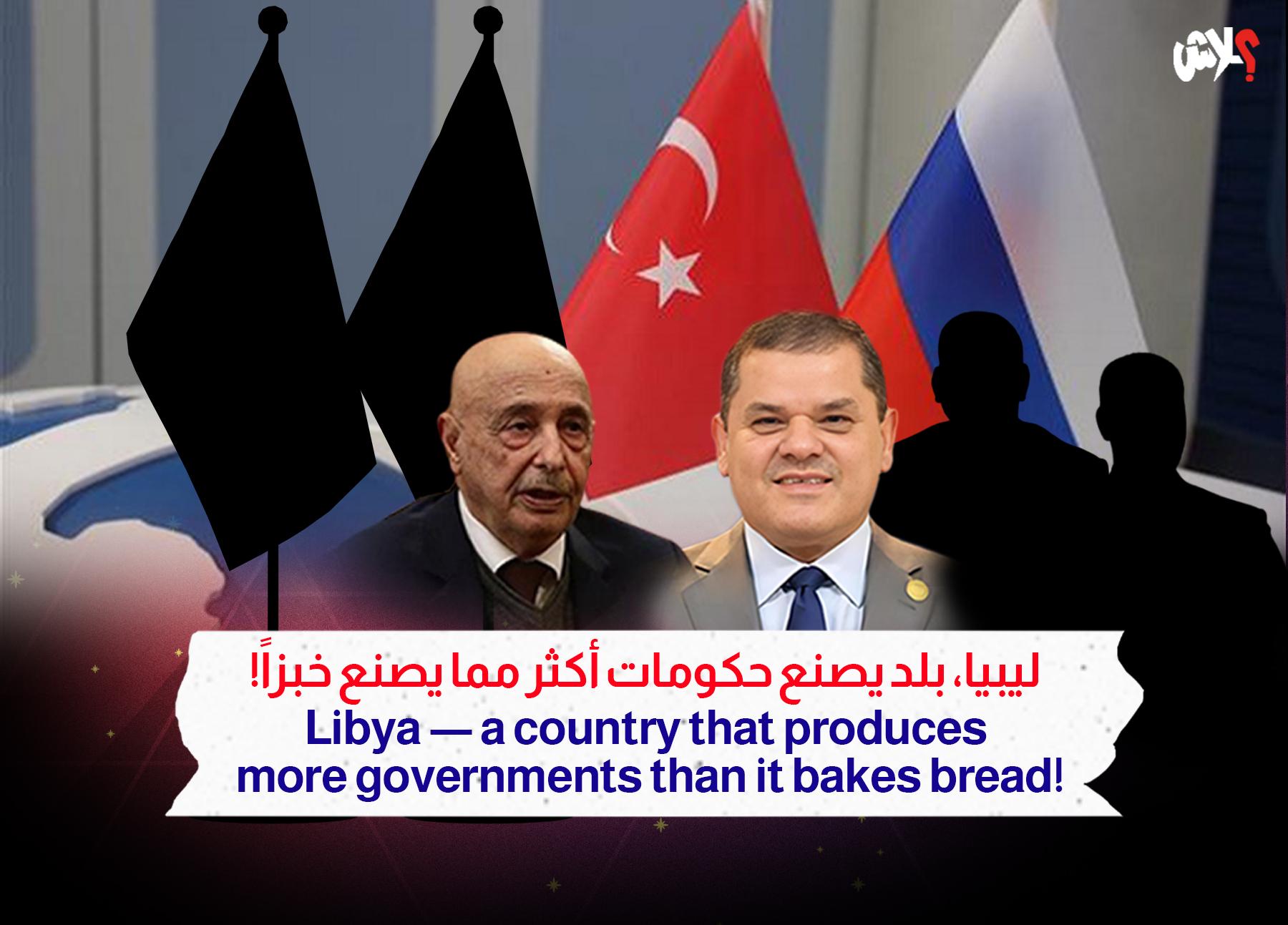
Libya a country that produces more governments than it bakes bread!
Fourteen years after the fall of the Gaddafi regime, Libya remains trapped in a vortex of political and military fragmentation that has turned the dream of transitioning from revolution (chaos) to a functioning state into a complex nightmare.
Today’s political and governance landscape continues to grow more complicated year after year, with two competing governments: one in the west that enjoys international recognition, and another in the east recognized by only a handful of countries but deriving its strength from its loyalty to Khalifa Haftar. Meanwhile, the House of Representatives backed by internal and external actors is attempting to form a third government, which it insists on calling “the unified government,” but which in reality may simply add another layer of complexity to a crisis that risks becoming a permanent syndrome of the Libyan condition.
The internationally recognized government is based in Tripoli and headed by the pragmatic Abdulhamid Dbeibah. It derives its power from its control over the capital and the sovereign institutions without which a rentier state like Libya cannot function most importantly the Central Bank of Libya and the National Oil Corporation, the economic lifeline of the country.
This financial control has made the Government of National Unity an indispensable player in the international equation, despite its relative military weakness in the face of eastern alliances and certain armed groups in the west that were once loyal to it. On top of that, the government faces accusations of corruption and failure to achieve stability, leaving its international legitimacy fragile in the eyes of Libyans—many of whom have begun taking to the streets in the thousands every Friday, demanding its removal.
In contrast, the Osama Hamad government in the east functions as an extension of Khalifa Haftar’s military authority. It relies on backing from regional powers such as Russia, the UAE, and Egypt. Although it lacks international recognition, it controls a large portion of Libyan territory and benefits from deep-rooted tribal and military alliances. However, its inability to access financial resources limits its influence, rendering it dependent on external support or on its local proxies, who fund it through a fictitious oil company they jointly established with their rivals in western Libya!
Amid this polarization, the House of Representatives and its speaker the seasoned “eskanbil” player” Aqila Saleh are pushing to form a third government under the banner of “unification,” in cooperation with a faction of the High Council of State (itself divided between the competing camps of Al-Mishri and Takala, both claiming legitimacy).
But this move is more a political maneuver than a realistic solution, as both Dbeibah in the west and Hamad in the east would certainly refuse to relinquish power. Worse still, such a proposed government might become yet another cover to prolong the crisis instead of resolving it especially since the main actors behind its formation refuse to submit to elections that could eliminate them from the scene and disrupt the gains they have secured over more than a decade.
What is particularly striking is that most of the candidates for this “third government” know perfectly well that they will not wield real power, since Dbeibah and Haftar currently hold the actual levers of control. So what is the point of seeking to head a government that will not rule?
I believe the answer comes down to two things:
First: securing a share however symbolic of the state budget through positions that provide access to resources or contracts, thus allowing participation in the open corruption banquet that has persisted since 2011.
Second: self-promotion, turning themselves into necessary faces in any future settlement, whether through political roles or new alliances.
It is impossible to understand the complexity of the Libyan scene without considering the web of regional and international interests. The states backing the rival factions from Turkey and Qatar to Russia, the UAE, and Egypt see the continuation of the crisis as a guarantee for securing geopolitical gains, such as control over energy resources or expansion of military influence.
Local elites, meanwhile, depend on an “crisis-management rather than crisis-resolution” strategy, transforming power into a source of individual and familial income.
Although we believe that Aqila Saleh’s maneuver to form a third government is nothing more than an acrobatic leap to buy time and avoid the threat of elections for himself and his parliament, the most likely outcome should this attempt succeed is further entrenchment of division through the existence of three governments.
This would deepen the separation between Libya’s east, west, and south, exacerbate mistrust among Libyans, and make national cohesion even harder to restore.
Moreover, if Aqila Saleh and his allies succeed, it will accelerate the collapse of the idea of a single Libyan state in the minds of Libyans and erode the principle of unity amid multiplying sources of legitimacy. Libyans will lose trust in any political authority and increasingly turn toward local or regional loyalties, which will inevitably lead to rising violence as competition over resources and legitimacy pushes armed groups to escalate militarily in order to impose de facto control.
Libya’s problem is not the number of governments it is the absence of genuine political will to build a state.
Ruling elites both east and west treat power as spoils, while international institutions have turned into actors in the conflict rather than neutral mediators. The only real solution lies in holding free elections under effective international supervision that can unify authority and renew eroding legitimacy.
But this solution threatens the interests of many of those in power today, making it almost impossible. As a result, we will continue moving in the same vicious circle until pressures erupt as they did in February 2011, or until one party decides to launch a war driven by the dream of exclusive control.
In all scenarios, the ultimate loser will be the Libyan citizen who will pay the price of chaos or war, without receiving any share of the spoils of power