
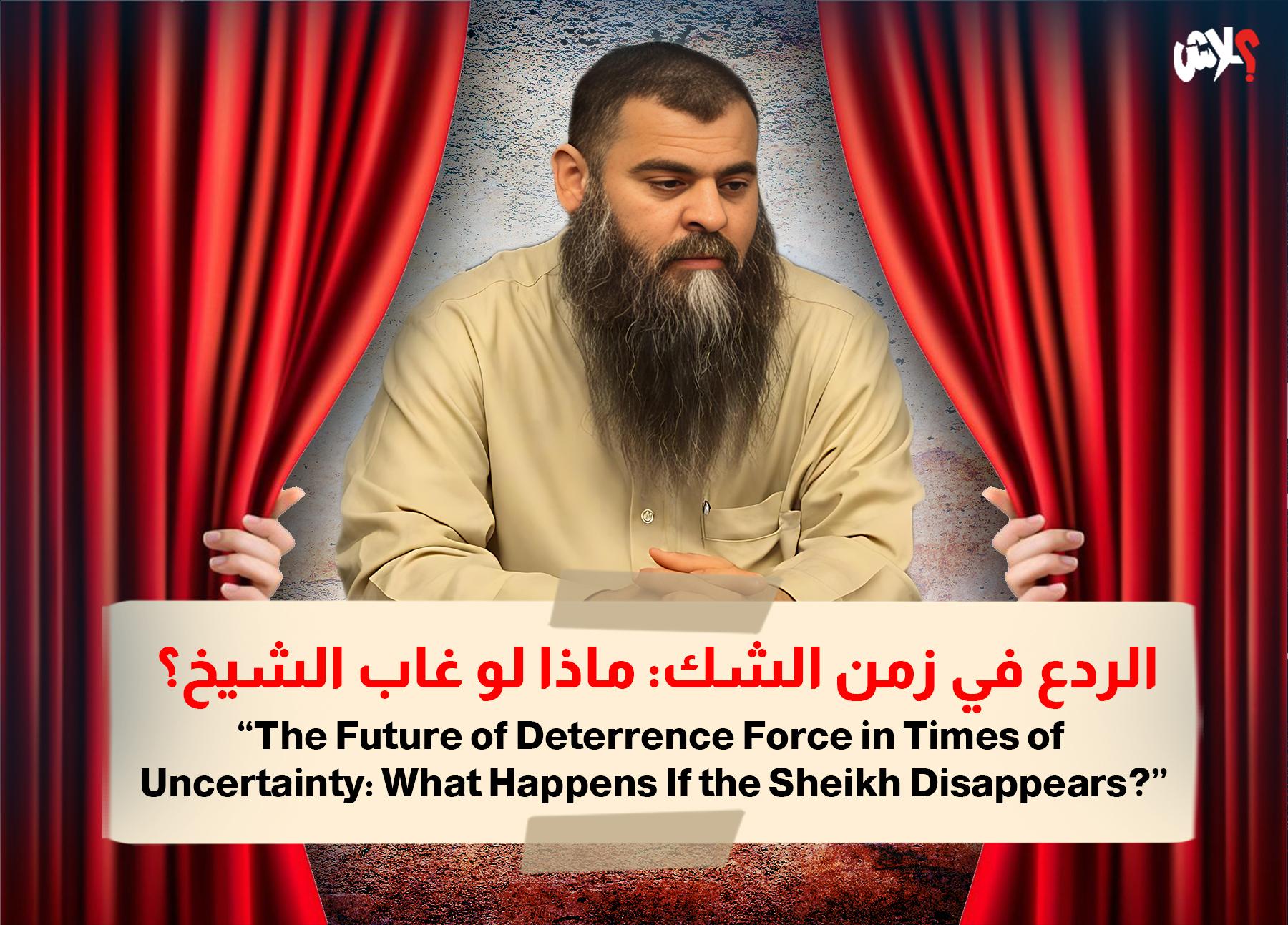
Deterrence in a Time of Uncertainty: What If “the Sheikh” Disappears?
Many accounts exist regarding how Alexander the Great died, leaving behind a vast empire whose impact remains visible to this day. There is no clear narrative about the succession mechanism he proposed before his death, but the most prominent version comes from Diodorus, one of that era’s historians. He wrote that Alexander’s companions asked him on his deathbed: “To which man do you leave your vast empire?” He answered briefly: “To the strongest.”
History tells us that most authoritarian projects built around a single individual stumble and sometimes collapse immediately after that individual’s disappearance. Yet some argue this is not always an inevitable rule.
In Libya, following the February uprising, numerous armed groups emerged. Some persisted to this day, while others dissolved or merged with stronger forces, either by choice or coercion. Among the formations that managed to endure and evolve across all these stages is what is known today as the “Special Deterrence Force for Combating Organized Crime and Terrorism”, led by a figure who has long been the subject of controversy: Sheikh Abdelraouf Kara.
The Deterrence Force with all that its supporters consider its strengths and its critics consider its flaws is nonetheless widely acknowledged to have a major influence on security developments in Tripoli in particular, the western region more broadly, and Libya to some extent. Any significant development concerning this force, whether in its structure or continuity, will undoubtedly affect everyone living in this geographical area.
After the killing of Ghneiwa Al-Kikli, commander of the Stabilization Support Apparatus, in the Takbali camp south of Tripoli at the hands of the 444 Brigade, his armed formation collapsed unexpectedly within just two hours. This opened significant questions among Libyans regarding the fate of other armed groups should their leaders disappear. No one in Tripoli had anticipated such a rapid downfall, especially given the media and military aura surrounding the apparatus and its role in previous battles.
There is also clear hostility toward the Deterrence Force from other armed formations currently present in Tripoli those that led the “Night of the Long Knives,” ending the Stabilization Support Apparatus. Here we refer to the 111 Brigade, led by Abdulsalam Al-Zoubi, and the 444 Brigade, led by Mahmoud Hamza. These forces attempted to advance toward Mitiga but failed after the Deterrence Force repelled their attack. This makes it necessary to imagine possible scenarios of the force’s collapse in Tripoli.
The Deterrence Force is described as a “semi-regular” force, as stated in a publication from an American security institute monitoring the security landscape in the Middle East and North Africa. The force operates presumably on two levels of leadership:
A hierarchical level, embodied in Sheikh Abdelraouf Kara, from whom all major and sensitive instructions originate, whether related to the capital’s stability or to any military movements.
A horizontal level, shared by several second-tier leaders who make daily decisions related to pursuing criminals, carrying out arrests and releases, and managing the force’s prison which some consider a point of weakness, while others see it as a source of strength. The prison’s containment of a large number of dangerous criminals, including individuals accused of being ISIS leaders in Libya, has granted the force an implicit form of protection from all political governments that have come and gone over the past fourteen years.
The Deterrence Force has also played a pivotal role in every war that Tripoli has witnessed, shaping a strong narrative in the minds of Libyans. It has long been a force that is difficult to challenge. It has never entered a war and lost, consistently calculating its moves and avoiding conflicts without careful consideration. This was evident in its refusal to participate directly in the “Libya Dawn” war, and in its delayed entry forty days after the start into the battle to repel General Haftar’s offensive on Tripoli.
When the force decides to remove someone from the security equation in Tripoli, the number of fighters or proximity does not matter. This was seen in what happened to the 444 Brigade and the Nawasi Force, where the former met the fate of “the slaps,” and the latter the fate of “escaping by sea.”
We are not here to grant or revoke legitimacy from any armed group. Rather, we attempt to understand and analyze the consequences of the disappearance of some of them on our lives and stability.
Many believe that no one can fill the vacuum that would be left by the absence of “the Sheikh” inside the Deterrence Force. He represents the balancing point within the force and ensures the cohesion of second-tier leaders. Some believe that his absence would give each of these leaders a sense of entitlement to succession, potentially leading to internal divisions that threaten the force’s collapse from within, without any need for external intervention.
he social base of the Deterrence Force cannot be overlooked. A significant portion of its resilience and stability stems from its presence in the Souq Al-Jumaa district, and from the fact that Abdelraouf Kara hails from this area, with his family being one of its large and influential clans. Thus, his leadership enjoys local, regionally driven support, while other second-tier leaders may lack these characteristics placing their popular acceptability in question.
Recent events confirm this: the local community’s rallying around the force played a major role in maintaining its cohesion. It also sent a clear message to all other armed groups in and outside Tripoli that any attempt to target the force would inevitably mean entering a war against an entire district inhabited by more than 400,000 people.
No one can assert this narrative with certainty, but what we do know and it is little suggests that the Sheikh enjoys a form of reverence within the force, strengthened by years of action and positioning. Filling this void will not be easy. And unless a clear mechanism for leadership transition is established, the force may revert to the very commandment with which Alexander the Great left his empire: “Succession to the strongest,” or it may meet the same fate as the Stabilization Support Apparatus but the cost will be far, far greater!!