
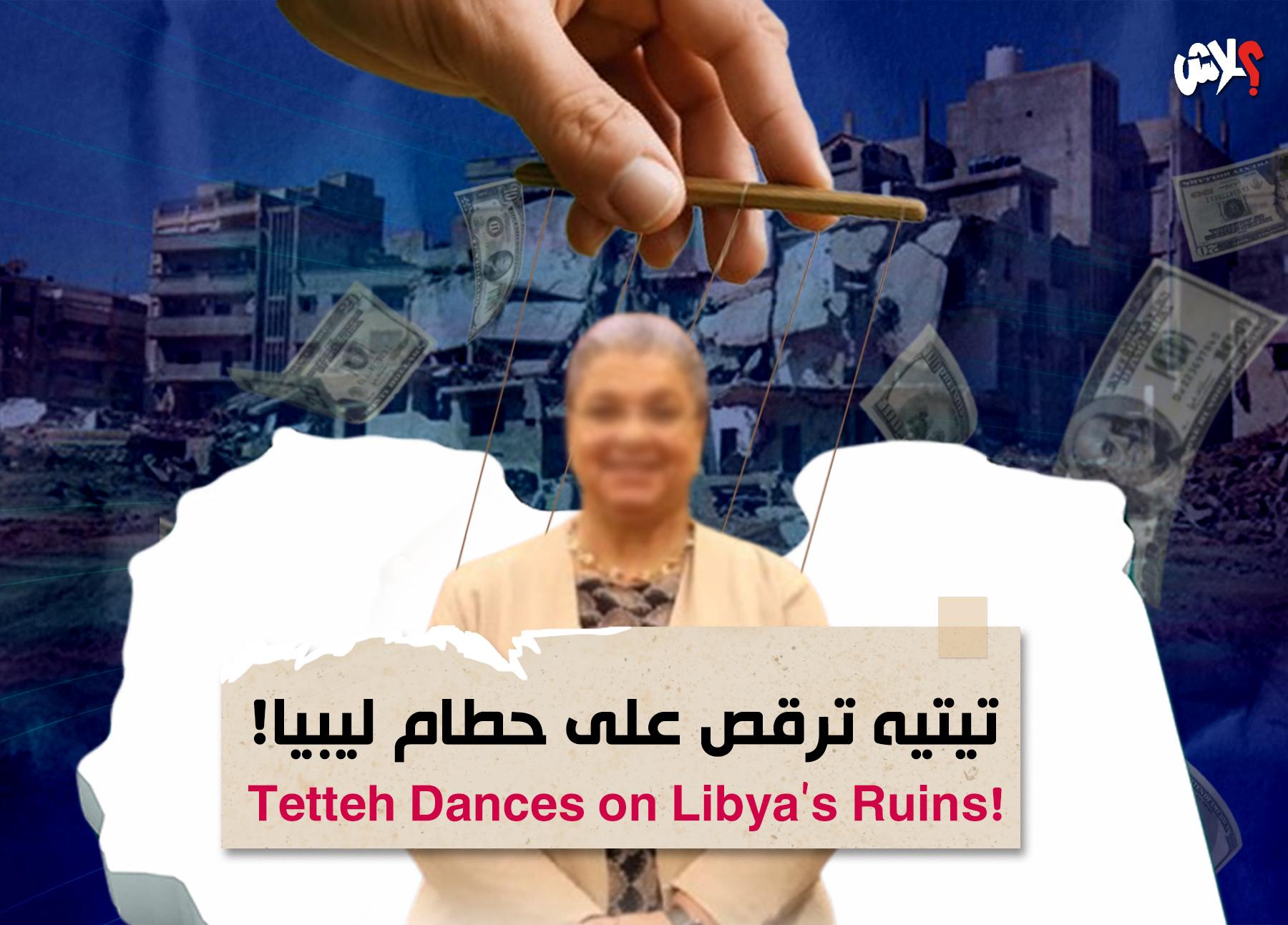
Teteh Dances on the Ruins of Libya!
Local media outlets, citing private sources within the advisory committee recently formed by the United Nations Support Mission in Libya (UNSMIL), reported that the committee will issue its final proposals regarding the disputed points in the electoral laws within a few days and it may have done so before this article is published. Days earlier, the new UN envoy to Libya, Hanna Tetteh, revealed in her first briefing to the Security Council a dual-track approach to addressing the Libyan crisis.
The first track focuses on saving the economy by implementing an urgent reform package that includes unifying the government budget, ending the financial division between the east and west, and applying the Central Bank of Libya’s recommendations to halt the deterioration of the local currency. This step comes as a response to warnings that the foreign currency reserves are approaching a dangerous level, amid the continued withdrawal of foreign currency to fund both real and fake letters of credit, in addition to swollen government spending.
In the second track, the UN mission will begin inviting the warring parties and others to nominate representatives for a new political dialogue. As usual for the UN, in summoning names with no local weight or popular base, participation in the dialogue will not be limited to the factions currently in control. It will also include entities and groups that were never given a voice in previous transitional governments, nor took part in the billion-dinar corruption festivities.
The dialogue aims to discuss the proposals of the advisory committee, which as mentioned is expected to submit its final suggestions within days. Supposedly, the resulting dialogue will select the viable options needed to ensure that elections can take place.
Despite Tetteh’s announcement of a timeline, the details of the political process remain vague. We still do not know exactly who her local supporters and opponents are, and it is unlikely these details will be revealed before ensuring that none of the permanent members of the Security Council object. From reviewing the statements of Tetteh and her predecessor, Stephanie Khoury, it appears the mission will rely on international support more than local backing first, because of the deep mistrust between local rivals, and second, because everyone knows that most local actors are merely puppets moved by the fingers of their foreign handlers.
Libya has no shortage of frustrating precedents in this area. After every political dialogue, a national unity government is announced and granted powers to unify institutions and prepare for elections only to collapse due to internal conflicts, military maneuvers, or political games flavored with tribal-regional interests, usually led by the House of Representatives. That parliament with its fragile legitimacy earned in Bouznika’s backrooms has repeatedly used its authority to obstruct governments and deny them budgets, leading to the creation of parallel governments whose only purpose is to hinder or delay elections, buying more time at the expense of our livelihood and our children’s future.
The greatest current fear is that the upcoming dialogue becomes a replica of Geneva and Tunis, with minor cosmetic adjustments that change nothing in the roots of the crisis: shrinking the government in terms of ministries, inflating it with technocrats, adding new entities and regions excluded from previous governments, changing the name, and as always keeping the magic password. Every government must include the word “national” in its title so we can believe it cares about the homeland and seeks to bring us to safety.
Facts indicate that any optimism must be tempered by greater skepticism and caution. As long as real power remains concentrated in the hands of the House of Representatives with its long history of sabotaging political solutions through stalling and repeatedly rejecting any track that does not guarantee its dominance elections remain a distant dream.
While the United Nations attempts to widen participation in the dialogue, the success of this new track depends on its ability to bypass the veto game played by the parliament through its alliances with internal and external actors opposed to any change that reduces their influence.
Overall, the new UN plan appears to be an attempt at “a perfumer fixing what time has ruined” patching up the existing political system by inserting a new government tasked with preparing quick elections, while ignoring deeper issues such as: the total lack of trust between Libyans and their political elites; the deterioration of essential services; the spread of armed groups entrenched in state institutions and invested in the status quo; and the growing foreign influence that complicates every negotiation track.
Thus, even if the plan succeeds in achieving elections a highly unlikely scenario nothing guarantees that elections will lead to stability, rather than reproducing the same crisis in a new form.
Given the recent economic decline, and the fact that most Libyans have reached a point where they will accept any change simply because it cannot be worse than what exists today and because “changing saddles brings relief” the new UN track carries a flicker of hope. Yet it moves on shaky ground: economic reforms may ease the symptoms without curing the disease, and political dialogue may produce a government that cannot govern unless accompanied by a change in the rules of the game.
The real challenge lies in breaking the vicious cycle we have been stuck in for more than a decade recycling governments one from the womb of another and crafting a lasting solution by removing all current actors from the scene. Because repeating failed experiences cannot produce success, and those who benefit from the problem cannot be trusted to design its solution.