
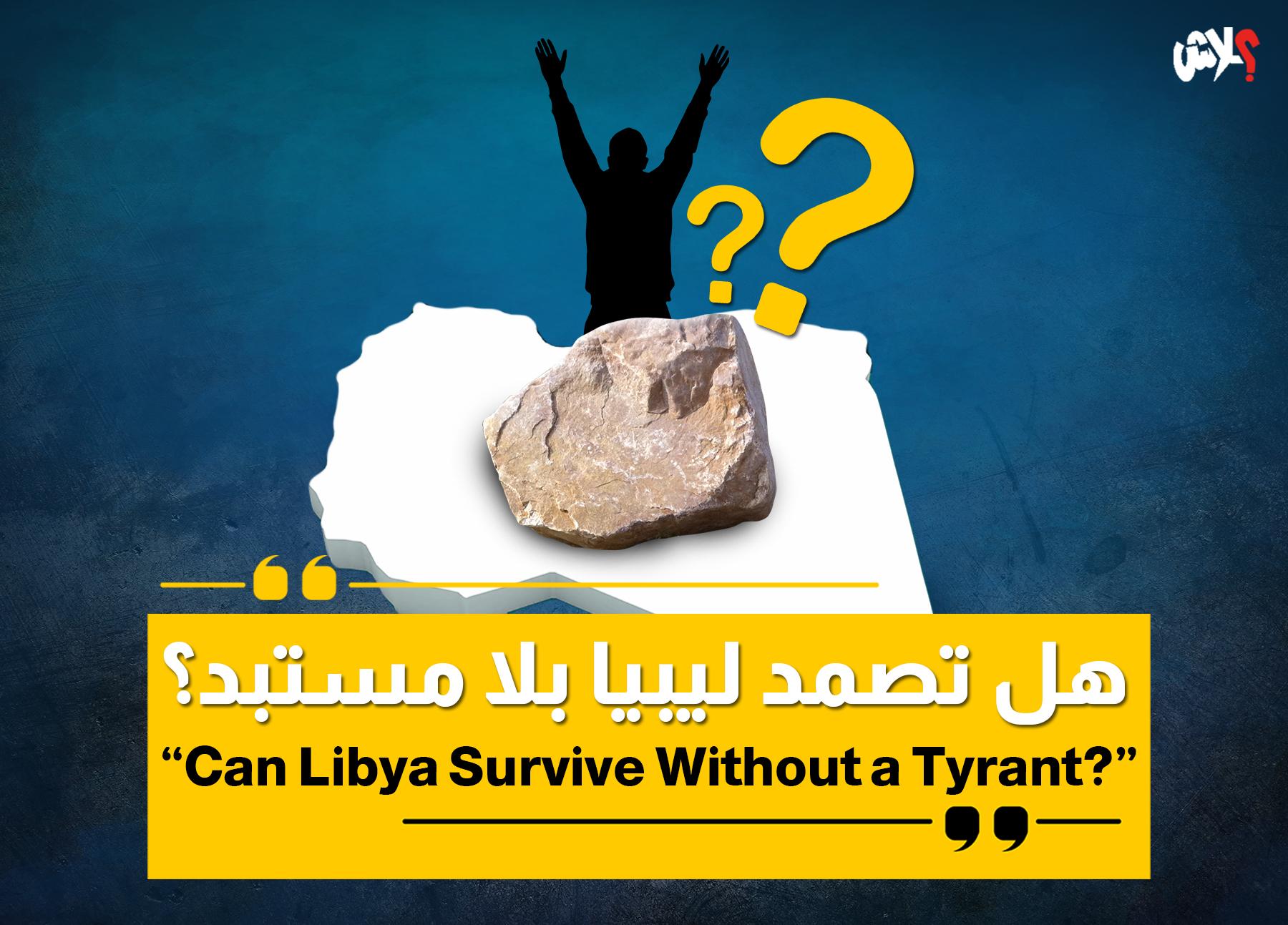
can Libya Survive Without a Strongman?
Libya, within its current political borders, was nothing more than a product of international geopolitical shifts following World War II. Before 1951, Libyan territory had always been a stage for competition between great powers each in its own era or between local tribes within their respective spheres of influence, without ever possessing a unified national identity at any historical point.
Although independence granted Libyans a political entity that brought them together, this entity remained fragile in the face of deep or shallow tribal, regional, and even ethnic divisions that became starkly visible after the fall of the Gaddafi regime in 2011, reviving a question long suppressed by the force of reality: Can Libyan unity survive without a power imposed by authority?
With the collapse of the former regime, the political and security vacuum became fertile ground for fragmentation. From the earliest days of the 2011 revolution, eastern Libya (Cyrenaica / Barqa) declared its separation from the control of the central state in Tripoli, igniting a wave of calls for autonomy or even full secession. Yet a sweeping sense of national unity dominated the protests in the Courthouse Square during the revolution, temporarily quelling such sentiments. Added to that was the political pragmatism of certain ambitious actors who believed that settling for Cyrenaica while Gaddafi remained in Tripoli and Fezzan would amount to political suicide killing the dream of a Cyrenaican state even before its birth. Thus, secessionist dreams were postponed temporarily until Gaddafi’s fall. Once that occurred, the calls quickly resurfaced as several political bodies began forming and holding meetings to promote the revival of the Cyrenaican state.
The most infamous of these was the so-called Soap Factory Meeting of 2012, but the strongest and most influential phase came during Ibrahim Jadhran’s control of the oil ports, leading to the creation of the Cyrenaica Political Office in 2014. Suddenly, the dream of secession shifted from a distant mirage to a tangible, almost-achievable reality. And although most Tripolitanians maintained their support for a unified state and rejected separation, the Cyrenaican movement of that period caused secessionist rhetoric in Tripoli to echo loudly across all corners of what was dubbed the Tripolitanian Republic. The debate began shifting from secession or not to a new question: Where would the borders of the new emerging states be drawn from the Pillars of Phileni or from the Red Valley?
Amid this fragmentation, the name Khalifa Haftar emerged as a military force asserting its dominance over the east starting in May 2014. Haftar’s name transformed from a rebel commander in the west to a general, then a field marshal, as he consolidated control over the east through Operation Dignity. He tightened his grip on all institutions and crushed any voice opposing his absolute rule including secessionists.
Supporters of this view argue that Haftar transformed the east from a region torn by separatist demands and pockets of jihadist influence into a unified political and military bloc despite criticism of his repressive methods. Some analyses even suggest that his presence prevented the state from collapsing entirely and fracturing into multiple micro-states.
But this supposed stability is not without contradictions. Haftar, who raises the banner of unity, in reality launched a war against the UN-recognized Government of National Accord in the west in 2019, and he continues to support a rival government led on paper by Osama Hamad that opposes the government formed through a UN-led political dialogue in 2020. For many, Haftar’s portrayal as the sole, perhaps final, guarantor of Libyan unity is rooted in his ambition to control all Libyan territory, not just Cyrenaica. In other words, the unity he seeks is not the product of genuine national conviction but of a political ambition typical of an authoritarian military ruler who refuses to settle for governing a small region and instead aspires to rule an expansive state.
Herein lies the dilemma: those who reject Haftar’s dictatorship his sidelining of political institutions and repression of dissent find themselves confronted with a troubling question: What happens if the man disappears? Would secessionist movements return with greater force? Modern Libyan history suggests that tribes, regions, and identity-based factions move quickly to fill the vacuum whenever strong central authority recedes. This raises an ethical question: Should democracy and human rights be sacrificed in exchange for preserving geographic unity?
Global experiences show that authoritarian regimes may achieve short-term stability, but they plant the seeds of deeper crises. True Libyan unity cannot be built on military coercion but rather on a new social contract in which all Libyans east, west, and south participate in shaping a decentralized system that protects everyone’s rights and balances the shared national identity (religion, language, history) with local particularities.
Relying on figures like Muammar Gaddafi or Khalifa Haftar only postpones crises rather than solving them.
Today, Libya stands before two difficult choices: either continue in a fragile truce maintained by military dominance that temporarily suppresses divisions, or risk a new civil war if the controlling force disappears. But a third option despite being the hardest remains the most viable in the long term: building institutions that redefine national unity not as land ruled by force, but as a shared project willingly embraced by Libyans.
States are not built only by strong men; they are built through the will of a people who believe that their unity, existence, and freedom matter more than power struggles.