
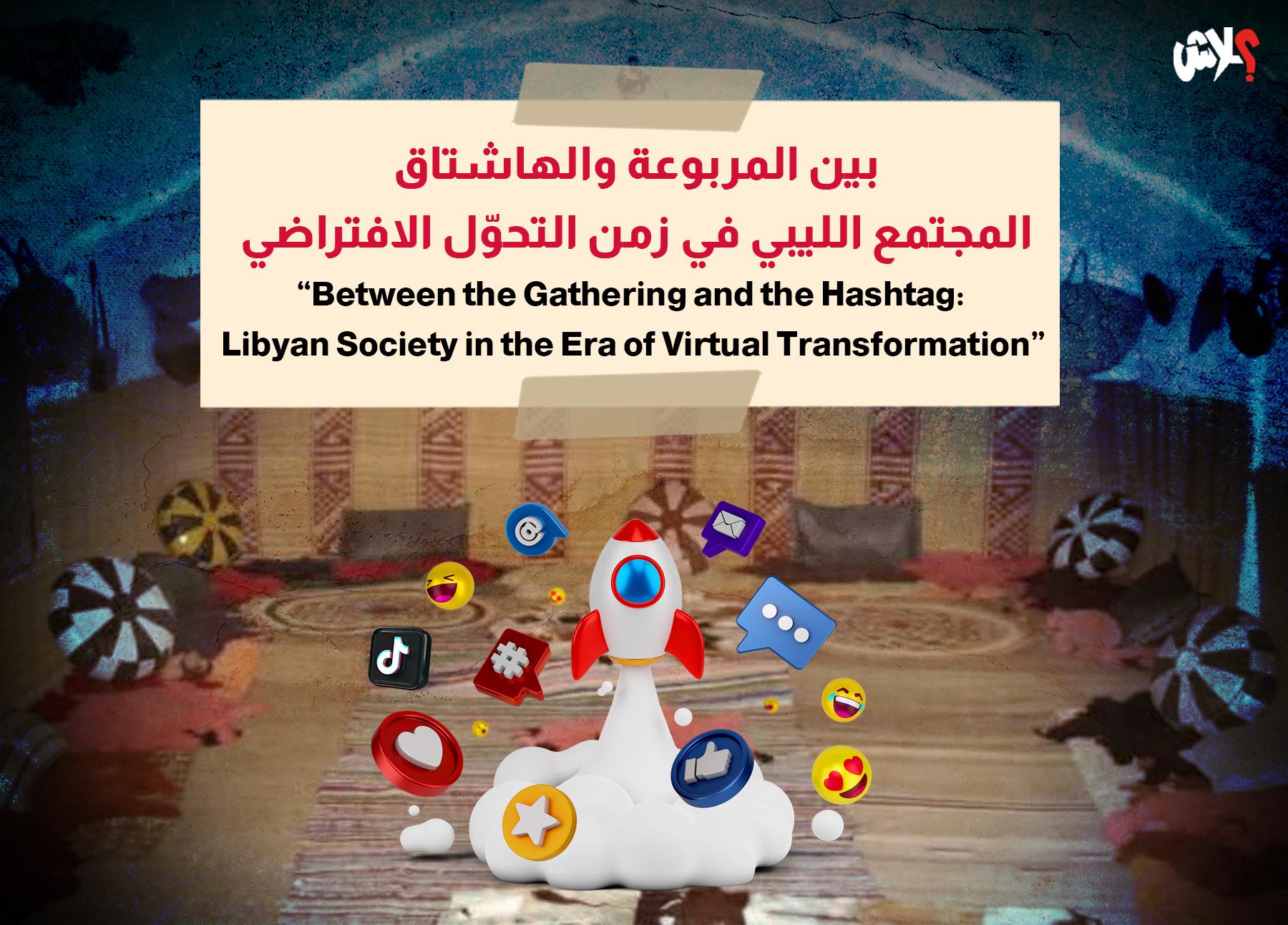
Between the Majlis and the Hashtag: Libyan Society in an Age of Virtual Transition
Libyan society represents a unique case in the region, shaped by a complex mix of historical, cultural, and religious factors, alongside rapid social and economic transformations. For decades, the tribe, the majlis (mabrū’a), and direct social networks formed the backbone of communication, providing individuals with a sense of belonging and a space albeit limited through which they could express themselves within traditional boundaries.
But with the rise of the internet and the expansion of social media over the past two decades, a parallel reality has emerged one that has become an integral part of daily life, especially among the youth. Today, platforms like Facebook, WhatsApp, TikTok, and Instagram are no longer mere tools of interaction; they have become alternative majalis digital spaces where social and political issues are debated, perceptions are shaped, and judgments are issued.
The new “influencers,” many of whom possess neither expertise nor genuine intellectual grounding, have become the sheikhs of the digital age. They steer public opinion, distribute labels, and decide who is “patriotic” and who is a “traitor,” based solely on the reactions of their followers.
What is happening is no longer a matter of personal expression; these platforms have turned into mechanisms of influence sometimes even threats to social peace when online disputes escalate into real-life incitement. In this environment, the name of an armed-group commander can rise to prominence not because of his actions on the ground, but because a popular influencer endorses him. We see videos portraying these figures as saviors repairing roads or distributing aid while behind the scenes, dubious deals and money laundering are wrapped in the packaging of fictitious “spatial development” projects.
This manufactured image is a form of consciousness distortion one of the most dangerous consequences of this digital shift taking root in Libyan society.
Within this new reality, Libyan identity itself is undergoing an unconscious reshaping. The young person who once absorbed values from family, tribe, and majlis gatherings now draws his standards from digital personalities detached from real life. Concepts of honor, belonging, and patriotism are no longer passed from grandfather to grandson in nightly gatherings they now pass through a quick post or a meaningless TikTok challenge. This rupture between heritage and the digital present has produced a generation with unstable identity and scattered loyalties, driven by rapid emotional impulses leaving society increasingly fragile and vulnerable to internal or external manipulation.
Yet this transformation is neither uniform nor complete. In major cities where internet access is stronger the digital sphere dominates daily life. In rural areas, traditional structures remain more prominent. There is also an evident generational gap: youth live most of their lives through screens, while elders still prefer the physical warmth of the majlis.
This disparity deepens communication gaps and complicates discussions of shared issues. It’s undeniable that social media has created new spaces for expression especially in a context of political stagnation and restricted freedoms. But these spaces have also produced a form of intellectual and emotional chaos. Misinformation spreads quickly. Facts blur into opinions. Public sentiment fluctuates unpredictably, fostering tension and polarization.
Today, we exist in a grey transition neither fully traditional nor fully digital.
We live in a “semi-virtual society” where the digital and the traditional intermingle, and where influence is contested between the tribal sheikh and the TikTok influencer, between the majlis gathering and the WhatsApp group.
This moment demands heightened awareness and collective responsibility, because the danger does not lie in technology itself but in how it is used.
Dear citizen:
Do not be a passive recipient of whatever appears on your screen. Think. Verify. Question. Debate.
Do not allow clowns to shape your awareness or trap you in their narrow labels.
Reject those who sell illusions and cloak theft in loud slogans.
If you don’t, you may wake up years from now in a distorted society, wondering how it became this way while the truth was passing before your eyes every day, in the form of a short video or a neatly written comment.