
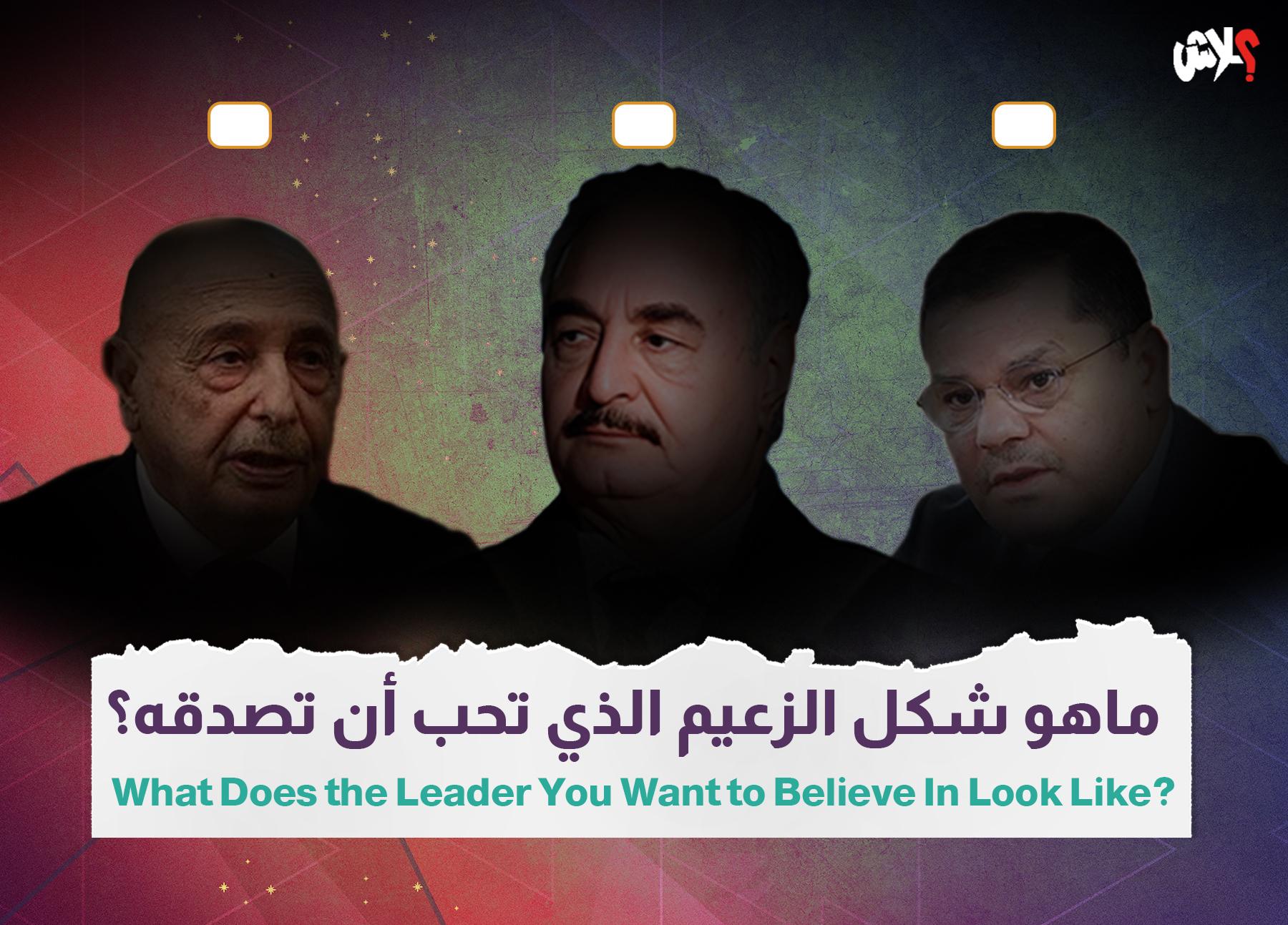
What Kind of Leader Do You Want to Believe In?
Politics, at its core, is nothing more than a reflection of what people want or at least what they think they want. But the deeper problem is that the public often demands something without being willing to pay its price. People want change, but they do not want to bear the cost of it. They prefer to wait for luck or a political miracle rather than acknowledge that the path to real change is paved with sacrifice and hard work. In this context, the politicians most skilled at selling illusions are the ones who succeed, because they appeal to people’s dreams without ever pointing to the cost of achieving them.
This dynamic is not theoretical; it is the lived reality of the Libyan political scene, where this pattern is embodied in figures like Abdulhamid Dbeibah, Aguila Saleh, and Khalifa Haftar.
Abdulhamid Dbeibah is a textbook example of a politician who makes grand promises without presenting a clear plan for execution. He presented himself as a leader capable of delivering economic revival raising salaries, supporting youth, revitalizing the economy yet he never explained how this could be achieved in a fragile rentier economy plagued by sharp political divisions. His strategy relied on repeating the slogan of “The Return of Life” without confronting the hard truth: there is no development without stability, and no stability without difficult, often unpopular decisions. Still, he managed to rally widespread support, because people preferred to hear what they wanted even if it was unachievable.
Aguila Saleh, for his part, played a different tune but shared the same core approach: political promises without practical solutions. He consistently portrayed himself as the guardian of institutions and the defender of the state against chaos, yet in reality, he was a key actor in obstructing political settlements whenever they threatened his interests. He adopted the rhetoric of “protecting legitimacy,” while exploiting political deadlock to preserve his influence. Thus, he won support from certain groups not because he offered solutions, but because he played on public fears of chaos, presenting himself as the necessary alternative.
As for Khalifa Haftar, he was more explicit in his messaging, though no less generous with promises. He built his image as a military leader capable of imposing order by force, exploiting the longing of many Libyans to end chaos at any cost. He vowed to eliminate militias and restore the state, yet never explained how this could be done amid deep internal divisions and complex regional rivalries. And while he did impose control over certain areas, his project failed to deliver comprehensive stability because it relied solely on force, without building sustainable political institutions. Nonetheless, he retained a strong support base, because many preferred to believe he might be the “strong man” who could deliver solutions, even without evidence that his project could succeed in the long term.
Across all these cases, the same pattern emerges: the public wants easy solutions, and politicians offer promises without acknowledging the real price. This is not unique to Libya, but it is far more visible here due to the complexity of the crisis and the multitude of foreign and regional actors involved. Libyans want the chaos to end, but cannot agree on how. They want stability, but are unwilling to give up factional or tribal privileges. They want a prosperous economy, but resist the difficult reforms required to achieve it.
This environment makes political manipulation easy, because politicians know that grand promises attract attention more than hard truths. That is why the most successful politicians are often the most evasive: they sell hope without calculating the cost.
Unless Libyans understand that real change cannot come from waiting for miracles, but from political awareness and action, the political scene will continue to revolve in a vicious circle. Unless people change their understanding of what they truly want and are willing to pay the price politics will remain a stage filled with characters who know exactly what the audience wants to hear, yet have no intention of ever delivering it. What Kind of Leader Do You Want to Believe In?
Politics, at its core, is nothing more than a reflection of what people want or at least what they think they want. But the deeper problem is that the public often demands something without being willing to pay its price. People want change, but they do not want to bear the cost of it.They prefer to wait for luck or a political miracle rather than acknowledge that the path to real change is paved with sacrifice and hard work. In this context, the politicians most skilled at selling illusions are the ones who succeed, because they appeal to people’s dreams without ever pointing to the cost of achieving them.
This dynamic is not theoretical; it is the lived reality of the Libyan political scene, where this pattern is embodied in figures like Abdulhamid Dbeibah, Aguila Saleh, and Khalifa Haftar.
Abdulhamid Dbeibah is a textbook example of a politician who makes grand promises without presenting a clear plan for execution. He presented himself as a leader capable of delivering economic revival raising salaries, supporting youth, revitalizing the economy yet he never explained how this could be achieved in a fragile rentier economy plagued by sharp political divisions. His strategy relied on repeating the slogan of “The Return of Life” without confronting the hard truth: there is no development without stability, and no stability without difficult, often unpopular decisions. Still, he managed to rally widespread support, because people preferred to hear what they wanted even if it was unachievable.
Aguila Saleh, for his part, played a different tune but shared the same core approach: political promises without practical solutions. He consistently portrayed himself as the guardian of institutions and the defender of the state against chaos, yet in reality, he was a key actor in obstructing political settlements whenever they threatened his interests. He adopted the rhetoric of “protecting legitimacy,” while exploiting political deadlock to preserve his influence. Thus, he won support from certain groups not because he offered solutions, but because he played on public fears of chaos, presenting himself as the necessary alternative.
As for Khalifa Haftar, he was more explicit in his messaging, though no less generous with promises. He built his image as a military leader capable of imposing order by force, exploiting the longing of many Libyans to end chaos at any cost. He vowed to eliminate militias and restore the state, yet never explained how this could be done amid deep internal divisions and complex regional rivalries. And while he did impose control over certain areas, his project failed to deliver comprehensive stability because it relied solely on force, without building sustainable political institutions. Nonetheless, he retained a strong support base, because many preferred to believe he might be the “strong man” who could deliver solutions, even without evidence that his project could succeed in the long term.
Across all these cases, the same pattern emerges: the public wants easy solutions, and politicians offer promises without acknowledging the real price. This is not unique to Libya, but it is far more visible here due to the complexity of the crisis and the multitude of foreign and regional actors involved. Libyans want the chaos to end, but cannot agree on how. They want stability, but are unwilling to give up factional or tribal privileges. They want a prosperous economy, but resist the difficult reforms required to achieve it.
This environment makes political manipulation easy, because politicians know that grand promises attract attention more than hard truths. That is why the most successful politicians are often the most evasive: they sell hope without calculating the cost.
Unless Libyans understand that real change cannot come from waiting for miracles, but from political awareness and action, the political scene will continue to revolve in a vicious circle. Unless people change their understanding of what they truly want and are willing to pay the price politics will remain a stage filled with characters who know exactly what the audience wants to hear, yet have no intention of ever delivering it.