
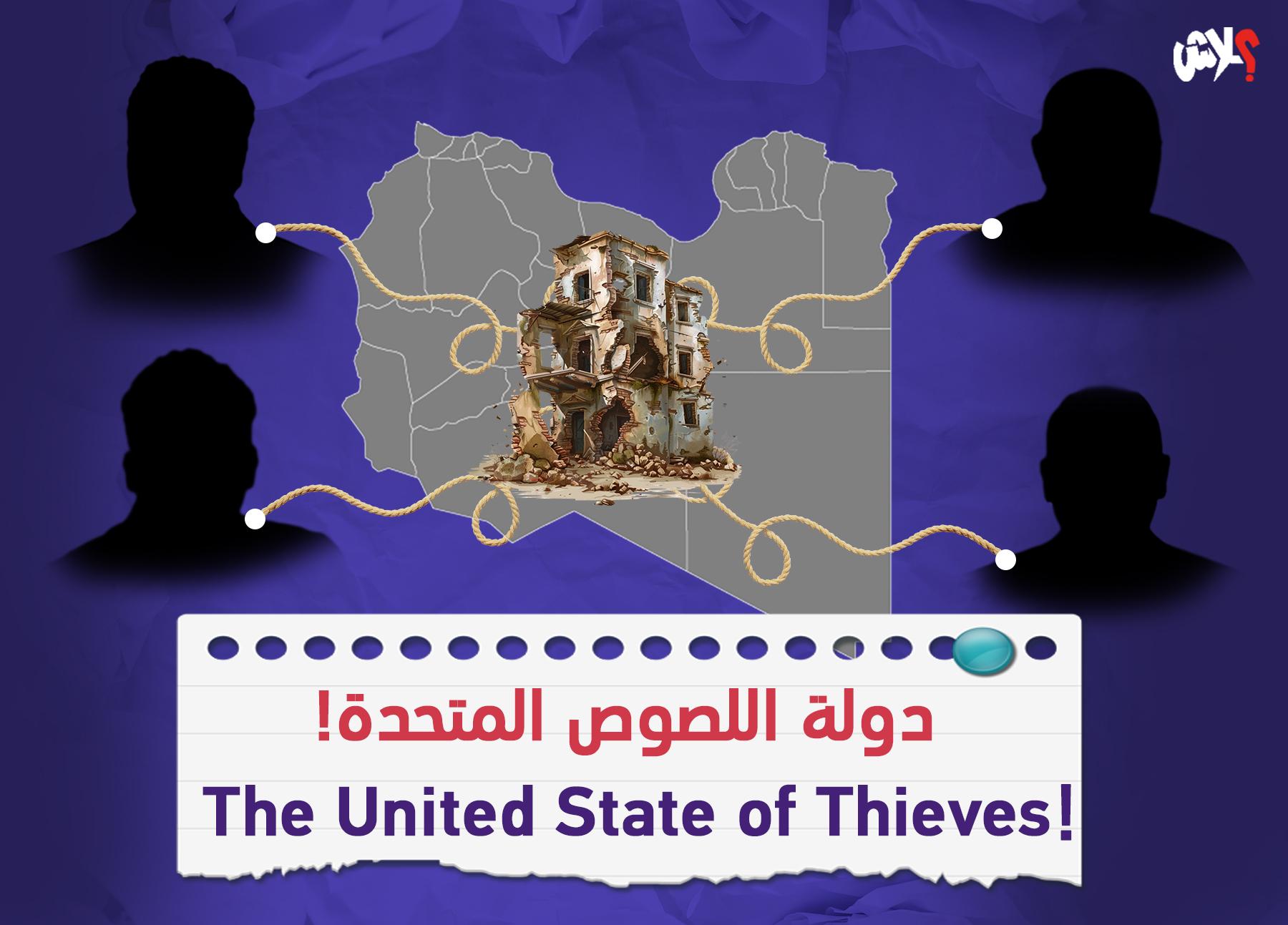
“The United States of Thieves!”
It is no longer a secret that the days we are living through may be the worst in the country’s modern history. We live under the domination of unruly armed groups, governed by two rival administrations competing only in their mastery of one skill: wasting public money.
Just days ago, the Central Bank of Libya released a detailed report on the spending of both the eastern and western governments during the past months. The report informed an exhausted people that their wealth is being squandered recklessly and on a terrifying scale all while hunger surrounds their homes and poverty approaches like a dark abyss, swallowing more citizens every day, every hour, adding them to the ranks of the poor and desperate.
For those living in reality, the numbers were not shocking. They were more like an unofficial death certificate for our hopes that our children might live better lives than we did. With explosive increases in military and security spending, inflated salaries, exceptional privileges, millions of “paper employees,” and projects that are either nonexistent or rotted by corruption before even opening the question that haunts every Libyan remains:
Where are our billions going?
Amid this storm, the Central Bank Governor emerged to announce “promising” meetings with the Prime Minister of western Libya, Abdulhamid Dbeibah, and his eastern counterpart, Osama Hamad, hinting at their “readiness to meet in the national interest.”
What sounded at first like a glimmer of hope quickly turned into a wave of ridicule. Hamad announced a so-called “package of economic reforms,” without uttering a single word about the billions lost to phantom projects and daily corruption deals in both east and west. Instead, he proposed “reforming” the tax and customs systems which together represent less than 1% of state revenue as if Libya’s problem were a shortage of money rather than the mass plundering of it in corrupt deals run like a public auction at the people’s expense.
The two adversaries ruling our necks east and west have disagreed on everything except one: stealing from us. And the more each steals, the deeper the state’s deficit grows, leading to a weakened dinar and soaring foreign exchange rates a knife at the throat of every Libyan family.
While officials feast on dividing the national cake, the citizen struggles to afford a single loaf of bread. International reports indicate unprecedented spikes in inflation. Yet the two governments excel only at pretending to save us from “the worse alternative”:
The western government steals in the name of protecting us from authoritarianism and militarization.
The eastern government steals in the name of protecting us from terrorism and the Muslim Brotherhood.
And the darkest scenario a total collapse of the state remains on the horizon as long as oil billions continue to flow into the bottomless sewer of corruption.
In the most painful part of the picture, the Libyan public seems to be contributing skillfully to its own tragedy. While their wealth is plundered and their children’s futures stolen, many are busy with trivial football disputes or gloating over politically orchestrated arrests performed as security theater. The uncomfortable question remains:
Where is the public outrage demanding accountability?
How did Libyans accept a life reduced to a match between thieves competing to steal whatever is left of the nation?
History, too, repeats itself in Libya with infuriating clarity. Each time the country rids itself of one thief, it hands itself over to another one more cunning and more experienced than the last. Just as Libyans nostalgically recalled Gaddafi’s era when theft was counted in millions and reminisced about the days of the Salvation, Accord, and Disaccord governments when theft reached tens of millions today’s leaders, despite stealing in the billions, warn us that their departure would bring disaster.
Perhaps they are right. They are stealing the future. And when that runs out, the next rulers will steal the present and the past, and may even throw us out of our homes. And, truthfully, we will have only ourselves to blame .
just as the Arab proverb says: “Baraqish brought ruin upon herself.”