تحقيقات

Introduction :
Behind the white walls of hospitals, the sounds of devices and the steady, rhythmic beeping blend with the anxiety of waiting families. All of them are searching for one sentence from the doctor: Is the condition stable? But is that always the truth?
Between the trust people place in doctors, and files that may never be opened, the question remains present: do our loved ones die because illness is stronger than the body, or because negligence comes before treatment?
This investigation opens a door onto what is hidden behind the white curtains: testimonies from families who entered the hospital carrying hope, and left with bodies and endless questions. Here, we are not talking about an inevitable fate, but about mistakes and negligence that can turn into free death, and about a health system that turns the treatment room into a stage of loss one that nothing justifies except the absence of accountability.
A testimony reveals what lies behind the silence .
No one expected that a simple catheterization procedure, performed in one of the hospitals, would turn into the beginning of a mysterious journey toward death. The procedure went well, the stent was placed as it should be, and the condition was stable, to the point that the patient’s son filmed his father in a short video, speaking calmly and appearing in excellent health. But in less than twenty-four hours, everything changed.
With a voice weighed down by pain, the son’s words come out choked by a lump that almost suffocates him. His features are a mirror of misery and regret, as if screaming helplessness: his helplessness at being unable to be a witness to what happened to his father, or even to know exactly what happened to him.
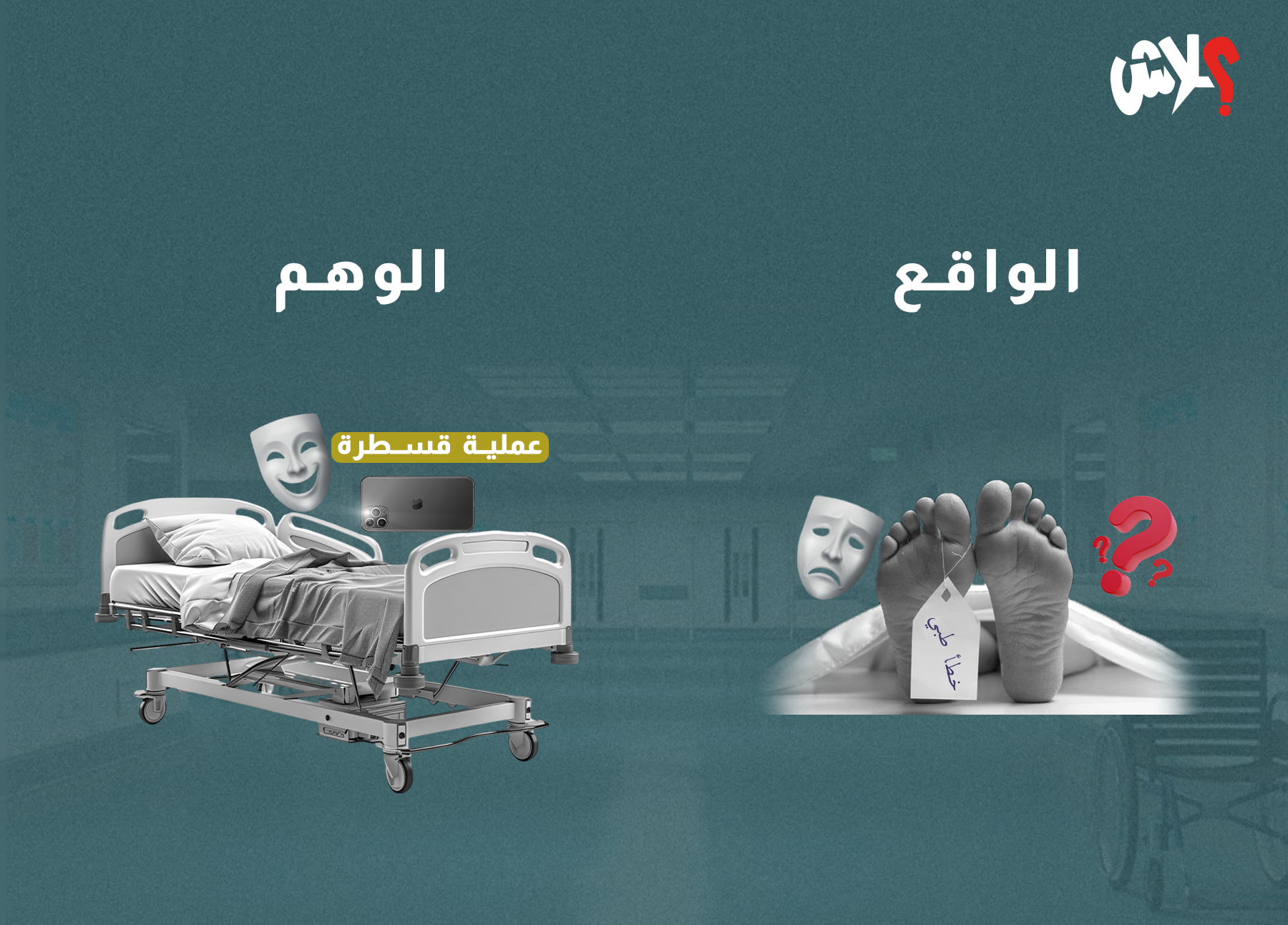
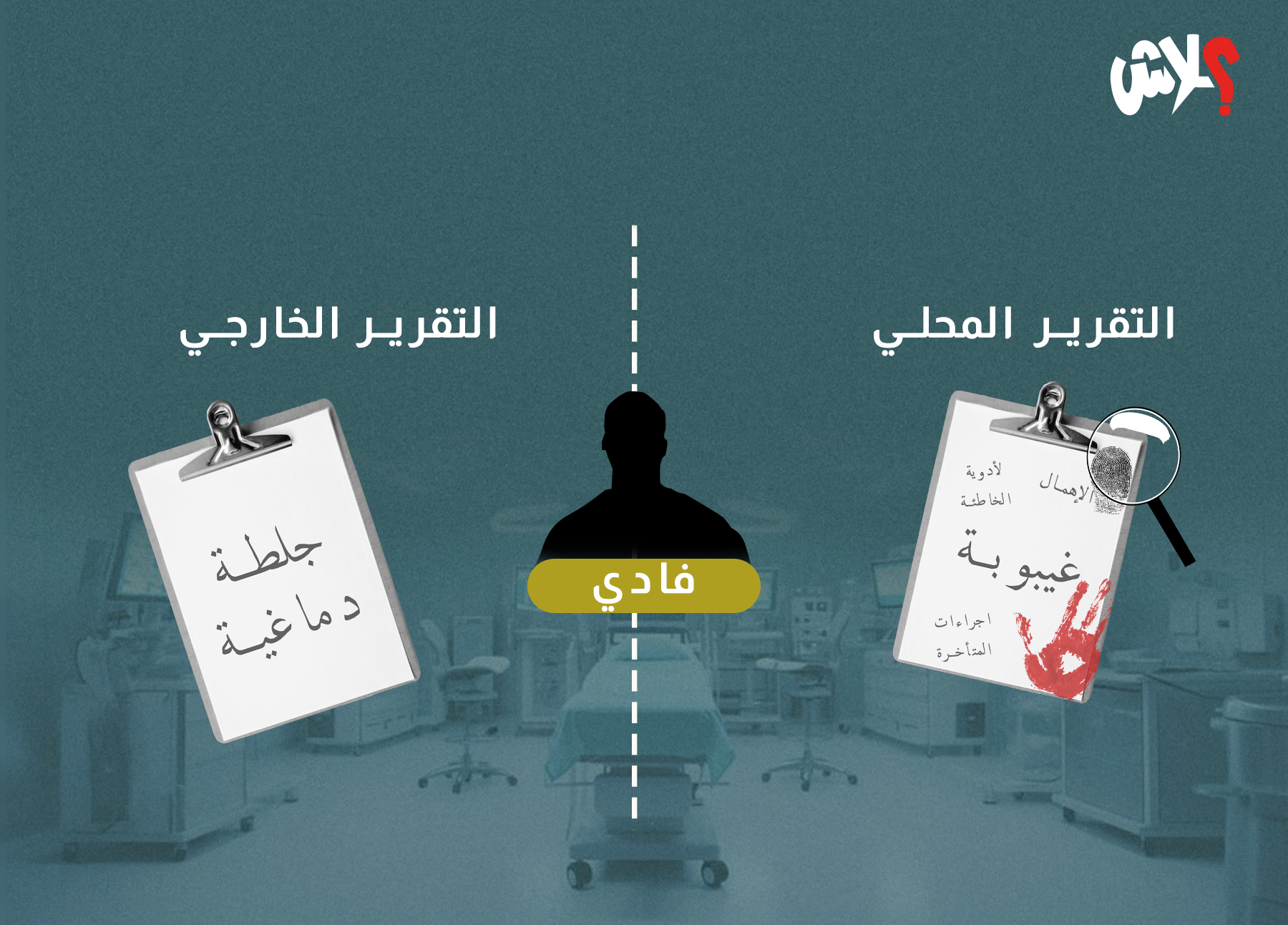
The son, Fadi) a pseudonym (says)The next day after the procedure, we noticed that my father’s condition suddenly deteriorated. We were looking for an explanation, but the doctors assured us there was nothing to worry about. Later they said they performed a CT scan of his head and found nothing, but that scan was not sufficient to detect a stroke. No one told us what was happening, and everything felt like attempts to conceal the truth When the patient was transferred to Tunisia, the shock was even greater: a major stroke, likely as a result of an increase in doses of blood-thinning medication. Within just days, the father lost his life.
Fadi continues: I have a video showing how he was speaking normally after the procedure, and another video showing his horrific deterioration after a day or two. The difference between the two scenes is enough to confirm that what happened was not fate and destiny, but the result of clear negligence and gross medical malpractice.
But the tragedy did not stop here; Fadi decided to turn to the law. He filed an official complaint with the Public Prosecution and demanded the medical file to review the treatment procedures his father underwent, but the surprise was that they received only a discharge paper just a paper that is not a medical file and explains nothing. Forensic Medicine intervened and confirmed that what was provided is not considered a medical file, so it requested it again, but the response came as denial. The archive department says one thing, the intensive care department says another, and each side throws responsibility onto the other.
Here the questions emerge: why is the medical file being hidden? What is inside its pages that makes the entire hospital disown responsibility?
Fadi also confirmed that if the file were sound and free of mistakes, they would have handed it over easily and cleared themselves before justice. But they hid it, and that in itself is evidence of a crime from Fadi’s point of view. According to his account, the file contains the truth, and he confirmed that the truth they fear is major negligence, wrong medications, and delayed procedures.
As for the medical report coming from Tunisia, it confirmed what the local report tried to deny: a major stroke in the brain, while the first report simply wrote: entered a coma. Here Fadi asks, as he recounts and relives these painful memories: Can they reduce a human tragedy and a whole life to a single word: coma? Isn’t that blatant falsification of the truth, without clarifying the cause of the coma?
Today, after time has passed, the legal stalling continues, and the medical file is still missing. But Fadi insists he will not back down, and that for him this is not only a case of death, but a case of a clear crime, collusion by multiple parties, and negligence and evasion of responsibility. He explained that there was clear negligence by the medical staff, medications were administered incorrectly, and the measures taken after his condition deteriorated were not appropriate and not merely natural complications. The person directly responsible for follow-up was the cardiology specialist, who was monitoring his father’s condition by phone from another hospital, without attending in person.
He confirms that all evidence and documents are available to support the complaint, and that the doctor’s direct supervisor bears full responsibility, as he was overseeing the case remotely, and there was failure by the relevant departments in the hospital.
A traffic accident and medical negligence.
And if the details of the first case revealed negligence inside hospital walls, the scene does not differ much when we move to another case.
This time, negligence did not begin only at the hospital, but from the moment of the accident itself. On the ninth of August, the life of Khaled ) a pseudonym ( was turned upside down when a speeding car hit him as he tried to cross the road. He fell to the ground with swelling in the head and a dislocated shoulder, while the woman who caused the accident did not pay him any attention, leaving passersby alone to provide him with aid.
He was transferred to the general hospital, but found only fleeting looks; no hand extended to examine him, and no procedure was taken. He left carrying his pain, returning home while suffering from an ache gnawing at his body and dizziness that intensified every minute. And as the pain increased reaching an unbearable level, his body groaning and the dizziness nearly dropping him with every step he carried what remained of hope inside him and headed to a private hospital, believing that paying money would be a passport to better care, to different attention, to treatment befitting a human being in pain.
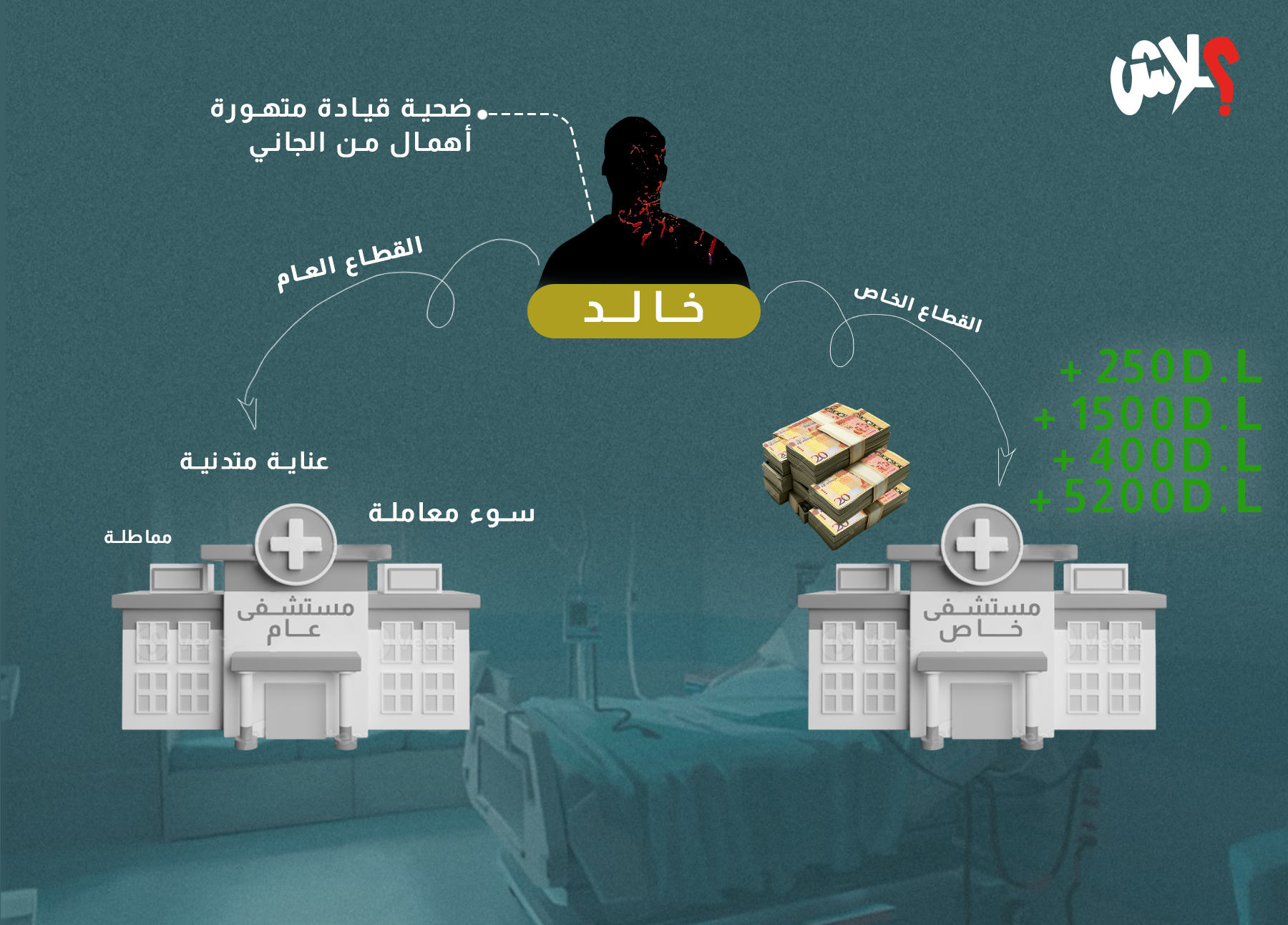
But what he faced there was shocking. The hope he carried broke at the doorstep of negligence. The reception was no different from the general hospital. The same faces, the same cold stares, and the same indifference that drove knives into his nerves before his body. He spoke with muffled pain and visible anger, as if his voice was screaming, as he described it: Even with my money I can’t find treatment!
He was left for half an hour on the bed without care, in pain without even being asked about his condition. Nurses without responsibility one of them believed that a CT scan and an X-ray are done together. His shoulder was imaged incorrectly while he was lying down instead of standing, and the truth was lost behind inaccurate images. He kept screaming in pain: My shoulder is dislocated, gentlemen! But no one listened. He had to take the doctor’s hand himself and place it on the protruding bone to prove the injury.
As for the swelling in the head, obvious to the eye, it received no attention. They did not treat it as a possible dangerous internal bleeding, but as if it did not warrant urgency. Khaled left with a bitter feeling: even in the private hospital, even while paying money, a person in his country does not find care that preserves his dignity or eases his pain. Negligence and indifference controlled the situation, and the outcome was shocking: an urgent shoulder operation.
This story is not just an accident, but a shocking testimony to a daily tragedy lived by patients. A patient bleeding with physical and psychological pain, and finding no one to save him neither in public hospitals nor sometimes even in private ones. The pain he endured was not mere coincidence, but a reflection of ongoing negligence, and a silence that kills before any blow, dizziness, or fracture.
Voices from the inside .
In this context, we tried to understand the reasons for this negligence through an interview with Dr. Haitham ( a pseudonym ), an anesthesiologist with broad experience, present in many operations, who answered general questions about medical errors. What he revealed was a mix of shock and justifications.
Dr. Haitham says: He acknowledges the existence of errors before, during, and after operations, but downplays their seriousness, confirming that they are unintentional, and that most matters are later corrected.
But how can something be corrected while the patient is suffering, and every minute of delay doubles the pain? How can the error be unintentional while daily reality is full of real suffering and unbearable anguish? Here lies the striking contradiction: on one side, a patient struggling with pain and betrayal; on the other, an official medical view that looks away from tragic outcomes, as if patients’ voices are not heard.
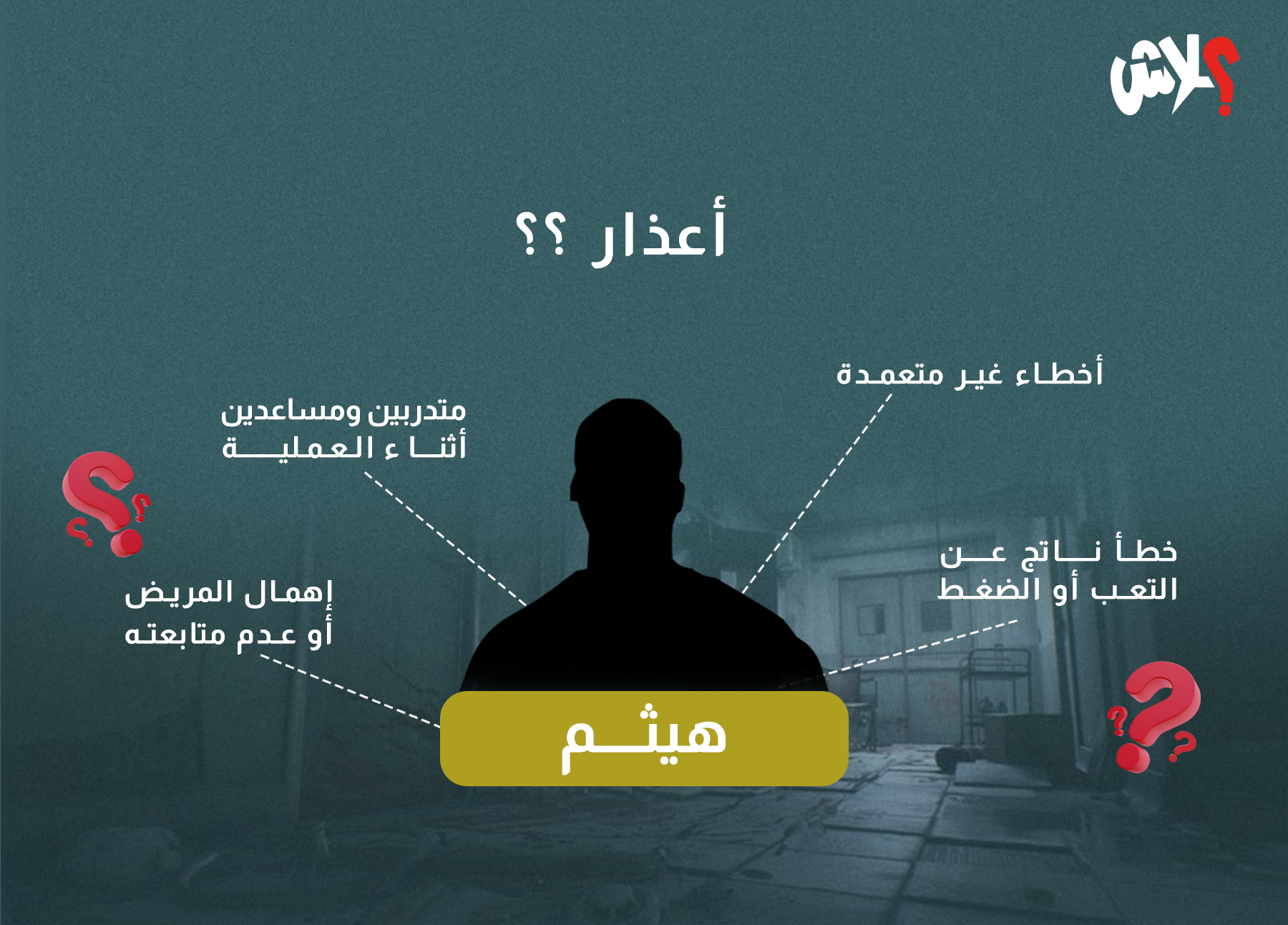
According to him, errors before the operation often result from weakness or failure to take the medical history accurately, or the patient not being fully informed about their condition. As for errors during the operation, they are according to him often the result of the patient’s sensitivity to a certain substance or medication, or injury to one of the organs. But he explains that the matter is usually remedied, as if everything that happens cannot be catastrophic, in his view!
He points out that errors after the operation happen due to the patient’s negligence or lack of follow-up, confirming that they are unintentional errors, and that he has not seen a deliberate error resulting from negligence or a death caused by a medical error. Yet he admits that many cases obtained their rights through the judiciary or by filing lawsuits, but he describes these rights as sometimes: took his right and more, as if they are merely financial matters and not a matter of life or death.
He also tried to evade responsibility by saying that errors resulting from fatigue or pressure on the medical staff happen, but that some responsible individuals are held accountable and matters are remedied by increasing the number of doctors as if every dysfunction can be fixed easily, without pointing to the real harm that may be inflicted on patients. Regarding the presence of trainees performing the operation, he stressed that the operation is always carried out by a specialist or consultant, and that the trainee does not perform the operation, but he implicitly admitted the presence of assistants or trainees helping during the operation, which opens the door to possible errors.
From all of this, it appears that medical errors do exist before, during, or after the operation and that the doctor tends to downplay their severity and evade responsibility for their consequences, even in cases that caused major problems for patients, as if the matter is confined only to getting his right with money and not to the physical or psychological harm that may be inflicted on the patient.
Medical errors and negligence under an old law According to Law No. 17 of 1986 on medical liability, lawyer Adnan Othman Abu Aisha says the law defines medical error as (any professional error arising from the practice of a medical activity that causes harm to others, and professional error is considered a breach of obligation according to applicable legislation or recognized scientific principles, taking into account circumstances and available capabilities. The occurrence of harm is also considered a presumption of committing the error or breaching the obligation)
He also states that there is a clear difference between unintentional medical error and criminal negligence: Unintentional medical error: arises from lack of competence or an unintentional shortcoming in following scientific principles, with absence of intent. Liability here is based on breach of professional duty, as for gross negligence: it is dangerous laxity that leads to major harm, and is classified under disciplinary or even criminal liability.
He also notes that there are no specialized medical courts, and cases are heard in ordinary courts, and the law is old (more than 30 years) and has not been updated to keep pace with developments in modern medicine, and there are no clear provisions for handing over medical files and reports after death.
Also, the absence of a precise distinction between unintentional error and gross negligence leaves the assessment of responsibility to the judge’s or medical experts’ discretion.
This situation may lead some parties to fall short in pursuing victims’ rights, and often the balance tilts in favor of the doctor at the expense of the patient.
The patient or their family also has the right to access the full file, and the doctor is obligated to cooperate and disclose the health condition and inform the patient’s family if required by interest. As for penalties, they range between warning, reprimand, salary deduction, or suspension from practicing the profession, and may rise to criminal and civil penalties when gross negligence or deliberate error occurs.
Conclusion The most important question remains unanswered: Who holds accountability when the hospital turns from a house of healing into a theater of loss? Death is in God’s hands, but when it becomes the result of negligence or an avoidable error, the tragedy turns into a silent crime. Families leave hospitals carrying bodies and questions without files, and a wound that does not heal because the truth was hidden behind white curtains. Medical negligence is not merely an isolated incident, but a crisis of trust that shakes the foundation of the health system. And unless files are opened and responsibilities assigned, fear will remain present:
Do we enter the hospital seeking life, or do we leave it with an irreparable loss?