تحقيقات

Much has been written about the situation of irregular migrants in Libya and the many violations they have suffered over the past years as a result of attempting to reach Europe through Libyan territory. Due to the political, institutional, and security fluidity that has characterized Libya over the past decade, conditions have created fertile ground for the rise of human-smuggling networks networks that have continuously evolved to the point where migrants are now brought from their home cities in Africa to Libya stripped of their will and their ability to make choices.
Through this investigation, we aim to show how domestic workers are brought to Libya to work without having the right to receive their wages, choose their place of employment, or determine their working conditions. They work only to eat this is how an African migrant described her situation to one of our sources who attempted to speak with her about how she arrived in Libya and what her current work conditions are.
From the European Promise to Enslavement in Libya
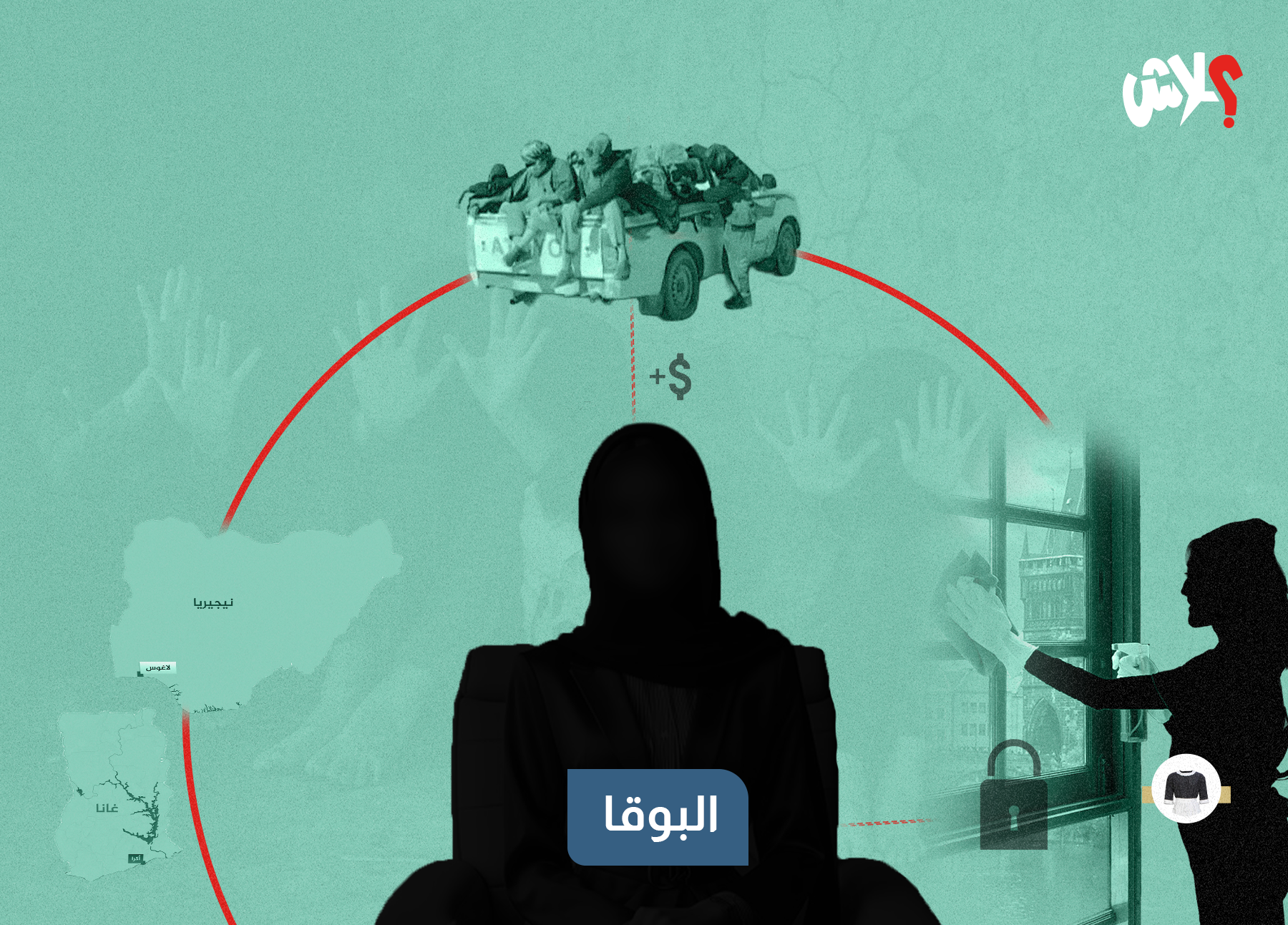
The stories of these migrant women begin in their cities across Africa, particularly in Nigeria, Ghana, and several Central African countries. Human-trafficking networks exploit their dire economic conditions, offering them promises of reaching Europe through Libya. These promises often come from a woman known as the “Boga”, who is responsible for recruiting domestic workers, paying the smugglers on their behalf, and thus effectively gaining full ownership of the worker until the “debt” and profits are repaid.
Upon arrival in Libya, the Boga arranges housing for the workers shared with others in residences that lack basic sanitary standards. They live in crowded, cramped rooms, and at this stage, the migrant enters what we describe as the “new slave market.”
How Fake Companies Operate and Control Domestic Workers
At this stage, the Boga moves in one of two directions: either she personally contacts Libyans seeking domestic workers, or she partners with so-called labor companies unlicensed entities consisting only of a name and logo, without any real authorization or regulation from the Ministry of Labor. This is despite the fact that Libya’s Labor Law No. 12 of 2010 regulates the recruitment of workers, requiring that they enter Libya legally.
Here, however, the workers enter the country illegally, smuggled across borders making them legally invisible and placing them in extremely exploitative contractual situations with no protections whatsoever.
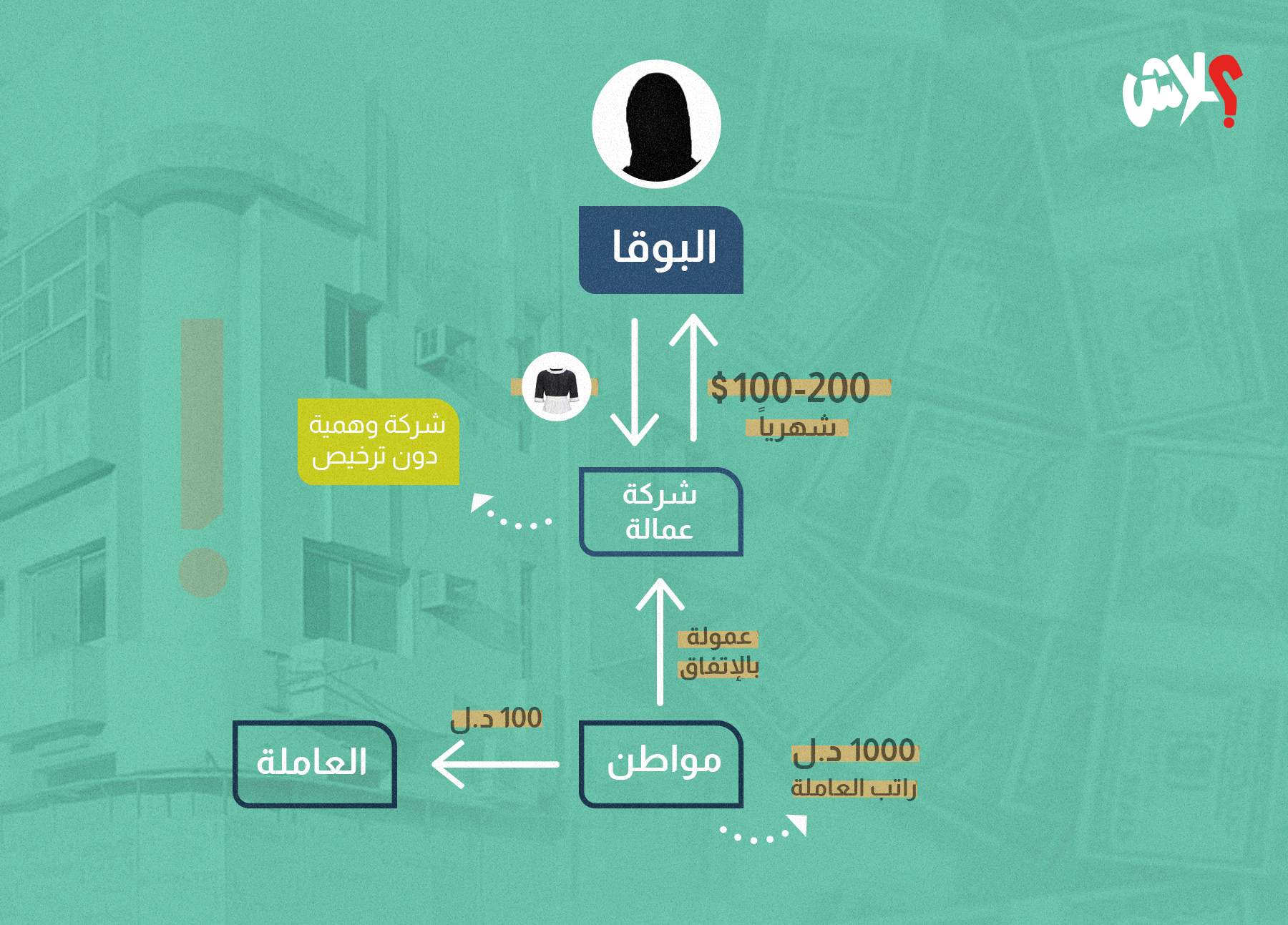
The Boga provides the workers to these fraudulent companies, which then distribute them to Libyan households. In return, the Boga receives a monthly commission ranging between 500 and 1,000 Libyan dinars (100–200 USD) for a period ranging from six months to a year. This income is separate from the share deducted from the worker’s salary to cover the smuggler’s fee for transporting her from her home country to Libya an amount that reaches 25,000 Libyan dinars (5,000 USD).
A worker typically needs about three years of daily labor to pay off this amount, while the fake company receives its own commission from the Libyan employer.
The worker’s salary is divided as follows: an average monthly wage of 1,000 dinars (200 USD), of which the worker sometimes receives only 100 dinars (20 USD). The rest goes to the Boga and the company, in addition to a “tax” paid by the company to the Boga for a period of three to six months, and sometimes up to a year, depending on the worker’s nationality and demand in the labor market.
To verify this narrative—based on testimonies from several of our sources a member of our team posed as someone seeking to open a labor company and communicated with one of the Bogas whose number we obtained from a source. He conducted a recorded phone conversation in which she confirmed all the details we gathered, including the financial amounts extracted from domestic workers, and expressed her willingness to provide as many as ten women.
Testimonies from the Inside: Inspection, Humiliation, and Wage Theft
As part of this investigation, we were able to reach one of the workers employed through such companies and obtain details regarding the management of the workers, the legitimacy of these companies, and the origin of the domestic workers.
“Rahaf” (a pseudonym) stated:
“As a cleaning company, we deal with domestic workers coming from Nigeria, and all of them enter Libya illegally, without official contracts or legal residency. They enter the country without valid passports or with forged documents. We hope the state will make things easier by issuing legal passports, residency permits, or any official papers that guarantee the workers’ rights and facilitate our work as companies, so that problems do not arise.”
Rahaf added regarding the payment system:
“The worker’s salary usually comes to the company first, then her sister or a relative in Libya transfers the money directly to her family in Nigeria. The worker herself does not receive the cash. Their stay with us varies some stay three months, others six or eight months, and some renew and stay longer before returning home and coming back to work again.”
Rahaf also confirmed that the workers are subjected to humiliating personal searches every time they enter or leave a household:
“As a company, when a worker enters a workplace, we search her to ensure she does not carry anything prohibited, and we search her again when her shift ends. But no entity can fully guarantee a worker’s behavior we can only try to ensure she does not run away. We cannot guarantee she won’t commit theft, for example.”
These testimonies confirm the dire reality: workers earn almost nothing, undergo mandatory personal searches, and survive only on the food provided in the households where they work.
The Second Path: Total Control Under the Boga
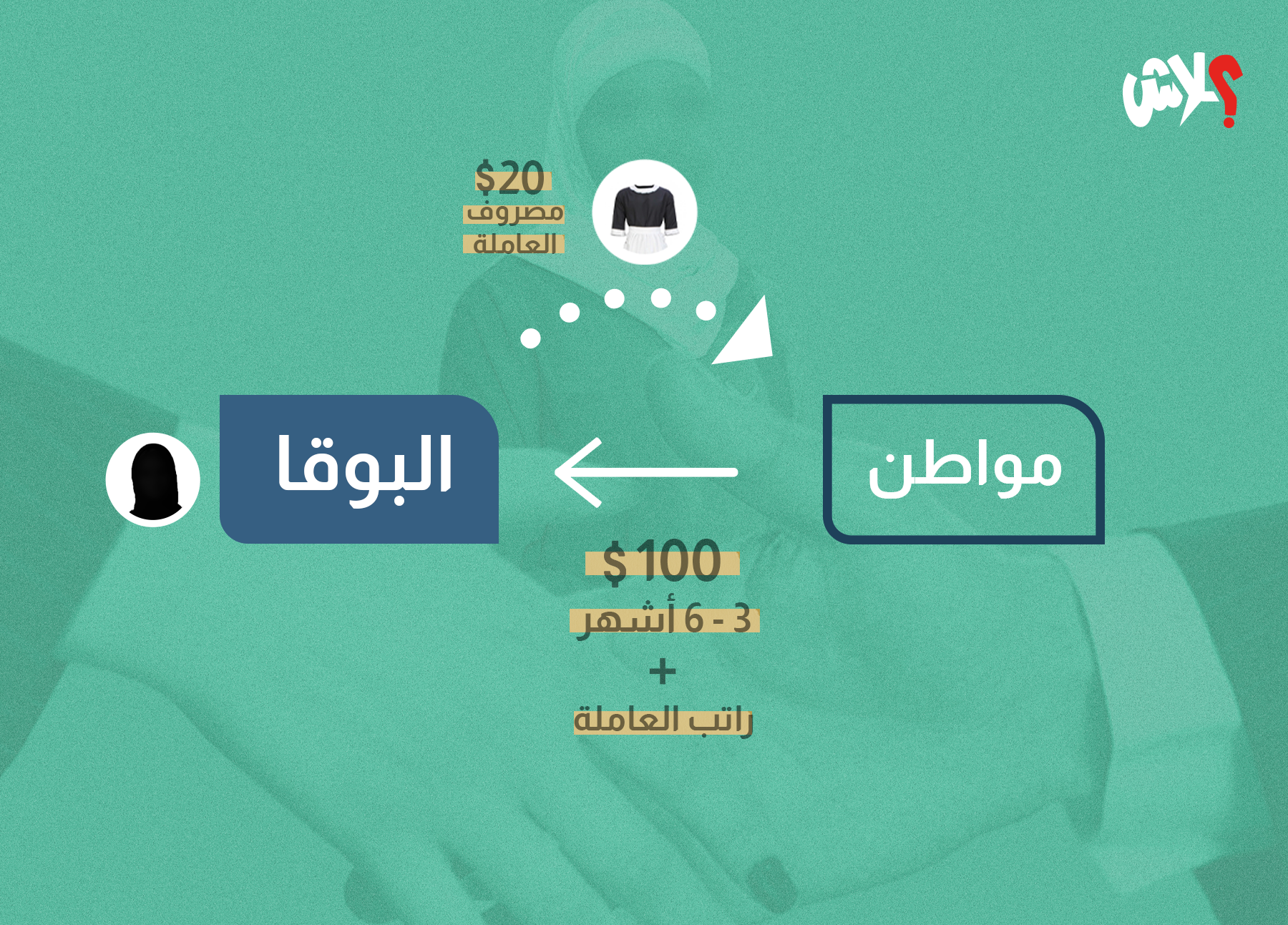
In the second operational model, the Boga takes full direct control of the workers. Libyans contact her directly, and the employer pays her a monthly fee of 500 dinars (100 USD) for three to six months, in addition to the worker’s daily wage or salary both of which go entirely to the Boga to repay the cost of smuggling.
The workers themselves receive only a negligible amount no more than 100 dinars (20 USD) per month barely enough to buy food, making them work exclusively in exchange for meals.
Testimonies from Libyan Women: Long-Term Surveillance and Total Control
Given the sensitivity of the issue and the workers’ fear of speaking out due to the abuses they experience, our investigative team was unable to obtain direct statements from many of them. Instead, we contacted Libyan women who have interacted with these workers over long periods and have learned their stories.
“Rana” (a pseudonym) stated:
“If the arrangement is directly with the Boga, she usually controls a group of up to 20 workers, all of whom were smuggled through the desert illegally. The Boga paid for their transportation to Libya and starts recovering the cost from their salaries. She takes a commission from each worker every three months (for example 500 dinars – 100 USD), while the worker receives only a very small fraction of her salary. The Boga collects the workers’ salaries and sends them in bulk to their families in Nigeria every few months. The worker has no control over her money until the entire debt is repaid.”Rana continued regarding the workers’ living arrangements:“Most workers live with the Boga or very close to her so she can monitor them constantly. She controls all their movements. They are not allowed to leave the house or work freely. Some workers remain under her control for 10 to 15 years without ever gaining freedom or receiving their salaries themselves.”
The Legal Framework: Rights Lost Amid Extreme Legal Fragility
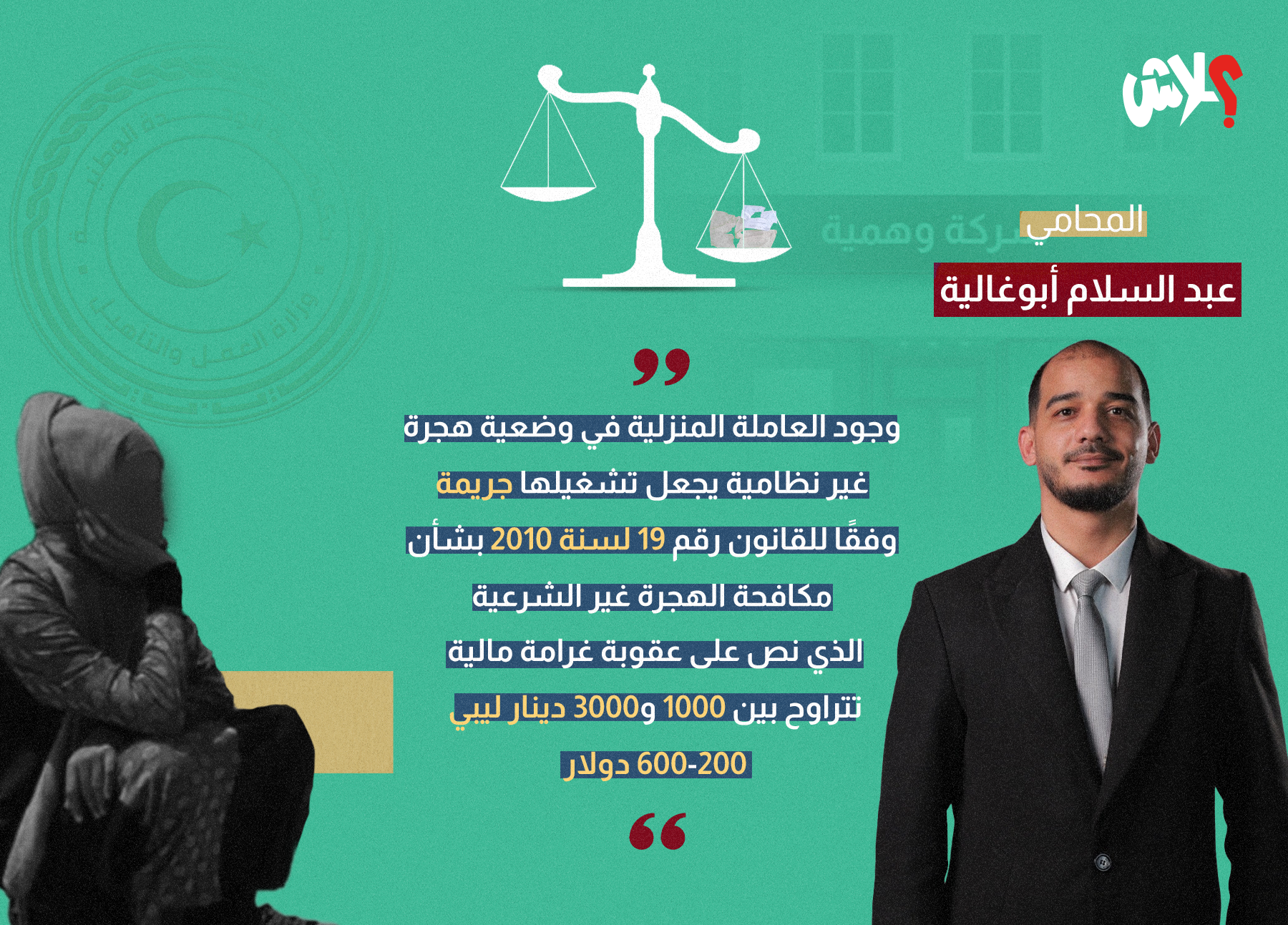
Lawyer Abdalsalam Abu Ghalia explained:
“A domestic worker in a situation of irregular migration makes her employment a crime under Law No. 19 of 2010 on Combating Illegal Migration, which imposes a fine of 1,000–3,000 Libyan dinars (200–600 USD) on any employer or company that hires irregular migrants. Since the worker’s presence in Libya is illegal, she is not legally capable of entering into contracts, making commitments, or undertaking valid legal actions. As a result, her rights financial or otherwise may be legally unenforceable under prevailing interpretations.”
He added:“In cases of official contracts, a labor inspector monitors companies to ensure compliance, verifying the alignment between actual working conditions and those outlined in the contracts. If violations are found, the inspector takes legal action against the employer. But if the worker entered Libya illegally from the outset, her employment is a crime and she is not legally entitled to work or remain in Libya. If she entered legally but her residency expired, she is granted one month to settle her status or leave. After that, her residency becomes illegal. Yet she may still appoint a lawyer to defend her rights if she is owed money or has suffered violations.”
We attempted to contact the Libyan Ministry of Labor in the Government of National Unity to inquire about the legal status of these companies and whether they meet the required legal standards. However, they refused to provide any statement, claiming that such matters require approval from the minister personally. We were unable to reach the minister, despite the fact that such inquiries do not require such a high level of authorization. But this reflects the state of Libyan official institutions.
A Closed Circuit of ExploitationWhat this investigation uncovers reflects a shocking reality for thousands of migrant women who find themselves trapped in Libya in a closed loop of exploitation and modern-day slavery under the gaze of absent institutions and unenforced laws.
The persistence of this parallel market for domestic workers is a direct consequence of institutional and legislative chaos, and of the exploitation of security conditions by human-trafficking networks.
These facts require urgent action by official bodies and both national and international human-rights organizations to address the root causes starting with dismantling these networks and cutting off their financial sources, and ending with protecting migrant women and enforcing laws that guarantee their human and legal rights.
In a historical context reminiscent of the tragedies of enslaved people on cotton plantations in the United States where people were deprived of their wages and freedom under legal and economic structures designed to justify enslavement we find today, in Libya, parallel mechanisms adapted to new times and tools. The absence of state authority and rule of law allows modern forms of slavery to re-emerge, targeting migrant women who work under coercive conditions, deprived of control over their wages and destinies.
This investigation also highlights the real security risks journalists face in Libya when reporting on sensitive issues such as this one including the “Alash” investigative team. The information revealed here may expose them to direct threats from the networks involved, especially in the absence of a safe environment for independent journalism and the weakness of legal protections for journalists.
Remaining silent about these violations not only exacerbates the suffering of domestic workers but also entrenches a culture of impunity and undermines the principles of justice and human dignity in a country already overwhelmed by overlapping crises. Conversely, the determination to uncover these truths is a collective responsibility and requires genuine support for independent media institutions and journalists to ensure they can continue their critical role in exposing abuses and defending the rights of society’s most vulnerable.

 باحثة ميدانية وجامعة مقابلات:
رباب نور
باحثة ميدانية وجامعة مقابلات:
رباب نور
 مدقق معلومات:
ربيع داقو
مدقق معلومات:
ربيع داقو