
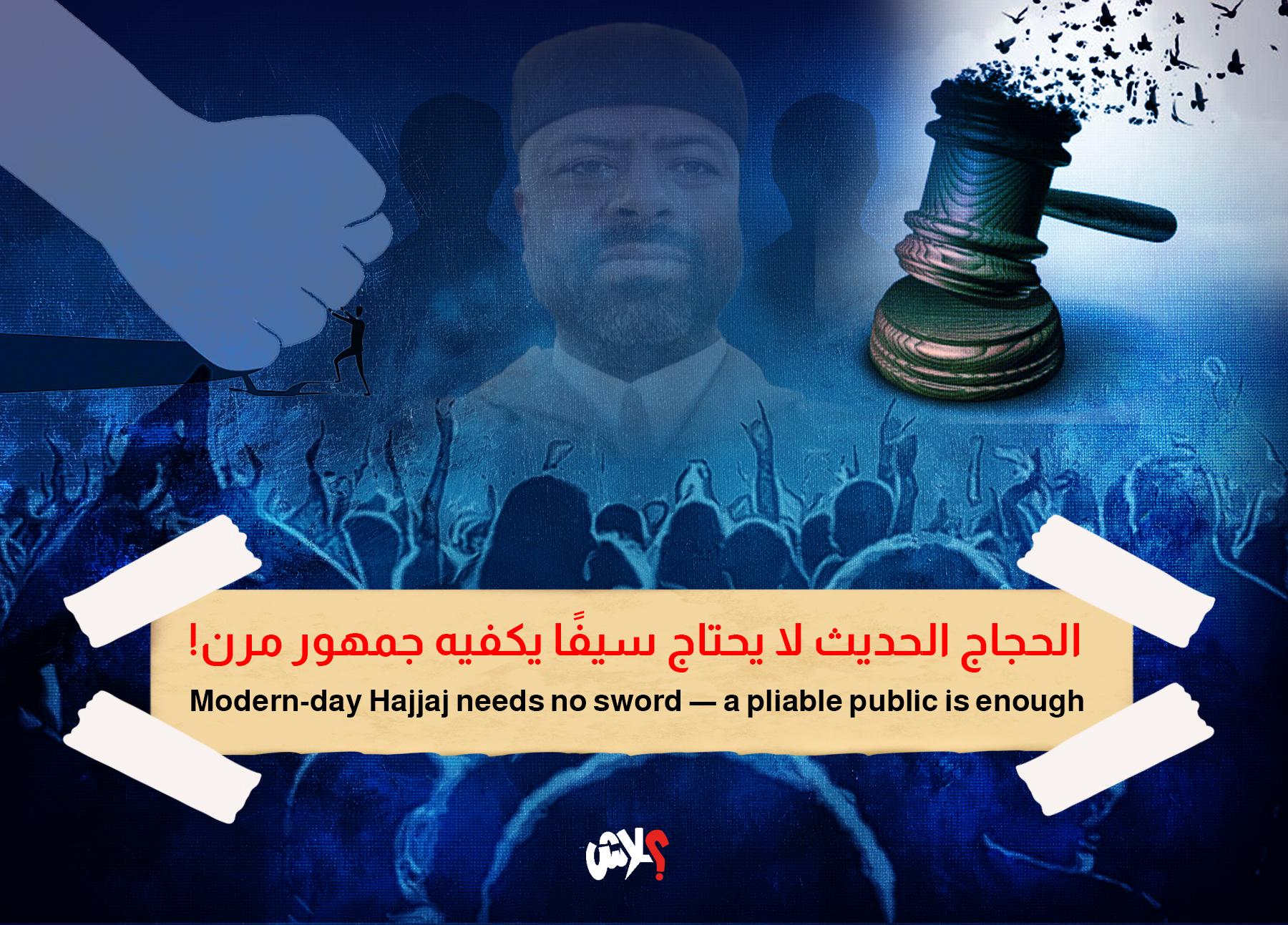
Modern-day Hajjaj needs no sword a pliable public is enough
In our Arab world especially in this bleak piece of land we call Libya and amid political and social conflicts, we often find ourselves facing a troubling phenomenon I like to call flexible principles or elastic values.
A phenomenon that turns supreme values such as justice, freedom, and human rights into slogans that can be folded, stretched, or reshaped depending on circumstances or on the identity of the person involved.
The idea is simple: a principle is indivisible you cannot defend it in one case and abandon it in another simply because the enemy changed or the scene shifted.
What happened to activist Abdul-Munim Al-Maryami may he rest in peace and the media uproar and speculation that followed his mysterious death, even after a video was released attempting to explain the incident, presents a stark example of this dilemma.
Some who claim to uphold transparency and seek truth quickly shifted to oversimplifying the tragedy or excessively doubting official narratives while others accepted the official account without scrutiny.
But the more important question is: Would their reaction have been the same if the deceased belonged to their political camp or if the incident occurred in a different region?
In the answer lies the catastrophe turning values and principles into commodities for sale.
Abdul-Munim died and met his fate but turning his blood into a weapon in any side’s war against the other is sheer depravity.
And the authorities’ use of the released video to exonerate themselves from direct killing is no less vile than their opponents’ use of his death before the video to accuse and slander the government.
It reads only through the lens of the sayings: “She accused me of her illness and slipped away,” and “He whose house is made of glass should not throw stones.”
To both sides we say: Al-Maryami’s case is neither unprecedented nor isolated dozens before him in the east, west, and south were abducted, tortured, and perhaps killed and in every case, you see only the silence of graves from the supporters of whichever party was accused.
If we take a quick look at the Libyan scene, we see bitter examples of this contradiction reacting to victims and events based on identity or affiliation.
Where is the discourse in Tripoli about Abdul-Moaz Bannoun or about Intisar Al-Hassairi?
Why did we not demand the Attorney General reveal their fate or identify the killer?
Why did we not see calls for video footage showing what happened to MPs Fariha Al-Berkawi and Siham Sergiwa, or activists Salwa Bugaighis and Hanan Al-Barassi?
Internet was cut off in Benghazi for a long period before the operation that ended with killing former Defense Minister Mahdi Al-Barghathi yet why did those demanding justice for Al-Maryami not demand justice for Al-Barghathi?
Why is there no footage of the alleged escape attempt supposedly leading to the death of Siraj Daghman?
And forget all that — why not call for the release of MP Ibrahim Al-Darsi?
The list is long and painful the names too many to count and every case tested our loyalty to the principles we claim to uphold.
The result was often disappointing the principle dissolves before loyalty to ruling power, tribe, party, or personal bias.The problem is not limited to killing and disappearance.
Look at the glaring contradiction in the case of handing over Abu-Aguila Al-Maryami to the United States while retrieving Osama Anjime from Italy.
Some of those demanding that Anjime be handed over to the International Criminal Court were the same ones rejecting Al-Maryami’s extradition to the United States.
If rejecting Al-Maryami’s extradition was rooted in sovereignty, distrust of foreign courts, protecting Libyans from foreign jurisdictions, and rejecting intervention then this principle applies to Anjime and others so why limit it to Al-Maryami?
And if the reasons for demanding Anjime’s extradition were militia dominance, state weakness, judicial incapacity, the case’s international nature, and the need for a neutral court then why protest Al-Maryami’s extradition?
Note: (At Alash, we categorically reject the extradition of any Libyan citizen to a foreign state, and we call for prosecuting and punishing all criminals without exception inside Libya.)
This is the core problem double justification.The same act (extraditing a suspect abroad) is fiercely rejected in one case on grounds of sovereignty and outside interference, and criticized for not happening in another case on grounds of distrust in local justice!
The principle rejecting or insisting on extradition shifts depending on who is wanted and who is asking.
The erosion of principles means erosion of society’s foundations it means that truth is never constant, and justice is not for all it means that conflict will remain eternal, because there will never be shared ground of fixed values upon which all stand.
When right and wrong are tied to political color, regional identity, or personality, we drown in a moral chaos without bottom.
The story of Abdul-Munim Al-Maryami, and so many like him, is not just isolated incidents it is an alarm bell and a painful reminder that salvation does not lie in selective application of principles justice must be for everyone, not only for those we like.
Truth-seeking must be a constant path, regardless of who is victim or perpetrator rejecting torture, killing, or enforced disappearance must be absolute and rejecting violation of sovereignty or calling for it must be consistent.
Holding to principle means defending it even when it costs dearly even when it benefits those you dislike.
When we bind ourselves to these standards, we will deserve to raise slogans of freedom, justice, and human dignity for principles are not outfits we change with fashion they are the backbone of any sane society.
And finally as we have stood before, without hesitation, with every stifled cry, every chained hand, every name disappeared in dungeon shadows and as we raised our voice demanding freedom for those we disagree with before those we agree with today we renew our demand for the immediate release of every abducted person, revealing the fate of every disappeared individual, and ending the suffering of every victim of enforced disappearance.
For freedom is a divine breath a gift from the Creator of heavens and earth no human, no matter how powerful, has the right to seize it, restrict it, or hide it behind walls of silence.