
How Political Immaturity Swallowed Libya's Intelligence Agency ?
Anyone following Libya's broader political landscape inevitably finds themselves reflecting on the immature political game played by figures who have risen to prominence while remaining far removed from any genuine sense of political maturity in its national and responsible meaning. It is a state of political adolescence that lays bare the flaws of these actors flaws they have never made the slightest effort to conceal behind slogans of the public interest. Why would they? Why should they trouble themselves with shame when they neither respect the citizen nor fear being held accountable? As a people, we did not elect them through free elections, nor do we possess the practical authority to remove them from the political scene. They understand this reality perfectly and know, deep down, that they owe us nothing. Their continued stay in power depends solely on networks of interests, political bargains, and narrow power-sharing arrangements.
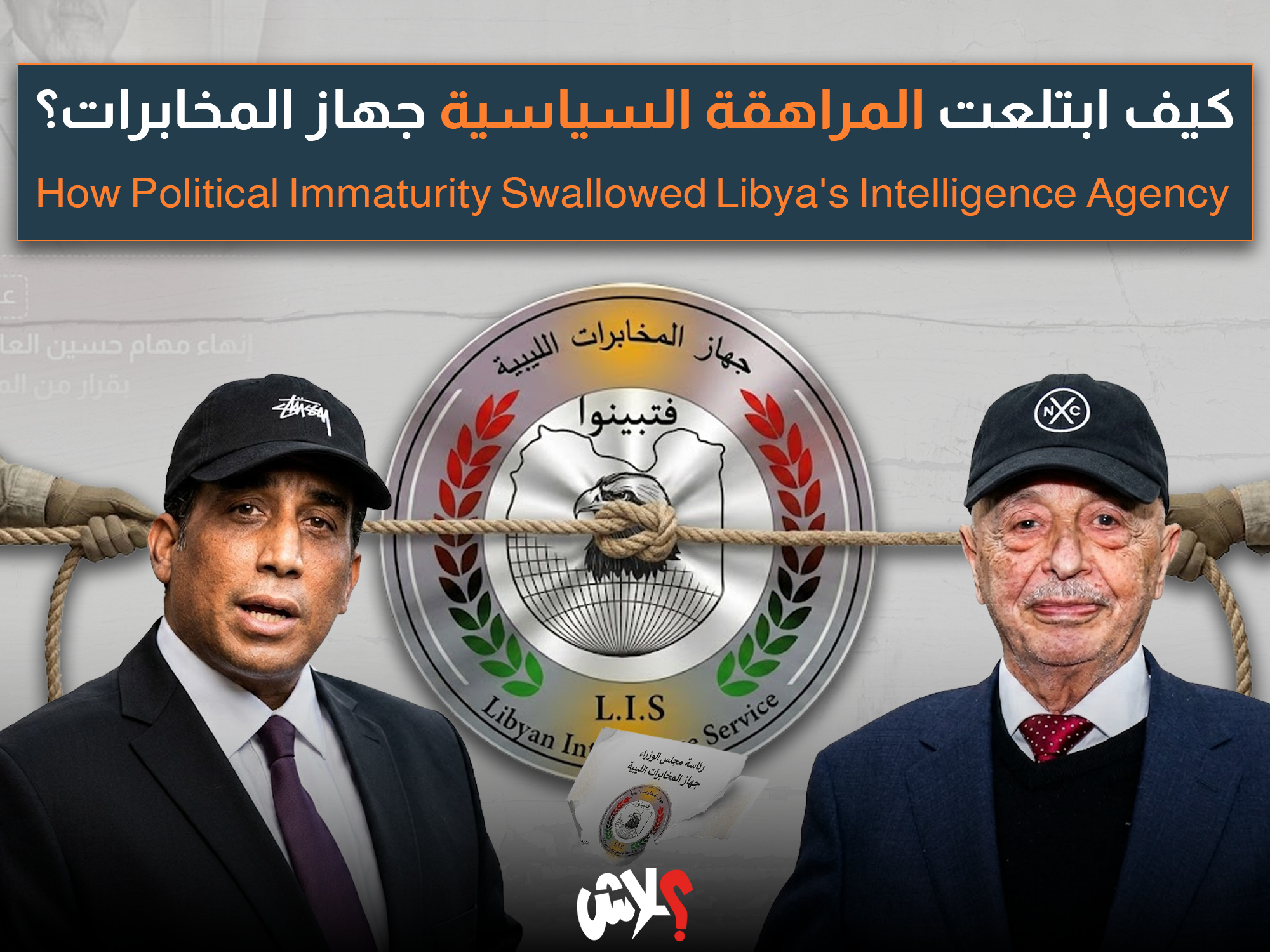
The latest manifestation of this continuous and ever-evolving political absurdity is the recent decision by the Presidential Council to dismiss the Head of the General Intelligence Service and appoint a replacement. At first glance, this decision may appear to be an ordinary administrative measure taken by an executive authority managing state affairs. In reality, however, it is anything but ordinary. The appointment of the dismissed intelligence chief was, from the very beginning, a clear act of political maneuvering based entirely on personal loyalty rather than professional competence or an independent security record. The President of the Presidential Council consulted no one before appointing a man widely described within political circles as one of his closest friends to this highly sensitive position affecting the country's national security. Objections did emerge at the time, but they remained muted and restrained, perhaps because undisclosed political bargains and quota-sharing arrangements behind closed doors facilitated the appointment. Ultimately, the decision was implemented, and the man assumed office in a country already suffering from division and fragmentation, without any objection from the House of Representatives or its Speaker. Decisions issued from Tripoli have traditionally carried little weight in eastern Libya, where they are neither politically nor legally recognized.
As the years passed and events unfolded, it became increasingly evident that the man was unsuited for the sensitive position he occupied. The General Intelligence Service failed to perform the sovereign role expected of it in safeguarding the country. Instead, through the absence of effective oversight, it gradually transformed into something resembling a private family enterprise managed by the director himself, his relatives, and his close associates much like a commercial investment company concerned primarily with narrow financial returns. When signs of his impending dismissal began to emerge, he behaved for perhaps the first time in his professional career like a genuine intelligence officer who understood how conspiracies and political intrigue are conducted behind closed doors. He embarked upon what could only be described as a political pilgrimage to the sanctuary of Libya's dissident politicians in the eastern city of Al-Qubbah, where he received the blessing of the High Priest, Aguila Saleh. He returned carrying what amounted to a political pardon, absolving him of both past and future responsibility while granting him a new source of legitimacy from an authority that, until recently, had refused even to acknowledge his existence.
This political protection secured his continuation in office for a period of time and shielded him from dismissal but not indefinitely. Only recently, signs of a new rupture began to emerge within the Presidential Council itself. The President of the Presidential Council attempted to rally the support of the remaining members to appoint a new intelligence chief pursuing a different agenda. Unsurprisingly, the concerns and daily suffering of the Libyan people were nowhere to be found among these deliberations. Yet Presidential Council member Moussa Al-Koni, whose political positioning has recently shifted noticeably toward the interests and authorities of eastern Libya, categorically rejected the proposal. His rejection was not based on the dismissed official possessing exceptional expertise or irreplaceable qualifications deserving preservation. Nor was it because allegations of financial corruption, administrative misconduct, or abuse of authority were fabricated. Nor did he argue that the proposed successor lacked competence or qualifications. Rather, Al-Koni refused because he explicitly demanded that a new Chief of the General Staff, personally selected by himself and his allies, be appointed before he would approve the dismissal of the intelligence chief and the appointment of his replacement.
According to accounts circulating among informed sources close to these absurd negotiations which, following the well-known saying, "Neither believe them nor dismiss them," should be approached cautiously he imposed an extraordinary condition that crossed one of the military establishment's principal red lines: the appointment of Khaled Haftar as Chief of the General Staff in exchange for approving the appointment of a new Director of the Intelligence Service. It was a transparent attempt to merge military, intelligence, and political calculations in pursuit of regional and personal gains.
After lengthy negotiations and repeated mediation efforts conducted behind closed doors failed to produce consensus, Presidential Council President Mohamed Al-Menfi proceeded unilaterally and issued the decision. Al-Koni immediately emerged to declare the decision legally invalid on the grounds that it had not been approved unanimously by all three members of the Presidential Council, as required under the governing political agreements. Amid this institutional dispute, the gentle lamb, Aguila Saleh, adopting his familiar diplomatic tone and presenting himself as a guardian of the national interest, issued a statement emphasizing the importance of insulating sovereign security institutions from political conflict in order to ensure the continuity of their work. He further argued that reopening such a sensitive issue at this critical moment served only to create confusion, complicate the political landscape, and deepen both Libya's political and economic crises.
The Speaker of the House further warned that such confusion would inevitably generate new security crises, deepen institutional fragmentation, obstruct ongoing political efforts toward sustainable stability, delay the unification of Libya's sovereign institutions, and undermine preparations for long-awaited presidential and parliamentary elections as though holding elections and ending the transitional period had ever truly been his objective, or that of his rivals and partners who continue sharing power while seeking to preserve their influence indefinitely.
Anyone carefully examining this political theatre inevitably confronts a series of fundamental questions exposing the contradictions beneath it. Al-Menfi never previously required Al-Koni's endorsement or signature when issuing earlier executive decisions, so why should he suddenly need his approval today or be constrained by his position? Likewise, Al-Koni himself had never before protested so fiercely or publicly challenged executive decisions throughout his political career a career that existed only because of regional and political quota-sharing. Why choose confrontation now? Similarly, Aguila Saleh paid remarkably little attention over previous years to appointments and executive decisions made in western Libya. Why does he suddenly display such profound concern today?
Deep down, we all know the answers to these troubling questions, even as we hesitate to acknowledge them because of the sheer vulgarity of the political spectacle before us. We know and simultaneously pretend not to know that the recently dismissed official was not removed because of professional incompetence or financial and administrative corruption, just as we know that his successor is unlikely to bring exceptional qualifications or meaningful institutional reform to the security establishment. Rather, what we are witnessing is simply another episode in the endless rotation of offices and positions within Libya's narrow system of political interests and personal loyalties a game in which the people are simultaneously present and absent: present only as silent witnesses to its recurring tragedies, yet entirely absent whenever the doors close and the spoils of power are quietly distributed among the political adolescents.