
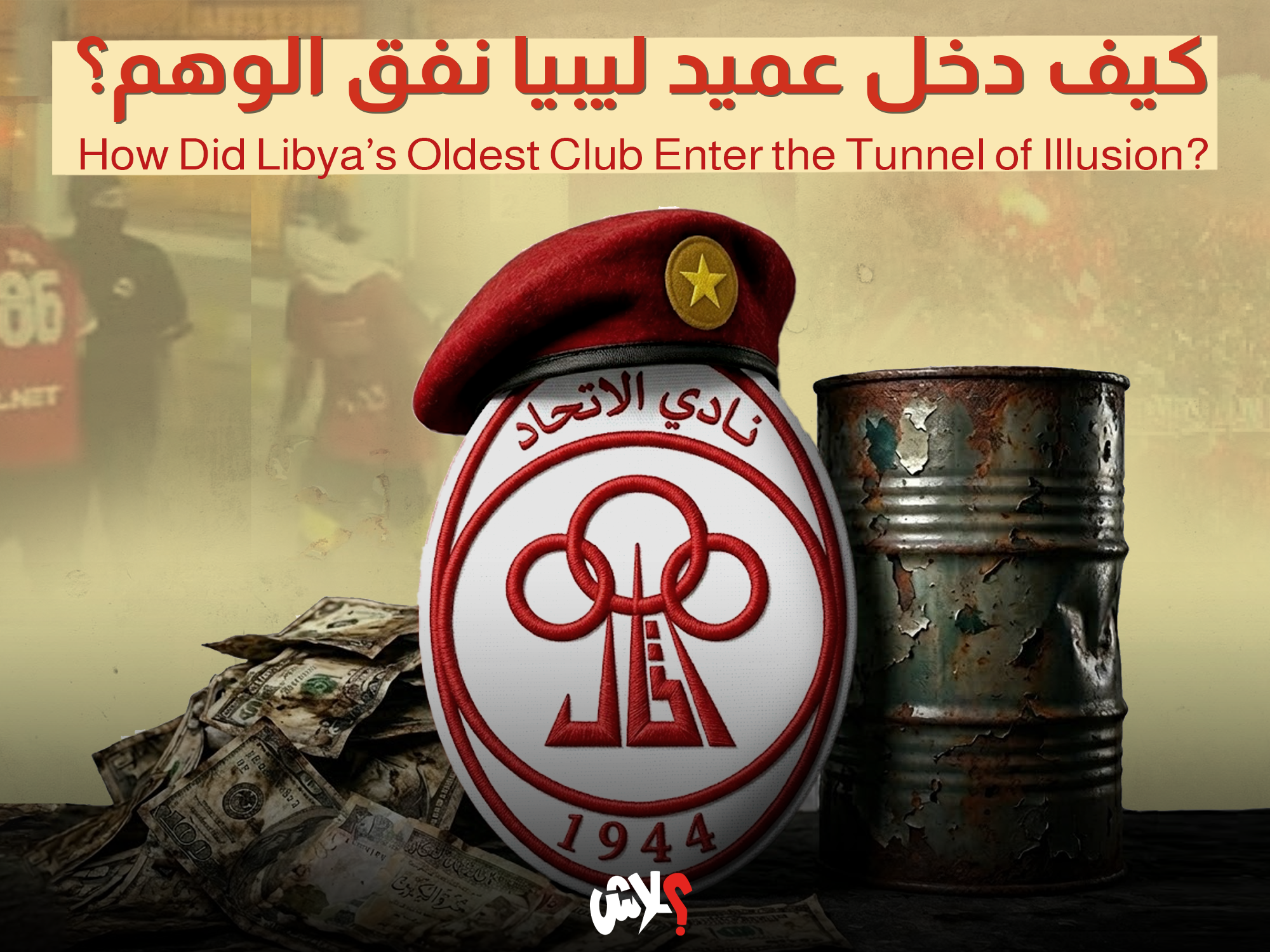
How Did Libya’s Oldest Club Enter the Tunnel of Illusion?
Sport cannot be separated from politics or society, and in Libya the football scene has become a mirror reflecting the country's broader reality: widespread chaos, administrative confusion, the absence of legitimacy, and the lack of sustainable projects. Football has gradually ceased to be a vehicle for entertainment and community building, becoming instead an open arena for political rivalry, settling scores, and displaying influence.
At the heart of this troubled landscape stands Al-Ittihad Club Libya's oldest football club and its most decorated champion as a symbol of a deeper existential crisis. Once the country's dominant force, the club now finds itself trapped inside a dark tunnel whose end remains nowhere in sight, driven by weak governance, overwhelming fan pressure, and the growing influence of illicit money.
If we are to diagnose the disease eating away at Libyan football, we must begin with the distorted economic structure of its clubs. Football clubs in Libya are not investments in the modern sense of the word; they are financial black holes that swallow millions of dinars every year without generating any meaningful economic return.
Modern football clubs rely on television broadcasting rights, lucrative sponsorship agreements, shirt sales, commercial investments, and the global marketing of their brands to generate sustainable income. In Libya, however, almost none of these revenue streams truly exist. Sponsorship deals are either symbolic or virtually nonexistent, often insufficient even to finance a single pre-season training camp.
Television broadcasting rights generate almost no income for clubs. Domestic investment remains weak and underdeveloped, barely enough to cover employee salaries. As for international marketing and commercial branding, Libyan football continues to suffer from regional and global isolation, lacking a recognizable commercial identity capable of attracting revenue comparable to that enjoyed by Arab or international clubs.
Faced with this commercial vacuum, where does the money come from?
The answer is simple: clubs survive on the limited "crumbs" allocated each season by the Ministry of Sports—funds that are insufficient even to sign a single professional footballer. Consequently, clubs become almost entirely dependent on board members and wealthy individual benefactors willing to finance operations from their own pockets.
The bitter reality is that, under such circumstances, no club can realistically compete for championships through honest management or long-term planning. The only remaining path to success is through injecting millions in illicit funds, provided by influential figures seeking to polish their public image or safeguard their political positions. Football clubs become convenient shields behind which corrupt officials hide from accountability, knowing that any legal action against them will immediately be portrayed by passionate supporters as "an attack on the club itself."
Within this tragic context, Al-Ittihad Club stands as perhaps the clearest example. Once feared by every opponent and accustomed to lifting trophies, the club has spent years absent from championship celebrations while enduring one of the darkest administrative and sporting periods in its history.
Today, Al-Ittihad suffers from a genuine crisis of legitimacy. Its leadership lacks electoral legitimacy, operating instead through temporary or caretaker administrations with little strategic vision. As institutional authority weakened, the club's supporters gradually became its true governing force.
Convinced of both their immunity and their ability to impose their will, fans increasingly interfere in fundamental decisions—from appointing coaches and selecting players to determining who should lead the club.
This emotionally driven and impatient intervention represents perhaps the greatest obstacle to any sustainable sporting project. Supporters have little patience for long-term rebuilding plans or five- and ten-year strategies. They demand immediate success, treating anything short of winning the league championship as an unforgivable failure requiring the immediate dismissal of the club's leadership.
The result is a destructive cycle that repeats endlessly:
Weak administration with no vision ► Angry fan pressure ► Removal of the administration ► Arrival of a new president carrying a large financial bag but no project ► Opening the door to opportunists and sycophants ► Satisfying emotional and short-term fan demands ► Failure once again ► Return to square one.
As a consequence of this perpetual instability, Al-Ittihad and its supporters have entered what can only be described as a "cycle of illusion" a condition that once afflicted other Libyan clubs as well. Rather than confronting reality and acknowledging administrative and technical shortcomings, failure is increasingly attributed to elaborate conspiracy theories.
Within the club and among large segments of its supporters, a widespread belief has emerged that state institutions are engaged in a coordinated effort to undermine Al-Ittihad.
Many have convinced themselves that winning the league is impossible because the championship has already been "tailor-made" for the club's traditional rival.
The narrative extends even further. If a striker misses a penalty or wastes an easy opportunity, it is supposedly not because of poor performance but because "he has been bought by the rival club." If the goalkeeper concedes a goal, it is because "he secretly signed a contract with the rival."
The rival, according to this mindset, controls everything: referees, competition committees, and even television commentators. Some even claim that evidence proving corruption was once found on a referee's mobile phone but that enormous pressure forced the club's management to abandon the case.
This psychological cycle functions as a localized anesthetic, allowing both supporters and successive administrations to avoid genuine self-evaluation and accountability. It is perhaps the clearest indication that the club has lost both its sporting identity and its strategic direction.
The condition of Libyan football clubs and Al-Ittihad above all is ultimately nothing more than a reflection of the Libyan state itself: widespread disorder, administrative confusion, weak legitimacy, and the absence of any genuine long-term project. This reality will not change so long as Libyan sport continues to depend upon government handouts, political image-laundering, and corrupt financing.
Saving Al-Ittihad Club first requires a revolution in public consciousness one in which supporters recognize that loving their club does not entitle them to destroy its institutions, and that building a championship-winning team requires years of stability rather than emotional decisions after every defeat.
It also demands the courage to remove opportunists and powerful vested interests, replacing them with a legitimately elected young administration capable of implementing a genuine investment strategy that can lead the club from the "black hole" of financial dependency into the world of true professional football.
Otherwise, the vicious cycle will continue turning, and Al-Ittihad will remain trapped inside the tunnel of illusion consuming millions while never seeing the light.