
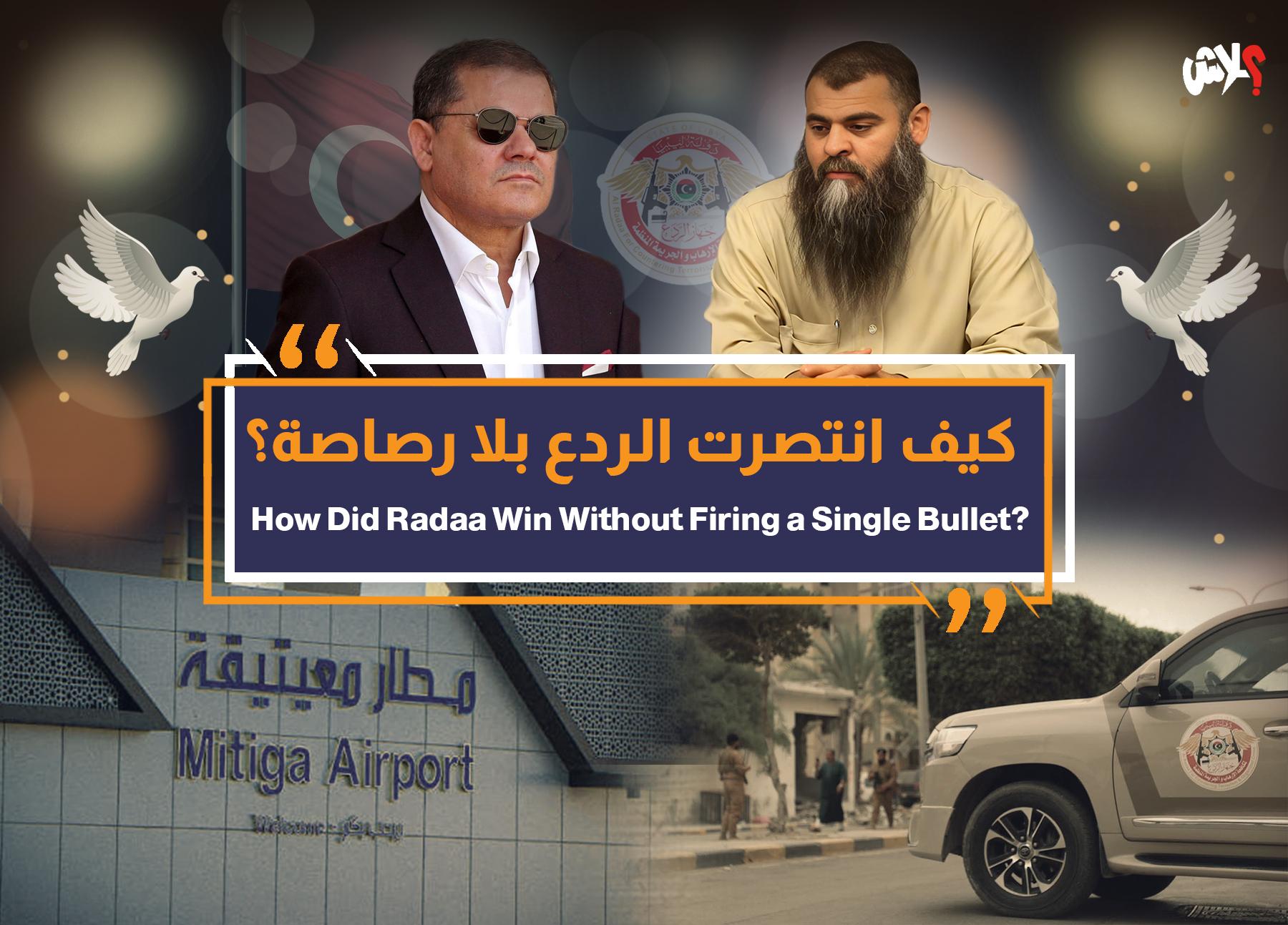
How Did Radaa Win Without Firing a Single Bullet?
For several weeks, residents of Tripoli stood on tiptoe, waiting for the first shot that would ignite what many believed could become a major confrontation between the armed groups loyal to the so-called “Return of Life” government and the Special Deterrence Force (Rada) and its allies.
Yet thanks to mediation by several Misratan armed groups led by Mohamed al-Hassan, the clash was temporarily halted until Turkish intervention pushed both sides toward a formal agreement. With the signing of that deal, the curtain fell on a war some believe has only been postponed, while others argue it has effectively ended.
Between these two views, this article examines the terms of the agreement, seeking to understand who emerged with the greatest gains or whether it truly safeguarded the interests of all sides without distinction. According to the details disclosed publicly so far, the Rada force agreed to hand over all individuals wanted by the Office of the Attorney General.
It also accepted the appointment of a new figure to lead the Judicial Police not the government’s preferred appointee, widely known as “al-Sari‘a”, a close associate of the Dabaiba family in the “Villa”, but instead another police officer, which has already taken place.
Rada also accepted the deployment of a unit from the Chief of Staff to secure the exterior perimeter of Mitiga International Airport, while the official police and security agencies would remain responsible for the inside. In return, Rada agreed to shut down its office inside the airport. For its part, the government agreed to withdraw all forces it had brought in from Misrata, returning them to their original bases on the outskirts of the capital. It also accepted the full reinstatement of Rada’s pre-conflict positions across Tripoli, as well as unhindered access for the Attorney General to inspect Rada-run detention facilities at any time and in any manner.
The agreement will be supervised by de-escalation units, with Turkey acting as guarantor for both sides. This raises a critical question: What interest do the Turks have in mediating this dispute? Observers argue that Turkey is well aware that the Dabaiba government will eventually exit the scene, sooner or later. Their strategic partnership with Rada which is firmly entrenched at Mitiga Airport is therefore far more valuable. Rada is a relatively stable and predictable partner, and its presence allows continued Turkish access to Mitiga, one of the largest military airbases in the region and a key asset on the Mediterranean.
On the other hand, what made the agreement acceptable to the government was the growing divergence among the armed groups operating under its umbrella a dynamic we previously analyzed in our article: “Is Tripoli Waiting for a War Without a Set Date?” Furthermore, the latest UN Security Council briefing by SRSG Stephanie Khoury (nicknamed “Tita”), which announced a roadmap toward a new government and whose recommendations were endorsed unanimously by the Council placed the Dabaiba government in an increasingly difficult position.
Rada’s deep presence in Souq al-Jumaa, where it enjoys strong community support and has assumed local protection duties, also meant that launching a war against it would have amounted to entering a prolonged and unpredictable conflict one the government and its affiliated groups were unlikely to win. Because Rada was the side under attack, acting in self-defense, many analysts believe it emerged from the agreement with greater gains than the government. The latter failed to dismantle Rada, failed to expel it from Mitiga Airport, and failed to confine it to Souq al-Jumaa as it had hoped.
Rada’s continued presence at Mitiga means that everything at the base above ground, underground, or in between remains under its influence.Meanwhile, cosmetic measures such as deploying an external security force around the airport serve mainly to give the government the impression that it gained something, when in reality it gained little more than illusion.
The restoration of Rada’s full positions across the capital stands as a clear sign of the government’s failure to restrict its influence. The force has now re-established its full security and military footprint in Tripoli while maintaining control over the detention facility inside the Mitiga compound. All visible indicators suggest that the Dabaiba camp returned from this venture worse off than before, unable even to emerge “with empty hands,” as the Arabic proverb goes, and now facing deeper isolation.
Rada, meanwhile, has sent a powerful message to anyone contemplating seizing Tripoli: there is only one gate to enter the capital and that gate is Mitiga, under the authority of Abdulraouf Kara. This crisis also revealed how significantly Rada has evolved on the political front. It is no longer the armed group that relies solely on bullets to impose its will. Instead, it demonstrated considerable flexibility, patience, and political maneuvering. Many observers argue that Rada won this round through restraint, calculated risk assessment, and community-based leverage more than through military strength.
For you, dear citizen of Tripoli, not much will change after this episode. You may take comfort in the fact that your home was not destroyed this week but no one can credibly promise that it will not be destroyed in the weeks or months ahead.