
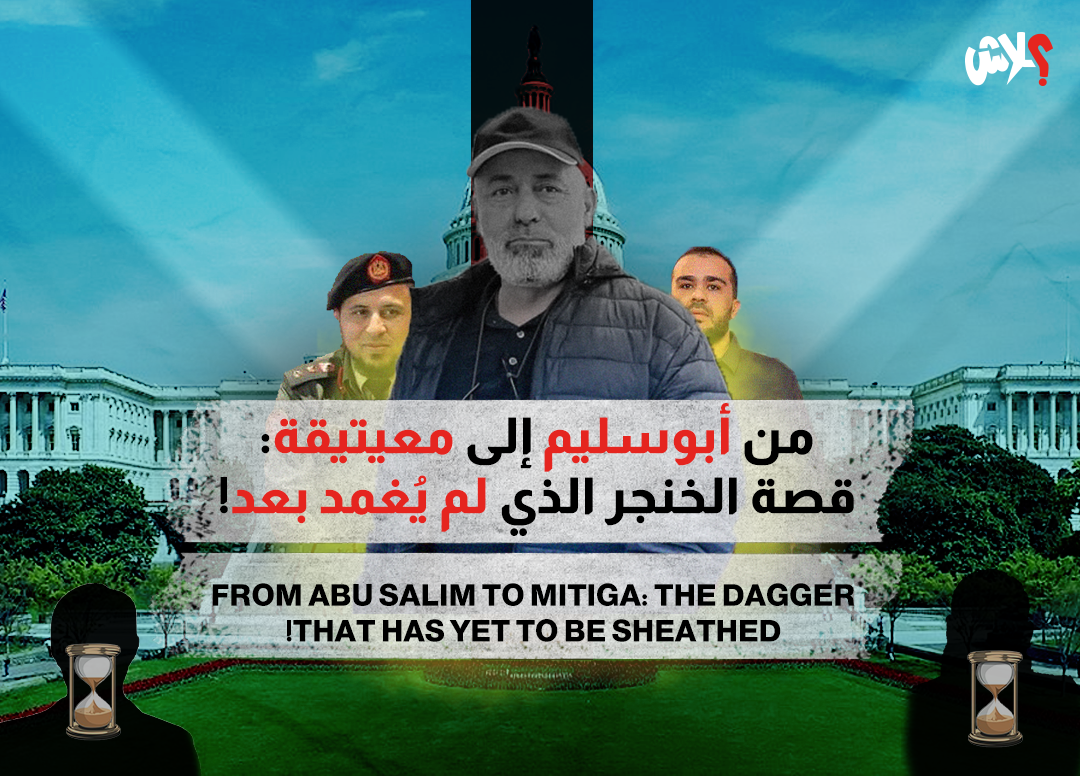
From Abu Salim to Mitiga: The Story of a Dagger That Has Never Been Sheathed!
In the court of ʿAbd al-Raḥmān al-Dākhil, where ideas were killed the moment they hesitated, chivalry was tested against the cunning of politics, and pledges were weighed on the scales of blood. A man from the Qays tribe (one of the Arab tribes that settled in al-Andalus) once came to him a knight born of swords, a commander not to be underestimated, backed by a tribe, a blade, and a word.
A rival who could not be left to rest in the shade of peace, for his roots were molded from the clay of treachery.
Some of al-Dākhil’s courtiers said to him:
“Grant him safety. He is of the noble Arabs; one who is trusted does not betray.”
So he sent one of his closest men to deliver the promise of amān, saying:
“Tell him: he has my oath and my guarantee, and I swear it upon myself.”
The Qays knight arrived, not alone, but surrounded by his clansmen, carrying the aura of war and the stillness of confidence.
He sat in al-Dākhil’s majlis, and the meeting was cold two dignities shaking hands with suspicion rather than goodwill.
Al-Dākhil sensed that the pledge in the man’s eyes did not match the pledge that had left his mouth, and beneath that calm exterior lay a volcano of ambition that refused to sleep.
So he whispered to his advisors after the meeting:
“The man is dangerous. What do you think?”
One of them, his face reddening, said:
“We were the ones who granted him safety, my lord. Is this the reward for a knight who surrendered his sword?”
Al-Dākhil replied with chilling calm:
“And who said politics was made for knights?”
The Qays knight entered the majlis again, only to find al-Dākhil wrapped in silence, having decided to cut doubt with the blade.
He called for his concubine; she arrived with a dagger, silent as breath.
He concealed it beneath his robe, sat beside the man, and with absolute composure plunged it into his heart.
Then he stood and declared:
“This is the oath… if the survival of my state costs me the breaking of chivalry.”
Outside, when his soldiers heard the news, no swords were drawn.
Their loyalty shattered like frightened glass, and they walked away.
Mamhoud Hamza and Abdulsalam al-Zubi are not in the place of ʿAbd al-Raḥmān al-Dākhil today such a comparison would insult al-Dākhil.
But the case of the Qays knight resembles, to a large extent, what happened with Abdulghani al-Kikli.
Had the latter remained in Abu Salim, they could not have taken him down so easily.
But leave him aside now, and let us try to understand:
What is happening? And what is the next step?
All indicators point to a decision by international actors to impose a form of stability in Libya even if only relative.
We heard this through the order of the American warship that docked in Tripoli and Benghazi,
and we saw it in Trump’s tweet linking Libya and Syria under the notion of “stability.”
Following that came the request for Mahmoud Hamza and al-Zubi to visit Washington, and for Saddam Haftar from the opposite side.
Mahmoud Hamza and al-Zubi succeeded relatively in presenting themselves as a semi-regular military force with no prisons, limited contact with civilians, and fighters who obey orders.
This made them a preferable choice for implementing a “relative stability” project in Libya.
Thus, they were relied upon to carry out the “Night of the Long Knives,” especially after Misrata’s forces decided to enter the capital to remove al-Kikli, due to his deep penetration of state institutions and his threat to Misrata’s interests as a city and as a powerful military actor in Tripoli.
The removal of al-Kikli became inevitable.
He had begun seeing no equal to himself in the capital, believing his strength came from those around him and from his fortress in Abu Salim.
There is another actor who views Ghnewa as an obstacle: the “Dabaibas’ faction.”
From the very first day of the “Return of Life” government, Ghnewa treated Dbeibah as a partner in power, not a subordinate.
And this was true
Ghnewa was the spearhead that thwarted the most dangerous threat to Dbeibah’s government,
when he foiled the attempt to bring Fathi Bashagha into Tripoli via the Nawasi Brigade and remnants of the “Tripoli Revolutionaries.”
Thus, removing Ghnewa became necessary, especially as his demands grew and his influence expanded to the point that he became more powerful than Dbeibah himself.
As we indicated in an article published on 25 December 2024 titled:
“A New Shadow Brigadier Appears in Tripoli! Have You Heard of Him?”
there were clear signs that the western region was being reshaped to fall under the control of a single force as happened in Benghazi or at least that Tripoli would, as a foundational step toward achieving “relative stability” according to the architects of the scene.
But this cannot happen without “the second step”:
dealing with the Special Deterrence Force (Radaa).
Despite Radaa’s relative distance from state institutions and its lack of political engagement, Mahmoud Hamza knows very well that he cannot establish full control over Tripoli without removing this force
especially after his bitter experience last year, when he was arrested at Mitiga Airport and a war erupted that killed around fifty fighters from both sides before he was released.
Many believe that using force against Radaa is not a logical option.
They are entrenched in Souq al-Jumaa an area with a strong armed history and significant local support.
And the scene of Ghnewa’s fall and the looting that spread in Abu Salim is enough to push other areas to defend themselves out of fear of suffering the same fate.
Not to mention the Mitiga prison, which holds dangerous terrorist elements, making any military confrontation extremely risky.
Although Ghnewa and his forces have been eliminated, the ontinued arrival of armored vehicles from Misrata, coupled with Dbeibah’s decision to dissolve the Judicial Police Operations Unit led by Osama Najim one of Radaa’s founders makes it clear that a new security reality is being imposed on Tripoli.
Building on the shock tactic that killed Ghnewa suddenly, causing his forces to collapse quickly, and the impression projected by Mahmoud Hamza and al-Zubi that these moves came after arrangements with “Uncle Sam”
especially since the military operation occurred seven days after their return they banked heavily on this shock, advancing toward Souq al-Jumaa under the belief that everyone was still stunned, particularly after all Radaa units outside Souq al-Jumaa had withdrawn.
This led Hamza’s forces to assume the shock had weakened Radaa significantly, so they advanced aggressively only to be met with an unexpectedly powerful counterattack that forced them back to al-Tukbali camp, while Radaa reclaimed all its positions and posts.
Meanwhile , a large military force from Zawiya and Warshefana moved in from the southern front to relieve pressure on Radaa and succeeded.
The two sides reached a temporary ceasefire, but with Radaa clearly holding the upper hand militarily, politically, and publicly.
Many believe Dbeibah will not be able to contain the situation this time.
Protests erupted in most areas of Tripoli, Zawiya, and Misrata.
Mahmoud Hamza, on his part, will not accept anything less than securing his position in the areas of Abu Salim and al-Hadba which he captured and which previously belonged to Ghnewa while Radaa will not accept that either.
What we believe is simple:
Those who dined with Ghnewa yesterday and turned a blind eye to his crimes did not do what they did today out of love for the nation or its interests.
The interests of the people are indivisible.
The victims of oppression are many among them those whose screams echoed while they were tortured in the basements of secret prisons,
while their torturers were having lunch with the very man who later ordered their execution next to the swimming pool at (Zero).
History does not repeat itself it is humans who refuse to learn and thus repeat the same sins.
Power always blinds, and rarely do we see anyone who held it and survived its tyranny.
Thus, ʿAbd al-Raḥmān al-Dākhil was once asked:
“Did you betray, O Emir?”
He replied:
“Betrayal is treachery if my state has no name.
But if it has a throne, then every dagger raised is a judgment.”
So beware, citizen of “al-Dākhil”…
and do not become the Qays knight.